
Application Note
AI-enabled decision-making in the automation of 3D organoid culture
- An AI-enabled solution that automates decision-making for complex biological culture workflows.
- Automate workflows across multiple organoid types
- Pre-configured protocols for easy and efficient assay set up
Oksana Sirenko, Krishna Macha, Zhisong Tong,
Auguste Kersulyte, Astrid Michlmayr, Misha Bashkurov,
Marco Lindner, Felix Spira | Molecular Devices, LLC
Introduction
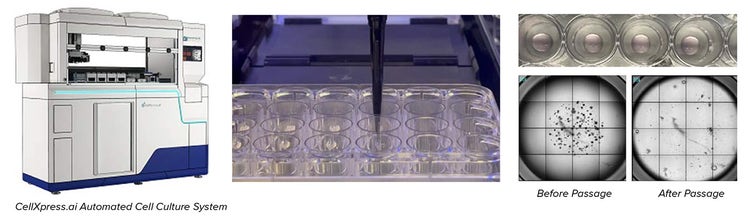
3D organoid models are increasingly important for biological research and drug development, however, workflow complexity, sensitivity to errors, and substantial training involved in cell maintenance make automation and reproducibility challenging. To alleviate the limitations of labor-intensive 3D cell culture protocols, we developed the CellXpress.ai® Automated Cell Culture System to enable fully automated organoid culture. The CellXpress.ai system contains four essential components: a liquid handler, an incubator, an imager, and integrated, AI-powered software that provides automated processing of complex protocols and scheduling based on the results of image analysis. Automated 3D organoid culture includes processes of plating organoid domes, changing media, monitoring the organoids by imaging, and passaging organoids. We automated workflows for three different organoid types: mouse intestinal organoids, human intestinal organoids, and patient-derived colorectal tumor organoids. 3D cultures were started from seeding organoids into Matrigel domes in 24-well plate format. Media exchanges were done automatically with set periods of every 24 hours using the liquid handler component of the CellXpress.ai system. Organoids were automatically passaged using liquid handling and an external centrifuge. The timing for passaging was based on organoid maturation and their phenotype. Mature phenotypes were determined by scientists, and machine-learning protocols were developed to recognize and count mature organoids.
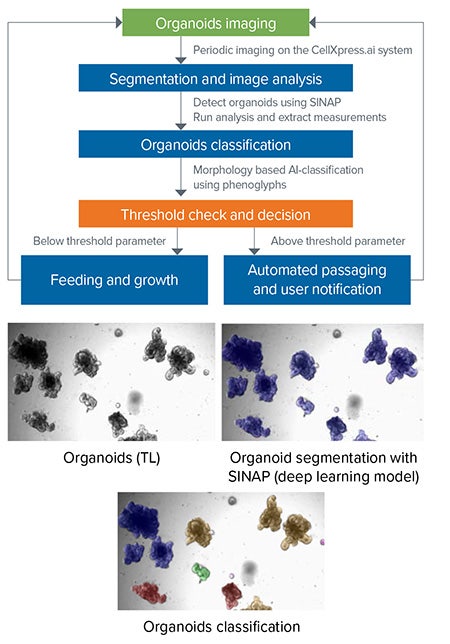
Then, decisions about triggering passaging were made automatically, by the software, based on results from the image analysis. For image analysis, organoid cultures were imaged every 12 hours using transmitted light and 4X magnification. Then, AI-based image analysis enabled the detection of organoid objects in transmitted light, followed by the extraction of various phenotypic readouts, including morphology, intensity, and texture. Organoids were classified into “mature phenotype” or “immature phenotype” using a custom-trained machine- learning model which was separately optimized for each of the three indicated organoid types. Based on image analysis, the AI model classified organoid phenotypes and triggered the automated passaging step when organoids in the culture became mature and needed passaging. We developed AI-based protocols and present results from the automation of three different organoid types. Passaging steps were triggered automatically according to a user-defined percentage and number of mature organoids in the culture, typically 40–50%. The AI-based classification facilitated the automation of 3D culture and expansion of organoids, providing a fully automated walk- away solution for organoid culture.
Methods
- Automated organoid culture: Mouse intestinal organoids (MIO, STEMCELL Technologies), Human intestinal organoids (HIO, 3D Ready organoids, Molecular Devices), or colorectal cancer organoids (CRC, 3D Ready organoids, Molecular Devices) were cultured in Matrigel domes in 24-well plates (Corning) and monitored with Transmitted Light (TL). The CellXpress.ai system seeded Matrigel domes with 5.5 mg/mL Matrigel concentration, with 40 µL per dome. Organoids were cultured with automated imaging and media exchanges (IntestiCult Organoid Growth media for mouse and human from STEMCELL Technologies and CRC media). Over time, organoids grow larger in size and develop a mature-looking phenotype.
- Image analysis providing detection of organoids and their classification: Images were taken with TL. Image analysis provided detection of organoids and analysis for multiple various measurements, then object classification was done based on organoid phenotypes: mature or immature. The organoids were imaged and classified. The picture above shows the TL image of human intestinal organoids, segmentation (defining organoids), and AI-based classification of organoids.
- Automated Passaging was triggered by image analysis: The CellXpress.ai system uses image analysis combined with object classification to monitor organoid growth and morphology and then triggers passaging when user- defined criteria (e.g., percentage of matured organoids) are met, with options to either notify the user or proceed with passaging automatically. Once the user-defined threshold of ≥ X% mature organoids in ≥Y% of the wells was reached, passaging was triggered.
Workflow
Automated seeding, imaging, monitoring, and passaging 3D organoids with the CellXpress.ai system
Matrigel domes with 50% Matrigel concentration, with 40 µL of Matrigel seeded for each dome on the CellXpress.ai system. The uniform distribution of the hydrogel and precise placement of the organoids ensure consistency across samples. The automated process of culturing and passaging organoids was previously described in Automation of 3D intestinal organoids culture with CellXpress.ai Automated Cell Culture System application note. Briefly, organoids were seeded in Matrigel domes on 24-well plates then cultured with media exchange every 48 hours and imaged every 24 hours.
After several days in culture, organoids developed mature phenotypes and automated passaging process were triggered either by scientist by pressing the “Passage” button, or automatically. AI-powered decision-making based on imaging provides a walk-away solution for complex organoid culture processes.
AI-based automated decision-making for organoid passaging with the CellXpress.ai system
How it works:
- Organoids were periodically imaged in TL, images segmented by deep-learning tool, then analyzed for variety of phenotypic measurements.
- Then organoids were classified for “mature” and “immature” phenotypes using AI-based classification
- Decision about passaging was automatically triggered by the software, based on the presence of enough mature organoids in culture
Organoid segmentation and image analysis workflow
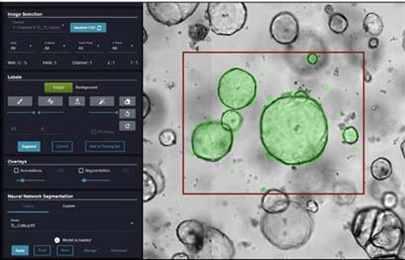
- Segment each organoid using deep-learning from the SINAP module in IN Carta
- Use drawing tools to select the target and the background, then add to the training set
- Then the model is trained using the training set of images
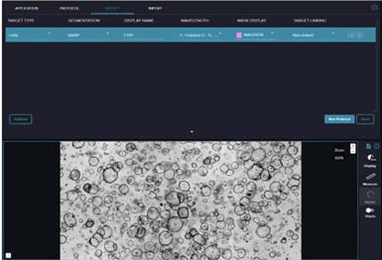
- Image analysis using Flexi-protocol 2D: Set up an analysis protocol in Flexi- Protocol 2D application
- Select the newly trained SINAP model and enable “fill holes”.
- Define desired set of features to be measured morphology, intensity, texture, etc. Run the analysis extracting morphological, intensity, and texture features from TL images.
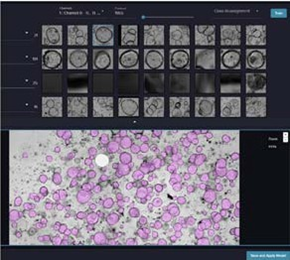
- Organoid classification using ML Phenoglyphs module for organoid classification.
- Cluster organoids based on extracted morphological, intensity and texture features defined from the analysis.
- Define “mature” and “immature” classes by providing user input.
- Train model and refine classifications of organoid classes. We classified organoids as “mature” or “immature” classes.
Results
AI-based organoid classification and automated passaging
Primary human organoids hold great promise as a useful model for drug testing and toxicity evaluation. However, the process of culturing and passaging primary human organoids is complex and time-consuming. The CellXpress.ai system automates this process, enabling automated plating of organoid domes, media exchanges, periodic monitoring by imaging, and cell passaging. Importantly, the instrument provides AI-based morphological classification of organoids from image analysis and based on that classification, the software can make decisions about the next step in the process— organoid passaging based on organoid morphology.
Example 1. Mouse intestinal organoids
AI-based classification of mouse organoids
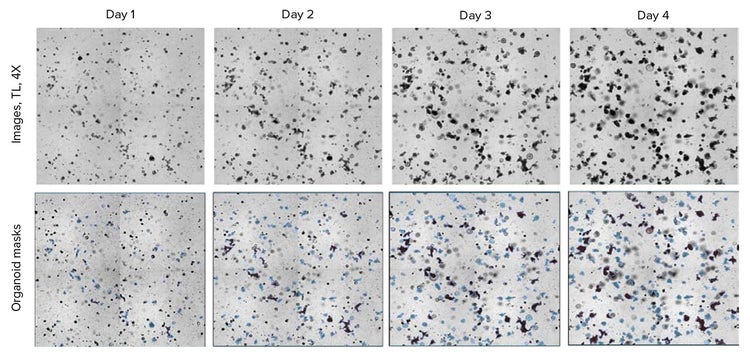
Organoids were imaged and classified using Phenoglyphs into mature (purple) or immature (blue) categories. The images show mouse intestinal organoids taken on days 1 to 4, which were segmented/defined using SINAP. These images were then classified into mature (purple) or immature (blue) organoids. As time progressed and the organoids neared passage, they developed more crypt-like structures and exhibited a higher proportion of mature organoids.
Decision rules for automated passage triggering:
- Well-based decision: A notification is sent to the user when ≥40% of organoids in a well reach the mature phenotype. In the case of well-based decision a notification was sent to scientist flagging the wells with organoids that reached maturity. Another threshold for 10 organoids minimum was added to avoid scoring wells with too few organoids present. Well-based decision may also allow to discard wells, i.e. to make wells inactive for the future processing.
- Plate-based decision: Passaging was triggered, and notification was sent when ≥40% of organoids on the plate reached the mature phenotype. Passaging was initiated when ≥50% of wells met these criteria. In the case of plate-based decision, entire plate, or all plates in the experiment will be processed for that rule. For example, all plates will be passaged, if we select the rule to proceed with passaging when 50% of wells will meet the criteria of 40% organoids will show mature phenotype.
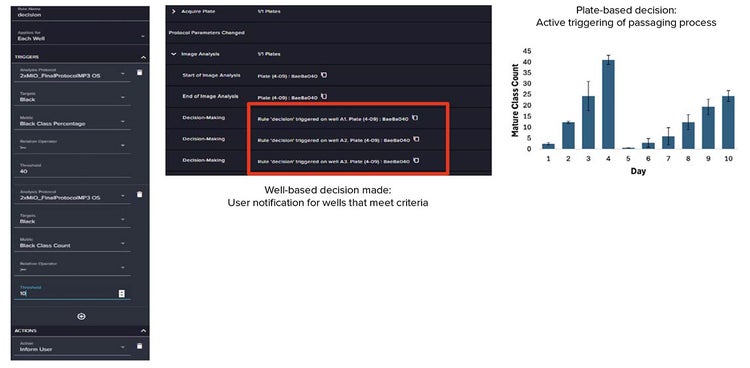
Example of Decision Rule that informs the user when percentage of mature organoids (called Black) in the well becomes greater than 40%. Passaging was triggered automatically on day 4.
Example 2. Human colorectal cancer organoids
AI-based classification of human colorectal organoids
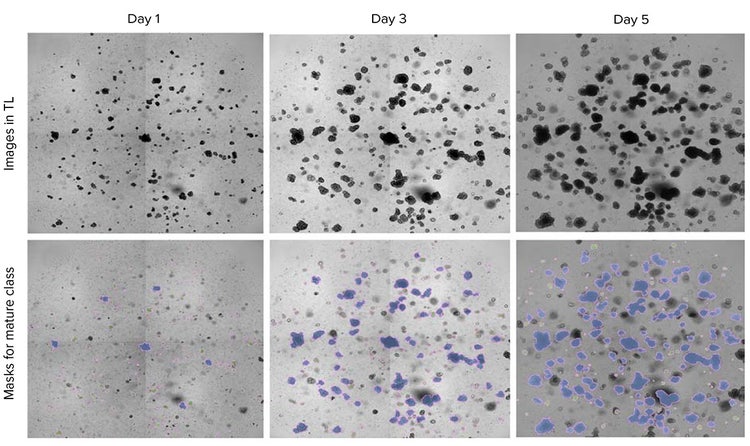
Organoids were imaged with TL twice a day and classified based on image analysis into “mature” (purple) or “immature” (light) phenotype categories. Organoid Classification was done by AI-based image analysis. Changes in percentage and number of mature organoids are shown over time. Analysis and classification criteria can be developed and optimized by the user for different types of organoid cultures.
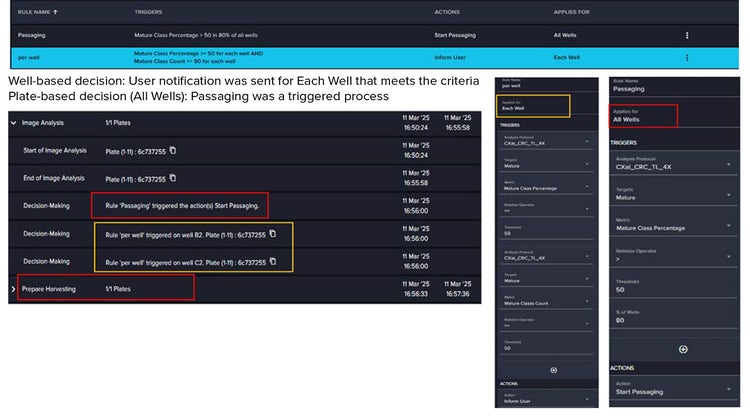
The decision-making process for Each Well (user notification) was triggered for wells B2, C2 when the conditions set by the decision-making rules were met. This occurred when reaching the threshold of ≥50% of mature (old) organoids, and when the number of mature organoids was > 50.
Decision-making for the All-Wells rule (start passaging) was triggered at the plate level. The decision event is highlighted in red; the passaging was triggered based on the following criteria: organoids were passaged when, for ≥80% of wells, ≥50% of organoids reached the mature phenotype.
Maturation of CRC organoids over time
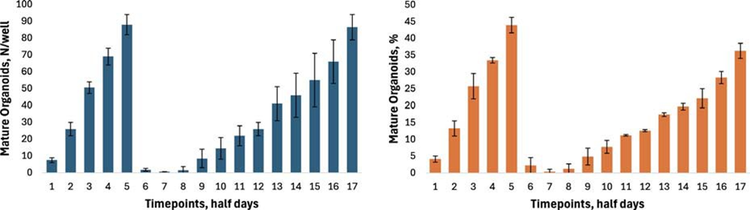
Graphical representation of the % and number of mature phenotype of CRC organoids over time. Passaging was automatically triggered by selected criteria: >40% of organoids became mature. Passaging was automatically triggered at 5th time point.
Example 3. Human intestinal organoids
AI-based classification of human intestinal organoids
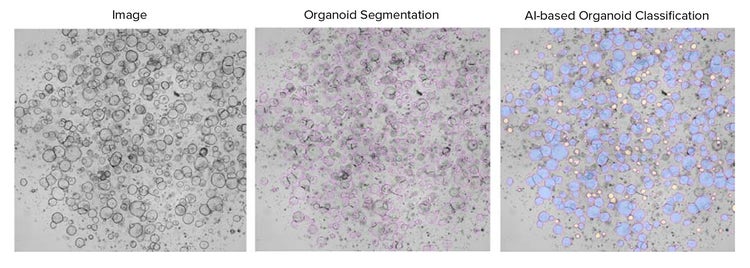
Organoids were imaged then objects were defined (segmented) from the background (pink traces), then analyzed and classified based on image analysis into “mature“ (blue) or “immature” (yellow) phenotype categories. The user can develop and optimize analysis and classification criteria for different types of organoid cultures. Transmitted light (TL) Images were taken using 4X objective on the CellXpress.ai system.
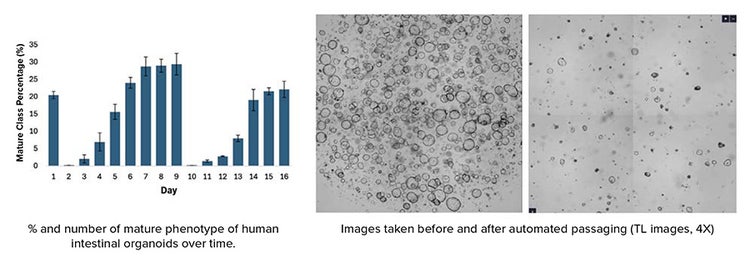
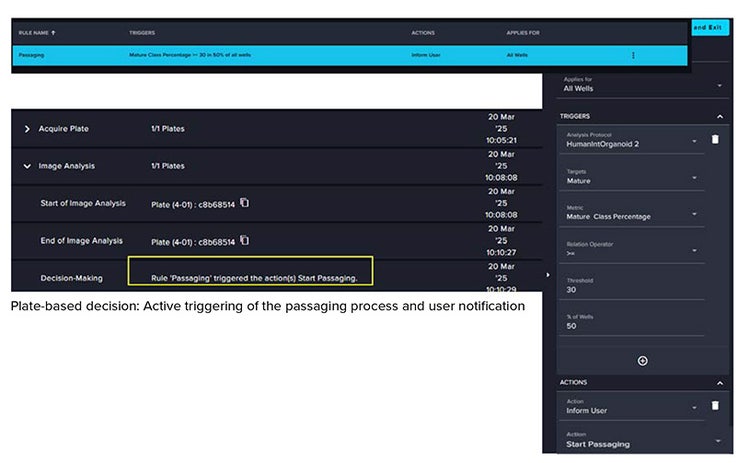
The decision-making process was triggered for the selected plate when the conditions set by the rules were met. This included reaching the threshold of ≥30% mature organoids per well, as well as the percentage of wells meeting that criteria ≥ 50%. Arrows point to when the rule was applied, and passing was triggered.
Summary
Here we have demonstrated AI/ML-enabled cell culture and passaging of three different patient-derived organoid types, each with differing morphology and rates of growth and maturation. The CellXpress.ai system applies consistent, datadriven decision-making to complex cell culture workflows thereby improving reproducibility and reducing variability. Researchers benefit from increased walk-away time and reduced manual workload, allowing them to focus on higher-value tasks. The solution operates with minimal human intervention and is a scalable approach for organoid maintenance and expansion. By standardizing workflows across multiple organoid models, this solution accelerates discovery and simplifies adoption for labs aiming to scale organoid-based research.