
Application Note
Configuring the SpectraMax i3x Multi-Mode Microplate Reader for kinetic turbidimetric endotoxin assays
- FUJIFILM Biosciences PYROSTAR ES-F/Plate and Limulus Color KY test reagents are endotoxin-specific and unreactive to 1–3 beta glucans, and do not need to be reconstituted with a special buffer, making dissolution simple
- SoftMax Pro Software enables a streamlined workflow with automatic standard curve graphing and calculation of results using a ready-to-use protocol
- SpectraMax i3x Multi-Mode Microplate Reader offers configurable settings, including plate definition, for assay optimization
- Molecular Devices provides a validated-ready workflow for kinetic endotoxin testing that combines optimized reader settings, automated analysis, and support for regulated environments
Cathy Olsen, PhD | Sr. Application Scientist | Molecular Devices
Timothy Bolus | Sr. Compliance Program Manager | Molecular Devices
Delaney Novak | Associate Field Application Scientist | FUJIFILM Biosciences
Timothy Francis | Associate Field Application Scientist | FUJIFILM Biosciences
Introduction
Monitoring for contaminants is a critical step during the production process in the pharmaceutical and medical device industries. Endotoxin, a frequent contaminant that is found in the cell wall of gram-negative bacteria, can cause fever, inflammation, headache, nausea, and even death, therefore careful testing of all medical devices and injectable pharmaceuticals is required to ensure there is an endotoxin concentration less than the endotoxin limit of the product. The sensitive and specific Limulus amebocyte lysate (LAL) assay is very often the test of choice for detecting bacterial endotoxin. To support these requirements, Molecular Devices provides a validated, ready-to-use workflow for kinetic endotoxin testing that integrates optimized reader settings, automated data analysis, and software designed for use in regulated environments.
This application note demonstrates the performance of FUJIFILM Biosciences PYROSTAR™ ES-F/Plate Test in combination with Molecular Devices SpectraMax® i3x Multi-Mode Microplate Reader. With this assay, LAL coagulation is monitored as an increase in turbidity over time, measured kinetically with an absorbance microplate reader. The more endotoxin is present in a test sample, the shorter the onset time, or time required for the absorbance of a sample to increase above its initial value by a specified amount, which for this assay is 0.015 OD. A standard curve of onset time versus concentration of a control standard endotoxin (CSE) is performed so that the amount of endotoxin present in a test sample can be interpolated from it. The PYROSTAR ES-F/Plate assay can be used to quantitatively detect levels of endotoxin from 0.01 to 10 endotoxin units (EU/mL).
With Molecular Devices SoftMax® Pro Software, the PYROSTAR ES-F/Plate or other kinetic turbidimetric endotoxin assay can be run using a preconfigured protocol with all the required instrument settings, as well as complementary data analysis and automatic reporting of results, available in the software’s Protocol Library (version 7.4 or higher), or through the Spectranet Customer Care Portal. For regulated environments, SoftMax Pro GxP Software is the latest, most secure software to achieve full FDA 21 CFR Part 11 and EudraLex Annex 11 compliance with streamlined workflows to ensure data integrity.
Materials
- PYROSTAR ES-F/Plate Reagent (FUJIFILM Biosciences cat. #543-10331)
- Control Standard Endotoxin (CSE, included with PYROSTAR ES-F/Plate assay)
- LAL Reagent Water (LRW, FUJIFILM Biosciences cat. #LRW-00125)
- Endotoxin-free microplates (BioClean Plate Wako, cat. #293-35221)
- Endotoxin-free pipettes
- Endotoxin-free dilution tubes
- SpectraMax i3x Multi-Mode Microplate Reader (Molecular Devices)
- Additional SpectraMax readers with absorbance detection mode and kinetic reading suitable for use with the PYROSTAR ES-F/Plate assay:
- SpectraMax ABS Plus Microplate Reader
- SpectraMax M-Series Multi-Mode Microplate Readers
- FlexStation® 3 Multi-Mode Microplate Reader
Methods
The SpectraMax i3x reader was turned on, and the reader temperature was set to 37°C through SoftMax Pro software or the reader’s touchscreen.
PYROSTAR ES-F/Plate Reagent was reconstituted by adding the volume of LAL Reagent Water (LRW) indicated in the product insert. The vial was swirled gently to dissolve the lyophilized reagent, avoiding bubbles. Control Standard Endotoxin (CSE) was reconstituted to 1000 EU/mL by adding the volume of LRW required, based on information provided on the Certificate of Analysis for the LAL and CSE matched kit. The vial was vortexed for 2 minutes to reconstitute thoroughly. Unused reconstituted CSE was stored at 4°C for up to one month and was vortexed for 1 minute just before each further use. A 1:10 dilution series of CSE for the standard curve was prepared in LRW. Standards ranged from 0.01 to 10 EU/mL.
Table 1. Instrument settings used to acquire data for the PYROSTAR ES-F/Plate endotoxin assay. The 96 Well Standard Slow Motion_i3x* plate type must be imported into the Plate Type Settings in SoftMax Pro Software. It is used to slow the speed of microplate movement in the SpectraMax i3x reader during the kinetic reading; this ensures the clot is not disrupted and prevents aberrant absorbance measurements.
*Available for download on Spectranet, Molecular Devices’ customer care portal
To set up the assay plate, 50 μL of LRW was added to wells designated as negative controls, and 50 μL of CSE standard dilutions were added to triplicate wells. 50 μL of sample dilution and corresponding positive product control were added to designated wells. After each of the solutions were added to the plate, 50 μL PYROSTAR ES-F/ Plate Reagent was added to all assay wells using a multi-channel pipette. The plate was placed in the pre-heated reader, and the reading of the reaction was initiated. For data generation and analysis, the ready-to-use, assay-specific protocol in SoftMax Pro software was used. To accurately run each assay, the protocol is configured with the parameters outlined in the PYROSTAR ES-F/Plate package insert, shown in Table 1, as well as complete data analysis features so that results are viewable immediately upon completion of the plate read. Progress could be monitored by viewing kinetic traces in the plate section of the protocol.
For all SpectraMax readers listed in Materials, the PYROSTAR ES-F/Plate assay produced data similar to that obtained with the SpectraMax i3x reader. Specialized plate movement optimization [or, slowing down plate movement] minimizes clot disruption and improves kinetic assay consistency for the SpectraMax i3x reader. This plate definition is available via Spectranet, Molecular Devices’ customer care portal.
For other SpectraMax readers, Slow Carriage Speed is provided as an option in SoftMax Pro software settings.
Results
Kinetic traces showing onset times for standards in the PYROSTAR ES-F/Plate assay are shown in Figure 1. Performance of the kinetic turbidimetric endotoxin assay on the SpectraMax i3x reader requires the use of the 96 Well Standard Slow Motion_i3x plate type in SoftMax Pro Software. This plate definition effectively slows the instrument’s plate carriage during the kinetic plate read, preventing disruption of clots for smoother kinetic data.
From the kinetic data, onset times were calculated, and mean onset time for each standard was plotted vs. CSE concentration by SoftMax Pro software (Figure 2). For two test runs shown, standard curve R2 was >0.98, meeting the specified criteria for the assay.
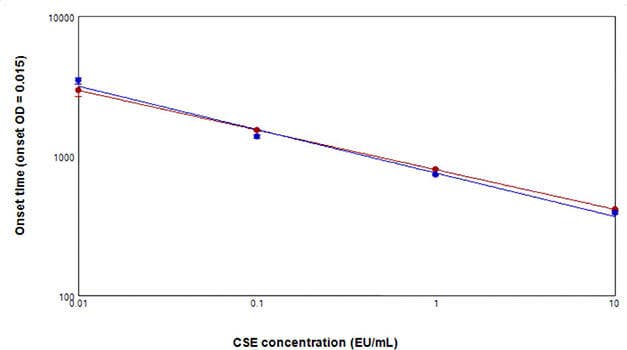
Figure 1. Kinetic traces of representative standards for the PYROSTAR ES-F/Plate assay. Vertical red lines indicate onset times (onset OD = 0.015). Data were generated using a ‘slow’ plate definition that ensures smooth kinetic data.
Designed to support regulatory compliance through:
- Data integrity: Ensures results are consistently accurate, complete, and protected throughout the assay workflow, supporting confident decision-making and regulatory readiness.
- Audit trails: Captures a complete, traceable history of data and user actions, simplifying inspections and strengthening quality assurance processes.
- Electronic signatures: Enables secure sign-off and user authentication, helping laboratories meet regulatory requirements such as 21 CFR Part 11.
- Regulated workflow support: Standardizes processes from data acquisition to reporting, reducing variability while helping maintain compliance with global regulatory standards.
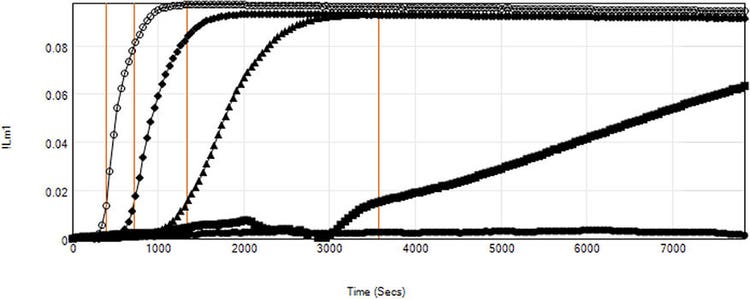
Figure 2. Endotoxin standard curves for two separate test runs of the PYROSTAR ES-F/Plate assay. Mean onset time in seconds, calculated from the kinetic data, vs. endotoxin standard concentration was plotted using the log-log curve fit in SoftMax Pro software. Test 1 (red) R2 = 1.000; test 2 (blue) R2 = 0.990.
Conclusion
The Limulus Amebocyte Lysate (LAL) test, recognized by the U.S. Pharmacopeia (USP), European Pharmacopeia (Ph. Eur.), and Japanese Pharmacopeia (JP), is a mainstay of drug and device testing for bacterial endotoxins. The quantitative, kinetic PYROSTAR ES-F/Plate assay offers labs a reliable method for ensuring safe endotoxin levels, detecting concentrations as low as 0.01 EU/mL. The SpectraMax i3x reader, as well as other SpectraMax readers listed above, along with SoftMax Pro software, provides a streamlined workflow with automatic calculation of results using a specifically configured protocol available for use in regulated as well as non-regulated labs. SoftMax Pro GxP software provides a system audit trail with e-signature statement capabilities and an audited document workflow within a SQL database. Together, the PYROSTAR ES-F/Plate assay, SpectraMax microplate readers, and SoftMax Pro Software provide a scalable solution for kinetic endotoxin testing, enabling laboratories to improve workflow efficiency, support regulatory compliance, and generate reliable quantitative results.