
Application Note
Automated organoid workflow for T-cell screening using the CellXpress.ai Automated Cell Culture System
- Reduction of hands-on time required to study PDO’s and T-Cell’s in co-culture.
- Generation of a scaffold-free workflow for co-culture and image analysis enables a simpler workflow, with better immune cell accessibility to the PDO model.
- Measurement by time-lapse imaging enables real-time understanding of T-cell co-location and exhaustion dynamics.
Zhisong Tong, PhD | Molecular Devices, LLC
Background
Chimeric antigen receptor (CAR) T-cell therapy has revolutionized treatment for hematologic malignancies, but its efficacy in solid tumors remains limited due to the suppressive nature of the tumor microenvironment (TME). Solid tumors are surrounded by a dense and immunosuppressive microenvironment that include regulatory T cells, tumor-associated macrophages, and myeloid-derived suppressor cells. The architecture of solid tumors promotes hypoxic regions, and poor vascularization. Combined, these factors inhibit CAR T-cell infiltration, activation, and persistence. Three-dimensional (3D) cell models like patient-derived organoids (PDOs) offer a more physiologically relevant model of a solid tumor compared to traditional 2D cultures, making them valuable tools for in vitro screening for T-cell engagement.
Despite the benefits associated with the use of PDOs, there are significant barriers that hinder their widespread adoption in drug discovery, including the costly and highly labor-intensive processes associated with their growth and maintenance. To address these challenges, here we demonstrate utility of Molecular Devices 3D Ready™ Colorectal Cancer (CRC) organoids combined with a hydrogel-free organoid time-lapse assay to characterize T-Cell interactions, using the CellXpress.ai® Automated Cell Culture System. After a 48-hour post-thaw period, we recovered CRC organoids directly into a novel nano film coated R3 CE cell culture plate (AcroCyte Therapeutics) enabling spontaneous dome-free 3D organoid formation moleculardevices.com | © 2025 Molecular Devices, LLC. All rights reserved. using the CellXpress.ai Automated Cell Culture System (Molecular Devices). Human peripheral blood mononuclear cells (hPBMCs), containing (approx. ~ 45%) CD4/CD8+ T-cells were activated and added to CRCs as a co-culture. Time-lapse monitoring was undertaken on the CellXpress.ai Automated Cell Culture System every 4 hours for 96 hours. We used Custom Module Editor (CME), an analysis module in IN Carta® Image Analysis Software (Molecular Devices) to segment the T cells and the organoids, measuring the co-localisation distance of each T cell within the organoid. We found that activated T cells exhibit concentration dependant chemotaxis. Thus, the CellXpress.ai system together with the image analysis workflow provides an innovative approach for reducing hands-on time in-vitro T-cell screening.
Materials and methods
Organoid thawing and preparation
We used cancer models expanded using our 3D Ready Organoid Expansion Service—which uses a patented, semi-automated bioreactor system to grow and expand patient-derived organoids (PDOs) with precision and consistency. They are an excellent cancer model on which to test potential new therapeutics in early-stage drug discovery. 3D Ready CRC PDOs are derived from adult stem cells from donated colorectal cancer patient biopsy tissue. The organoids are provided as a cryopreserved assay-ready product, that can be thawed, plated, and is ready to assay after a 48-hour recovery period. Organoids were thawed following our guide Protocols for Thawing and Plating 3D Ready Organoids, the resultant thawed organoids were initially embedded in 80% Matrigel (Corning) and cultured for 48 hours to promote recovery and growth. Post-recovery, organoids were harvested, stained with MitoTracker™ Red (Thermo Fisher Scientific), and resuspended in 3% Matrigel/medium mixture for downstream assay preparation (Figure 1).
Plate format and seeding
Organoids were seeded into R3 CE 96-well plates (AcroCyte Therapeutics). The R3 CE plate is a scaffoldfree single-cell proliferation 3D cell culture ware, that is coated with novel nanofilm enabling culture of complex 3D tissues in this case from single cell or organoid fragments. To develop this scaffold-free workflow, we used R3 CE 96W plate to maintain the structure of the 3D organoids, allowing free movement of T cells around organoids. The CellXpress.ai Automated Cell Culture System (Molecular Devices) was used to automate the seeding process. The SEEDING workflow was configured to dispense organoid suspensions uniformly across wells, ensuring consistent distribution and minimizing variability (Figure 2).
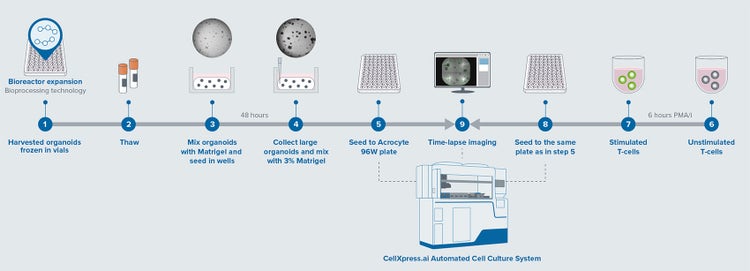
Figure 1. T Cell and CRC PDO workflow. 3D Ready ™CRCs were thawed into Matrigel/media mix for 48 hours recovery. Post recovery, the collected large organoids were then stained with MitoTracker Red and mixed with 3% Matrigel before seeding into 96-well plate using the CellXpress.ai system. The thawed PBMC/T cells were stimulated with PMA at 1ng/mL, 5ng/mL, 25ng/mL, 125ng/mL, or 625ng/mL combined with ionomycin at 1ug/mL for 6 hours and stained with CellTracker Green before being added to the same plate for coculture using the CellXpress.ai system. Time-series images every 4 hours were acquired automatically with AI-powered imaging using 10X air objective and 2D projection.
T-cell preparation and co-culture
Human peripheral blood mononuclear cells (hPBMCs) were thawed and stimulated with phorbol 12-myristate 13-acetate (PMA; 1–625 ng/mL) and ionomycin (1 µg/mL) for 6 hours to induce activation. PMA activates protein kinase C (PKC), a key enzyme in the T-cell receptor (TCR) signalling pathway. Ionomycin increases intracellular calcium, which is also crucial for T-cell activation and cytokine production. Together, they bypass the TCR and directly stimulate downstream signalling pathways, leading to robust T Cell activation. Following stimulation, The T cells were labelled with CellTracker™ Green (Thermo Fisher Scientific) and added to organoid-containing wells using the COMPOUND ADDITION workflow on the CellXpress. ai system. Co-cultures were maintained for 96 hours, with imaging performed every 4 hours (Figure 2).
Imaging and analysis overview
IN Carta analysis software with Custom Module Editor (CME) was used to analyze the images acquired from the CellXpress.ai system. The raw images of T cells were first pre-processed to smooth the image and remove the background, followed by the segmentation of T cells. The same procedure was performed on CRC organoid images to preprocess and segment the organoids, generating the masks of the organoids. The organoid masks were then used to generate a co-localisation image where the intensity values at a point represents the proximity of that point to the nearest white pixel in the organoid masks. The proximity image was then overlayed with T cell masks to measure the T cell co-localisation into the organoids. Co-localisation metrics were normalized to account for seeding variability and photobleaching.
Results
Custom Module Editor enables co-localization distance measurement
T cells, guided by their T cell receptors, patrol the body, scanning for cells displaying abnormal proteins. When a TCR encounters a matching antigen on a cancer cell, it triggers the T cell, which moves to from a close contact within the cancer cell. Thus, the co-localization measurement of T cells with the cancer cell is an important metric to evaluate the efficacy of T cells. On the other hand, CME is a specialized software environment that enables users to customize the modules for specific image analysis purpose. It includes built-in common modules like Gaussian Filter, Top Hat and Find Round Objects for background removal and object segmentation analysis. It also includes special module like Distance to allow 2D or 3D distance measurement. In this study, we used CME to evaluate the co-localization of T cell and organoids by measuring the distance from the co-localized T cell to the nearest edge of the organoid (Figure 3).
The CellXpress.ai system automates the monitoring of co-culture of T cells and cancer cells
An in vitro T cell screening assay is a laboratory test used to evaluate the effectiveness and safety of T cells against cancer cells. The monitoring of such assay often requires the setup of CO2 and humidity environment in the imager or automation of transferring plates between imager and incubators. Thus it either occupies the imager for one plate during the whole co-culture period or needs third-party automation software to control the transferring. To address this hurdle, we used the CellXpress.ai system to automate the process of seeding, culturing and passaging organoids and monitoring by imaging, with pre-established workflows and fine-tunied settings. In this study, we automated organoid seeding and T-cell seeding and monitoring in three distinct phases. We first used a pre-configured SEEDING workflow to plate the organoids mixed with 3% Matrigel into a R3 CE 96W plate in Phase 1, followed by a pre-configured COMPOUND ADDITION workflow to plate the T cells stimulated with different concentration of PMA into the same plate in Phase 2. The co-culture of CRC organoids and T cells were monitored every 4 hours for 4 days using a pre-configured IMAGING AND ANALYSIS workflow in Phase 3 (Figure 2B).
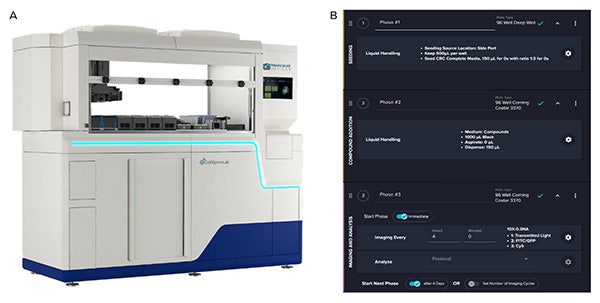
Figure 2. A. The CellXpress.ai Automated Cell Culture System that integrates a liquid handler, an incubator with up to 154 plates, an imager with TL and up to 6 fluorescence channels and waste system: B. Three phases of Seeding from 96W deep well plate to 96W R3 CE plate, Compound Addition from 96W compound plate to 96W R3 CE plate and Imaging and Analysis workflow on the 96W R3 CE plate.
PMA dependent increase in T cell co-localization with CRC cancer organoids
In T cell activation, Phorbol 12-myristate 13-acetate (PMA) acts as a potent stimulant by activating protein kinase C (PKC), a key enzyme in intracellular signalling pathways. When combined with ionomycin, which increases intracellular calcium levels, PMA can induce robust T cell activation and cytokine production. We thus titrated the concentration of PMA to regulate the T cell activation activity and demonstrate this effect by the measurement of co-localization of T cell and CRC cancer organoids. In this study, we covered the concentration of PMA from as low as 1ng/mL to as high as 625ng/mL with a fivefold increase. The stimulated T cells clearly show more significant colocalization than unstimulated T cells (Figure 4, last column).
To quantify the duration and concentration effect of PMA on T cells, we calculated the total co-localisation distance of T cells inside the organoids Σi∈INSIDEdi/Σi∈INSIDE1 + Σi∈OUTSIDE1 and counted all the co-localized T cells, respectively, normalized by the total number of T cells in the well to compensate the seeding variability and photobleaching. We found that 1ng/mL PMA has little effect on the T-cell co-localisation while higher concentrations have significant effects. Concentrations equal to or higher than 25ng/mL stimulates T cells more profoundly in the early timepoints followed by exhaustion (Figure 5A). In contrast, 5ng/mL PMA activates T cells energetically across all timepoints tested. The above observation suggests that PMA/i-stimulated T cells exhibited chemotactic behavior, with co-localization characteristics increasing with PMA concentration and T cells stimulated with 5 ng/ mL PMA showed sustained activation over time, while higher concentrations led to early activation followed by exhaustion. Quantitative metrics showed an expected increase in co-localization behavior and cell count in the stimulated T cells population versus unstimulated controls. These findings are consistent with known mechanisms of PMA/ionomycin stimulation in T-cell activation and chemotaxis3.
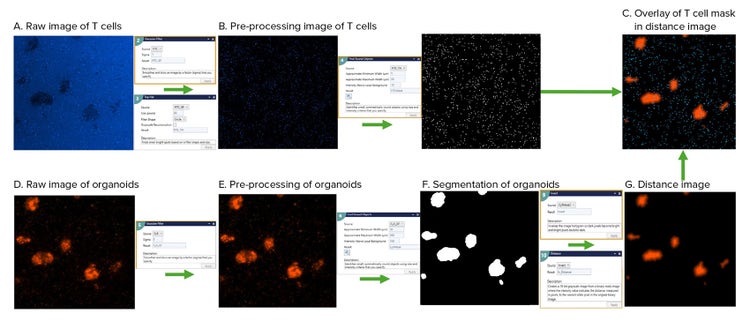
Figure 3. T cell penetration distance analysis workflow. A. Raw image of T cell; B. Pre-processed image of T cells; C. Masks of T cells; D. Raw image of CRC organoids; E. Pre-processed image of organoids; F. Masks of organoids; G. Distance image; H. Overlay of T cell masks in distance image.
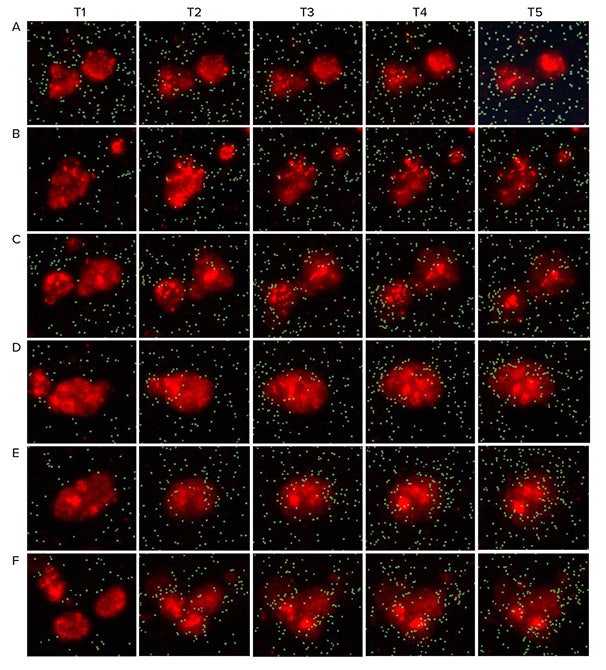
Figure 4. Representative overlays of organoid image and T cell masks for the five time points. A. Unstimulated T cells; B. T cells stimulated with 1ng/mL PMA; C. T cells stimulated with 5ng/mL; D. T cells stimulated with 25ng/mL; E. T cells stimulated with 125ng/mL; F. T cells stimulated with 625ng/mL.
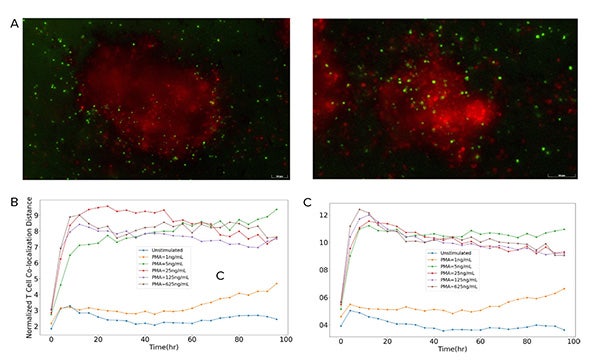
Figure 5. A. Representative images of Tcells (green) co-localized with organoids (red) at later time point; B. Normalized T-cell co-localization distance per treatment condition; C. Normalized co-localized T cell count per treatment condition.

Table 1. Normalized T-cell co-localization distance per condition and per time point.
Conclusion
This study demonstrates the viability of using the CellXpress.ai Automated Cell Culture System for high-throughput, scaffold-free organoid culture and T-cell screening. The integration of automated workflows and advanced image analysis enables precise quantification of concentration and duration dependencies on T-cell interactions with PDO’s as a model for solid tumors. This assay workflow offers a scalable solution for in vitro cell therapy research.
References
- June, C.H., et al. (2018). CAR T cell immunotherapy for human cancer. Science, 359(6382), 1361–1365.
- Sachs, N., et al. (2018). A Living Biobank of Breast Cancer Organoids Captures Disease Heterogeneity. Cell, 172(1-2), 373–386.e10.
- Kannan, Y., et al. (2005). Ionomycin-induced T-cell activation reveals a calcium-dependent pathway in cytokine gene transcription. Journal of Biological Chemistry, 280(6), 4473–4481.