Biomarker Discovery
Accelerate biomarker research with integrated detection, automation, and analysis solutions for confident, reproducible results.
What is biomarker analysis?
Biomarker discovery is a cornerstone of modern life sciences research, enabling scientists to interrogate disease mechanisms, stratify patient populations, and monitor therapeutic responses with increasing precision. Researchers today are expanding beyond traditional 2D assays toward human‑relevant systems, such as patient‑derived organoids, ex vivo tissues, and multi‑omics readouts, that offer more predictive translational insight but introduce challenges in standardization, data harmonization, and throughput requirements. At the same time, biomarker programs are often fragmented across imaging, ELISA, flow cytometry, proteomics, and computational pipelines, making it difficult to compare results across sample types, including precious clinical specimens, and complicating decision‑making.
Why does biomarker analysis matter?
Biomarkers are far more than laboratory measurements, they are the evidence base that drives modern biomedical decision making. They reveal whether a disease is emerging, progressing, or responding to therapy; they uncover molecular mechanisms that guide target selection; and they enable researchers to stratify patients so the right therapy reaches the right population at the right time. In oncology, for example, cytokines, immune checkpoint proteins, and spatially or phenotypically expressed markers within 3D models and patient-derived systems offer powerful insights into tumor–immune dynamics and can dramatically influence therapeutic strategy.
Because biomarkers shape early disease detection, target prioritization, trial design, and go/no-go decisions, the cost of inaccurate, slow, or inconsistent biomarker data is high. Fragmented workflows, whether manual ELISAs, isolated imaging systems, or disconnected computational steps, slow research and introduce variability that can obscure true biological signals. Academic and translational teams need biomarker workflows that preserve biological context, scale efficiently, and maintain reproducibility across plate-based assays, 3D organoids, spheroids, and other human relevant in vitro models. When biomarker decisions drive target prioritization and trial design, researchers need quantitative data they can trust across ELISA, luminescence, TR FRET, and western blot confirmation, without re validating platforms at each stage.
What are the stages of biomarker discovery?
Biomarker discovery typically progresses through several interconnected stages, from initial biological insight to validation.
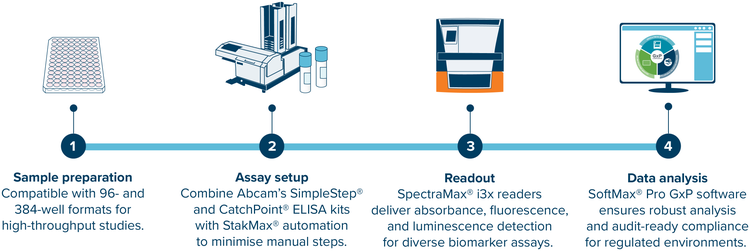
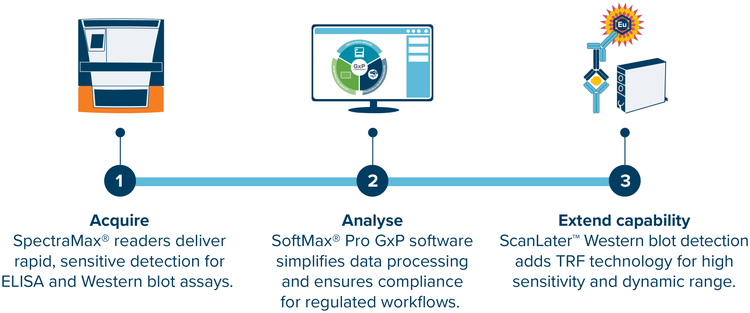
Molecular Devices enables continuity across discovery and validation by delivering quantitative, multi mode biomarker detection on a single platform. SpectraMax iSeries readers, led by the i3x, support ELISA, luminescence, TR FRET, and western blot workflows, while SoftMax Pro GxP software ensures standardized, audit ready data handling when research moves toward regulated environments. Together with Abcam's validated assay kits, the i3x reduces variability, accelerates decision making, and enables confident biomarker comparison across diverse sample types.
As biomarker strategies expand across assay types and sample models, success increasingly depends on a single, flexible detection platform that can produce comparable, quantitative data across workflows, without forcing labs to manage multiple disconnected instruments.
Common assay approaches in biomarker discovery
Across these stages, researchers rely on established assay formats to explore and validate biomarker signals. Techniques such as ELISA and western blotting support different phases of discovery, from early investigation through to downstream confirmation.
ELISA
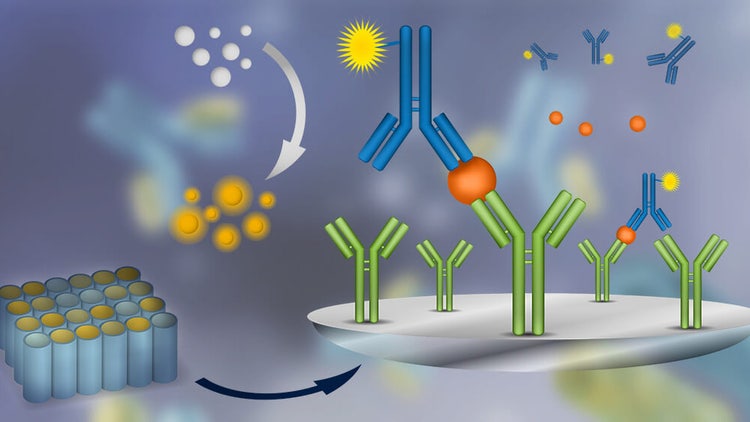
ELISA is widely used in biomarker discovery to detect and quantify specific proteins in biological samples. It is commonly applied at the early to mid discovery stage to confirm the presence of biomarkers, compare relative abundance, and support assay development.
Discover ELISA resources
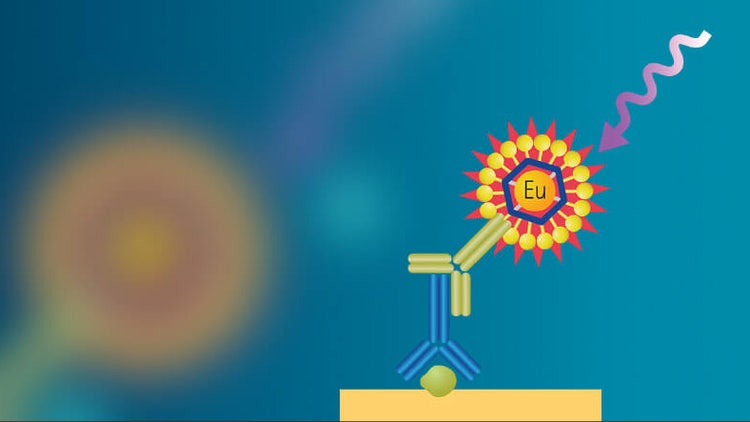
Western Blot
Western blotting is typically used later in biomarker discovery to confirm target protein presence and specificity. By separating proteins by size and detecting them with antibodies, it helps verify biomarker identity and supports downstream validation efforts.
Discover Western Blot resources
Data acquisition and analysis in biomarker research
Once assays are established, biomarker studies depend on appropriate acquisition and analysis techniques to generate interpretable data.
SoftMax Pro software transforms raw assay signal into defensible biomarker decisions, with built in analysis workflows, traceability, and optional GxP compliance, reducing reanalysis, rework, and regulatory risk.
Biomarker applications and assay use
Biomarker assays are applied across a range of research areas, depending on the biological question and study design.
How does biomarker discovery work in practice?
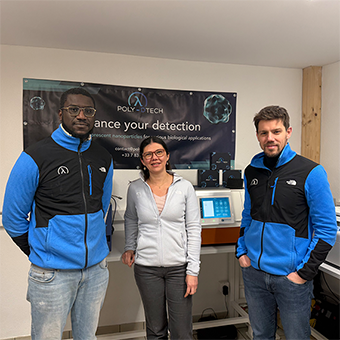
Learn how Poly-Dtech accelerated biomarker discovery from nanoparticle design to assay use
At Poly-Dtech, biomarker assays are used as part of ongoing translational research to investigate biologically relevant targets and support experimental decision making. This work focuses on developing and applying ultrabright lanthanide based fluorescent nanoparticles within immunoassay formats, enabling the detection and measurement of low abundance biomarkers that are difficult to resolve using conventional fluorescence methods.