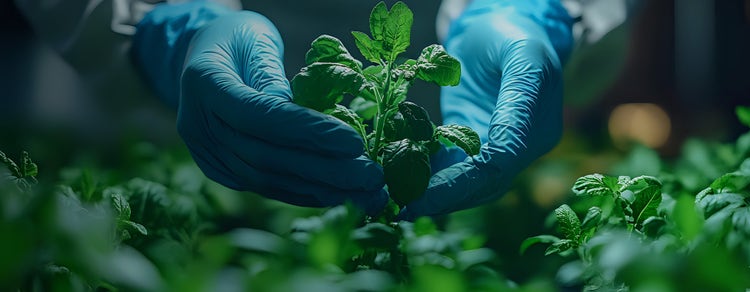
Agricultural Biotechnology
Accelerate crop innovation, sustainability, and food security with automated, data-driven tools designed for modern agricultural biotechnology research.
What is Agricultural Biotechnology?
Agricultural biotechnology applies molecular biology, microbiology, and automation technologies to improve crops, soil health, and agricultural inputs. Researchers use agricultural biotech tools to develop higher-yielding crops, improve stress tolerance, enhance nutritional value, and accelerate sustainable farming practices.
Modern agricultural biotechnology spans applications such as:
- Plant genome editing and trait development
- Microbial screening for soil health and biostimulants
- Crop protection and resistance research
- Fermentation-based agricultural inputs
- High-throughput phenotyping and assay development
As agricultural research moves faster and becomes more data-intensive, laboratories increasingly rely on automation, imaging, and integrated analysis to scale discovery while maintaining accuracy and traceability.
Why Agricultural Biotechnology Matters Today
Agricultural biotechnology plays a critical role in addressing global challenges including climate change, food security, and sustainable land use. Researchers are under pressure to deliver results faster, often with limited resources, while managing increasing experimental complexity.
Key trends shaping agricultural biotechnology research include:
- Genome-edited crops for drought, heat, and disease resistance
- Microbial-based solutions for soil health, nitrogen fixation, and crop yield
- Sustainable alternatives to chemical fertilizers and pesticides
- High-throughput screening to evaluate thousands of variants efficiently
To keep pace, agricultural biotechnology labs require reliable automation that reduces manual bottlenecks, improves reproducibility, and supports scale without overbuilding infrastructure.
Agricultural Biotechnology Process
Agricultural biotechnology workflows vary by application, but most follow a common sequence from biological design through screening, validation, and optimization. Automation and advanced phenotyping help researchers move through each step with greater consistency, confidence, and scale.
1. Biological Design & Engineering
Agricultural biotechnology research often begins with the design of genetic constructs, microbial pathways, or trait modifications intended to improve crop performance, resilience, or sustainability. This may include molecular cloning, gene editing, or pathway engineering in plant or microbial systems.
At this stage, researchers benefit from workflows that support repeatability and traceability, ensuring that downstream results can be confidently linked back to the original design.
How automation helps:
Reliable, standardized workflows reduce variability early in the process, setting the foundation for meaningful screening and phenotypic comparison later on.
2. Transformation or Introduction
Once designs are finalized, genetic material or engineered organisms are introduced into host systems such as plant cells, bacteria, yeast, or other agriculturally relevant microbes. This step often produces large numbers of colonies or transformants that must be handled carefully to preserve viability and diversity.
How automation helps:
Automated handling minimizes manual intervention, reduces contamination risk, and supports consistent processing across large sample sets, especially when working with fragile or slow-growing organisms.
3. Screening, Phenotyping & Selection
Screening is a critical inflection point in agricultural biotechnology workflows. Researchers must identify variants that exhibit desired traits — such as improved growth, stress tolerance, productivity, or functional performance — often from thousands of candidates. Morphology and phenotyping are especially important when working with hard-shelled, slow-growing, or visually similar colonies, where subtle differences can have significant downstream impact.
How automation helps:
Advanced imaging and automated colony handling enable researchers to:
- Visually differentiate colonies based on morphology and phenotype
- Reliably pick difficult or hard-to-access colonies
- Perform automated colony picking, plating, streaking, and liquid handling
- Maintain sample integrity and traceability at scale
https://vids.moleculardevices.com/watch/1GaaZyAvm65AhNY7XccJw7
The QPix FLEX system supports this critical screening and selection step by combining high-resolution color imaging with automated colony picking, plating, streaking, and liquid handling, enabling reliable phenotypic differentiation and selection, even for hard-shelled, slow-growing, or visually similar colonies.
These capabilities are particularly valuable in agricultural and environmental strains that are traditionally challenging to work with manually.
4. Validation & Characterization
Selected candidates are then validated to confirm genetic integrity, functional performance, and reproducibility. This step may include genetic confirmation, growth analysis, productivity assessment, or other application-specific characterization.
How automation helps:
Standardized workflows and consistent sample handling improve reproducibility, allowing researchers to compare results across experiments, operators, and timepoints with greater confidence.
5. Optimization & Scale-Up
Promising candidates move into optimization and scale-up, where growth conditions, media composition, or process parameters are refined to support larger-scale studies or production workflows. This step is especially important in fermentation-based agricultural applications and microbial-derived inputs.
How automation helps:
Automated workflows support efficient iteration and optimization, helping researchers scale without introducing unnecessary complexity or variability.
By combining a straightforward workflow with automation and phenotyping at key decision points, agricultural biotechnology researchers can:
- Increase throughput without sacrificing data quality
- Make better selection decisions earlier in the process
- Reduce manual bottlenecks and operator variability
- Confidently work with challenging organisms and morphologies
This approach enables labs to move from discovery to application more efficiently while maintaining scientific rigor.