Molecular Devices Home
Careers  |  Contact Us  |  Search:   


SpectraMax® Multi-Mode Microplate Readers

Your applications, your modes, your choice

  • Upgradeable platform for changing lab needs
  • Three-mode cuvette port for assay development
  • Dual monochromator tunability
  • Automated Absorbance Pathlenght Correction
  • Endpoint, kinetic, spectral and well-scanning read types
  • Comprehensive Data Analysis with SoftMax Pro Software
  • Validation & compliance
  • Robotics compatibility

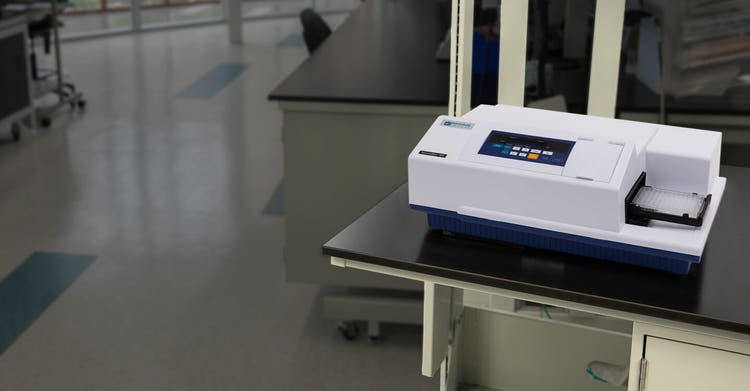
The SpectraMax® M3, M4, M5 and M5e Multi-Mode Microplate Readers are a modular, upgradeable dual-monochromator microplate reader platform offering a wide range of high performance multi-mode capabilities ideal for life science research and drug discovery screening. Choose from a three- (M3), four- (M4), or five- (M5/M5e) mode reader customized to your specific applications or budgetary needs, while optional capabilities allow you to upgrade with other detection modes at a later time. All configurations offer a triple-mode cuvette port, accurate temperature control, microplate shaking and comprehensive data management using our SoftMax® Pro Software. Detection modes include:

  • UV-Visible Absorbance (Abs)
  • Fluorescence Intensity (FI)
  • Luminescence (Lum)
  • Time-Resolved Fluorescence (TRF)
  • Fluorescence Polarization (FP)


Press the Play button to start the SpectraMax Product Video.
Turn on your speakers to hear the narration.

The SpectraMax M5e Reader offers the additional benefit of being certified for Cisbio Bioassays' HTRF® Assays.

Dual Monochromators for assay flexibility

With SpectraMax Multi-Mode Readers, there is no need to utilize expensive filters to optimize detection levels and background. The optical systems use two scanning monochromators so the user can determine optimal excitation and emission settings, resulting in assay performance similar to that of dedicated single-mode readers.

Patented Pathlength Correction for Better Absorbance

Only Molecular Devices microplate plate readers offer the capability to measure the depth (optical pathlength) of samples with no termperature dependency using the patented PathCheck® Sensor technology. With SoftMax Pro Software, the PathCheck Sensor automatically normalizes the well absorbance. This eliminates the need for standard curves, and, for compounds with known absorptive properties, enables users to calculate concentrations directly from absorbance.

Superior Optics for Optimal Assay Performance

Unique Optical Characteristics

  1. The reference diodes enable elimination of measurement noise due to slight fluctuations in excitation light intensity.
  2. The angled emission beam improves signal-to-noise, especially in narrow Stokes shift fluorophores, by reducing stray light.
  3. Elliptical mirrors are used instead of lenses for maximum transmission with minimal wavelength distortion.
  4. Top-quality UV-grade fibers give the highest light transmission down to even the lowest wavelengths.

Assay Collaboration For Ease of Setup

Molecular Devices has collaborated with various assay partners to optimize and validate homogeneous and heterogeneous biochemical- or cell-based assay performance on the SpectraMax platform. To support these assays, we provide application notes as well as ready-to-run protocols in our SoftMax Pro Software. Some of our featured partner assays include HTRF assays from Cisbio Bioassays and LanthaScreen® TR-FRET assays from Invitrogen.

HTRF Compatible LanthaScreen

Which SpectraMax Microplate Reader Do You Need?

  SpectraMax M3
Reader
SpectraMax M4
Reader
SpectraMax M5
Reader
SpectraMax M5e
Reader
Detection Modes
Absorbance X X X X
Fluorescence Intensity X X X X
Luminescence X X X X
Time-Resolved Fluorescence   X X X
Fluorescence Polarization     X X
HTRF       X
Upgrade Options TRF, HTRF, FP HTRF, FP HTRF N/A
Plate Formats
6-, 12-, 24-, 48-, 96-, 384-Well Microplates X X X X
Certification & Validation
IMAP Validation   X
(TR-FRET only)
X
(TR-FRET/FP)
X
(TR-FRET/FP)
HTRF Certification       X
LanthaScreen Certification     X X
Key Applications
ELISAs X X X X
DNA/RNA Quantitation X X X X
Protein Assays X X X X
Enzyme Kinetics X X X X
Protease Assays X X X X
Fluorescent Proteins and FRET X X X X
Cell Viability and Cytotoxicity Assays X X X X
Reporter Gene Assays X X X X
Cell Migration Assays X X X X
QBT Fatty Acid Uptake Assay X X X X
Neurotransmitter Transporter Uptake Assay X X X X
ADME-Tox X X X X
Membrane Permeability X X X X

Software for Data Acquisition and Analysis

Comprehensive data analysis and GxP solutions

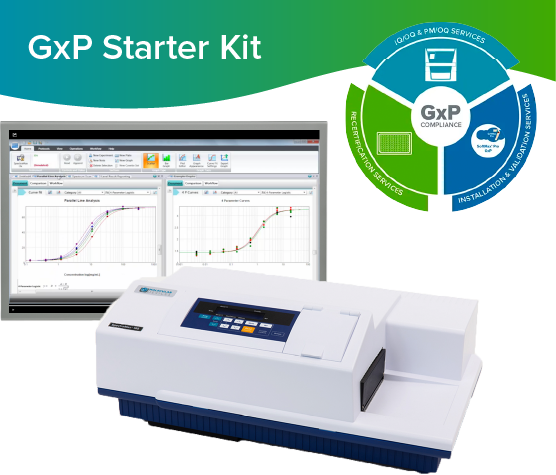
SoftMax Pro Software provides data acquisition, analysis and management capabilities, allowing cross-plate analysis and custom calculations. For users operating in a FDA 21 CFR Part 11 compliant environment, SoftMax Pro GxP Software is available, allowing user permissions, audit trails, e-signature and reporting tools.

Tools for Validation and Compliance

SpectraMax Readers have the most complete level of product validation and compliance. Molecular Devices provides the complete solution covering the instrument and software:

  • SpectraTest® ABS1, FL1, and LM1 Validation Plates for hardware validation of absorbance, fluorescence, and luminescence modes
  • IQ/OQ/PQ for all microplate readers
  • SoftMax Pro Software validation package
  • Software tools for FDA 21 CFR Part 11 compliance

Automation solutions

Robotics Compatibility for increased throughput

SpectraMax Multi-Mode Microplate Readers can be easily integrated with our optional StakMax® Microplate Handling System for walk-away processing. Operated from within SoftMax Pro Software, the StakMax System can hold up to 50 plates and facilitates barcode reading. For more advanced automation needs Molecular Devices interacts with all of the major lab automation providers, and is one of their leading choices.

Ordering Information

Acquiring a SpectraMax Multi-Mode Microplate Reader is extremely easy:

  1. Decide what modes you need and choose the specific configuration option that suits you best. All systems include SoftMax Pro Software for Windows® and Macintosh® Operating Systems.

  2. Choose the additional options you want:

    • Software validation tools
    • SpectraTest ABS1, FL1, LM1 Validation Plates
    • SoftMax Pro GxP Software
    • StakMax Microplate Handing System

  3. Contact your Molecular Devices sales representative to discuss the details.

Technical Specifications

general specifications

Dimensions (in.)

8.6 (H) x 22.8 (W) x 15.3 (D)

Dimensions (cm)

22 (H) x 58 (W) x 39 (D)

Weight

36 lbs (16.4 kg)

Power Consumption

< 420 watts

Power Source

100-240 VAC, 3 A, 50/60 Hz

Robotic Compatible

Yes

general photometric performance

Plate Formats

6, 12, 24, 48, 96, 384 wells

Light Source

Xenon Flash Lamp (1 joule/flash)

Detectors 2 photomultiplier tubes
ShakerTime 0 to 999 seconds
Temperature Control 2 °C above ambient to 60 °C
Temperature Uniformity < 1°C at 37°C set point
Temperature Accuracy ±1°C at 37°C set point
Endpoint Reading All modes
Kinetic Reading All modes
Spectral Scanning All modes
Well Scanning Abs, FI, TRF, Lum

Typical Read Times (minutes:seconds)††


96 wells

384 wells

Absorbance

0:18

0:49

Fluorescence Intensity

0:17

0:48

Fluorescence Polarization

0:42

2:03

Time-Resolved Fluorescence

0:17

0:48

Luminescence

2:00

7:00

absorbance photometric performance

Reading Capabilities

Cuvette or microplate

Wavelength Range

200-1000 nm

Wavelength Selection

Monochromator, tunable in 1.0 nm increments

Wavelength Bandwidth

< 4.0 nm

Wavelength Accuracy

±2.0 nm

Wavelength Repeatability

±0.2 nm

Photometric Range

0-4.0 OD

Photometric Resolution

0.001 OD

Photometric Accuracy (Microplate)

< ±0.006 OD ±1.0%, 0-2 OD

Photometric Accuracy (Cuvette)

< ±0.005 OD ±1.0%, 0-2 OD

Photometric Precision

< ±0.003 OD ±1.0%, 0-2 OD

Stray Light

< 0.05% @ 230 nm

fluorescence intensity performance

Reading Capabilities

Cuvette or top or bottom of a microplate

Wavelength Range

250-850 nm

Wavelength Selection

Monochromators, tunable in 1.0 nm increments

Bandwidth (Ex, Em)

9 nm, 15 nm

Sensitivity

< 5 pM fluorescein in 96 wells or cuvette,
< 20 pM in 384 wells

luminescence performance

Reading Capabilities

Cuvette or top or bottom of a microplate

Wavelength Selection

All wavelengths or with selected wavelengths

Wavelength Range

250-850 nm

Sensitivity

< 2 fg/well lower detection limit for firefly luciferase in 96- and 384-well top read

Cross-talk

< 0.5% in 96- and 384-well microplates

time-resolved fluorescence performance (M4, M5, M5e only)

Reading Capabilities

Top or bottom of a microplate

Wavelength Range

250-850 nm

Wavelength Selection

Monochromators, tunable in 1.0 nm increments

Bandwidth (Ex, Em)

9 nm, 15 nm

Precision Data Collectionn

1-100 flashes, delay of 0-600 µsec before read, integration time selectable between 50-1500 µsec

Sensitivity

100 fM europium in 96 or 384 wells with top-read

SpectraMax M5e reader only

Certified to Cisbio Bioassays' HTRF assays performance Specifications

fluorescence polarization performance

Wavelength Range

400-750 nm

Wavelength Selection

Monochromators, tunable in 1.0 nm increments

Bandwidth (Ex, Em)

9 nm, 15 nm

Precision

< 5 mP standard deviation at 1 nM fluorescein in 96 and 384 wells

*Specifications subject to change.
*FOR RESEARCH USE ONLY. NOT FOR USE IN DIAGNOSTIC PROCEDURES.
† The PathCheck Sensor is covered under U.S. Patents 5,959,738, 6,188,476, 6,320,662, 6,339,472, 6,404,501, 6,496,260 and 6,995,844. SpectraMax M3, M4, M5, and M5e readers are also covered under U.S. Patents 6,097,025 6,232,608, 6,236,456, 6,313,471 and 6,316,774 6,693,709, and 6,825,921

†† With 3 flashes/well in absorbance and fluorescence modes, and 1 sec./well integration in luminescence.


Part #: M5
SpectraMax M5 System
Login to Request a
Quote or see pricing

Part #: M5E
SpectraMax M5e System
Login to Request a
Quote or see pricing
 
 
?>