The Invisible Revolution: How Precision Automation Is Unlocking the Next Era of Microbiome Research
As microbiome science shifts from species-level insights to strain-level function, precision automation becomes essential to ensure reproducibility, scalability, and confidence in microbial workflows.
- Microbiome research is shifting from species-level function, requiring more precise and reproducible workflows.
- Metagenomics alone cannot confirm function – culture-based validation remains essential but is limited by manual workflow variability.
- Precision automation platforms like the QPix® FLEX™ Microbial Colony Picker from Molecular Devices enable consistent colony selection, traceability, and scalable strain isolation without sacrificing scientific control.
Introduction
Microbes are the unseen architects of biology. They drive nutrient cycles, power fermentation, and execute complex chemistry across environments as extreme as deep-sea hydrothermal vents and as familiar as the human gut. Their genetic diversity represents one of the largest untapped reservoirs of biological function on Earth, one that is increasingly central to medicine, agriculture, and environmental science.
Nowhere is this more consequential than in metabolic health. As research into type 2 diabetes and related metabolic disorders accelerates, evidence is converging on a critical insight: the gut microbiome matters—not at the level of species, but at the level of individual strains.
That shift, from species presence to strain function, is quietly rewriting how microbiome research must be done. And as this shift accelerates, Molecular Devices is working with research teams to translate these emerging biological insights into more consistent, scalable workflows—particularly at the critical step of strain isolation, where precision directly impacts downstream confidence.
From Species Catalogs to Strain‑Level Function
Early microbiome studies focused on identifying which microbial species were present in health and disease. Today, the field is asking a far more demanding question: which strains perform which functions and why?
This distinction is not semantic. Closely related strains within the same species can differ dramatically in gene content, metabolic output, and interaction with the host. In metabolic disease, these differences often carry the biological signal.
Large-scale metagenomic studies have now demonstrated that strain-specific gene content within common gut microbes correlates with metabolic risk, including pathways associated with insulin resistance. At the same time, advances in engineered biology—such as encapsulated cell systems capable of regulating blood glucose in animal models—highlight how rapidly functional, cell-based approaches are moving toward translational relevance.
Together, these developments signal a clear future direction: biological relevance is increasingly defined by function, not taxonomy.
Why Metagenomics Alone Cannot Close the Loop
Metagenomic sequencing has been transformative. By resolving strain‑level variation and functional gene content directly from complex samples, it has expanded the scope and scale of discovery. However, sequencing alone cannot complete the scientific loop.
Several limitations remain fundamental:
- Correlation identified in DNA do not establish causation
- Gene presence does not guarantee expression or activity
- Closely related strains can blur together computationally
- Sequencing cannot confirm viability or culturability
- Translation still requires real isolates for functional testing
As a result, culture-based validation remains essential. The challenge is that as biological questions become more precise, traditional manual microbiology workflows increasingly struggle to keep pace.
The Hidden Bottleneck in Microbiome Workflows
In early-stage microbiome research, scientists are still learning what the “right” colony looks like. That uncertainty makes colony selection inherently subjective — and subjectivity is exactly where variability enters.
Manual colony workflows consistently introduce the same risks:
- Inconsistent selection criteria across users and days
- Throughput limitations driven by cumbersome work
- Fatigue and ergonomics that reduce accuracy over time
- Strain level provenance risk from mispicks or labeling errors
These issues rarely announce themselves immediately. Instead, they surface downstream as irreproducible results, noisy datasets, or failed validation that appears biological but is often procedural.
For translational teams—responsible for converting discovery into decision‑ready evidence—this represents a critical vulnerability. Their mandate is not novelty, but confidence: confidence that a specific strain was isolated correctly, tracked accurately, and tested consistently.
Precision Biology Requires Precision Workflows
As microbiome science enters a strain‑resolved era, workflows must protect three things at the point of isolation:
- Selection consistency
- End-to-end traceability
- Scalable throughput
This does not require removing scientists from the process. It requires supporting expert judgment with systems that enforce consistency.
The QPix® FLEX™ Microbial Colony Picker: Enabling End-to-End Microbiome Research at Scale
The QPix FLEX system is designed as an integrated microbial workflow platform—not just a colony picker. It supports the full progression from metagenomic candidate to testable isolate in a compact, guided system.
In a single workflow, QPix FLEX integrates:
- Precise plating and streaking
- High-resolution color imaging
- Colony identification and segmentation
- Human-in-the-loop, operator-driven machine learning selection
- Picking, re-arraying, and archiving
- Built-in sample traceability
The core design principle is straightforward: scientists define what matters, and the system applies those rules consistently. Expertise is preserved, while variability is reduced.
Turning Phenotype into a Repeatable Rule
In strain‑focused microbiome research, colonies often appear deceptively similar. Small differences in size, shape, or color can matter—but are easy to interpret differently by eye.
The QPix FLEX system enables teams to move from intuition to repeatable logic by:
- Capturing subtle morphological differences with high‑resolution color imaging
- Allowing researchers to define selection criteria once (and refine if needed)
- Applying those criteria consistently across plates, runs, and operators
- Recording imaging and selection metadata alongside isolates with unique identifiers
Instead of relying on individual memory or informal bench intuition, expert judgment becomes embedded directly in the workflow, making results easy to reproduce, review, and extend.
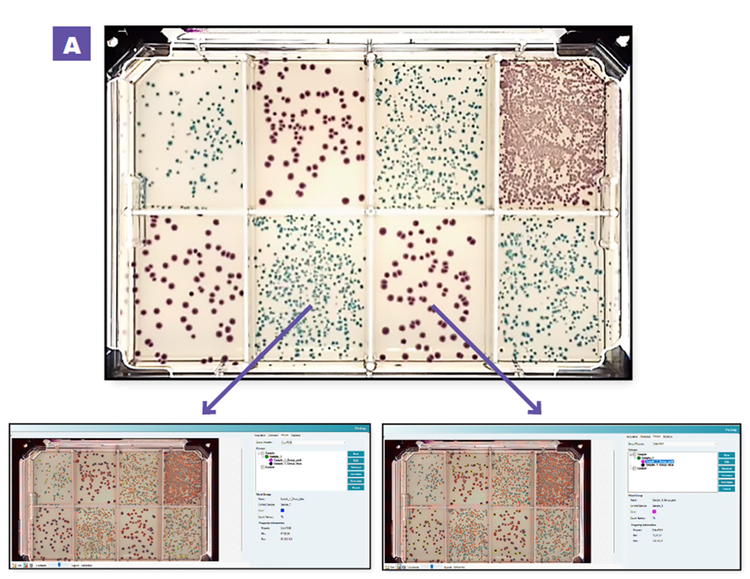
Fig. 2 Grouping of blue E.coli and pink Klebsiella aerogenes colonies plated on 8 region OmniTrays, selected using the color-based differentiation employed by the QPix FLEX software.
Why Fast, Under-an-Hour Onboarding Matters
Ease of use is not a “nice to have” in research environments; it is a reproducibility feature.
Automation systems built on unnecessary complexity are not only hard to operate, but they also present significant challenges when troubleshooting issues. The real value of automation emerges only when the system is designed with user accessibility in mind. When ease of use is prioritized, automation becomes a practical tool that enhances productivity and supports consistent, reliable results.
The QPix FLEX workcell has been designed with a guided, operator‑centric interface to ensure new students, technicians, or rotating team members can contribute efficiently and promptly.
Under‑one‑hour onboarding enables:
- Reduced dependence on a single expert operator
- Stronger inter‑operator reproducibility
- Throughput that scales by plates, not headcount
- More time spent on experimental design and analysis
This is where automation quietly strengthens data integrity: at the exact moment strains are selected and committed to downstream assays.
Consider a common microbiome workflow: building a strain library from complex gut samples to test functional hypotheses across many donors.
Manual workflows introduce variability at every step: selection differences, labeling risk, and limited throughput.
With the QPix FLEX system, teams gain:
- Imaging‑driven, consistent selection with expert oversight
- A streamlined plate‑to‑archive workflow
- Traceability from source plate to destination format
The difference is not just speed, it’s confidence.
Conclusion: The Infrastructure Shift Behind Precision Biology
Microbiome science has entered a strain‑resolved era. When organisms that share a species name behave differently, workflows must protect selection consistency and provenance at every step.
The shift toward automation is not about replacing scientists. It is about protecting what scientists discover.
Precision biology only works when the workflow is just as precise.
Key Takeaways
- Strain‑level precision is now essential for translational relevance
- Metagenomics identifies candidates; culture confirms function
- Manual colony workflows introduce silent variability
- Human‑in‑the‑loop automation preserves expertise while enforcing consistency
- The QPix FLEX integrated workcell standardizes critical microbial workflow steps in a compact platform
- Automation shifts time from repetition to discovery
Request a Workflow Consult to Learn More
If your science demands strain‑level confidence, your workflow should deliver it.
Request a workflow consult to review your current microbial process—from plating and imaging to picking, re‑arraying, and archiving—and identify where variability or bottlenecks may be limiting discovery.