
Application Note
Screening of 3D spheroids using a robust, sensitive, next-generation high-content imager
- Achieve exceptional image quality with improved signal-to-noise and robust autofocus in 3D spheroid models using the next generation imager, the ImageXpress HCS.ai High-Content Screening System
- Accurately quantify dose dependent effects on apoptosis and spheroid morphology using deep learning segmentation or traditional analysis tools
Zhisong Tong, Angeline Lim | Molecular Devices, LLC
Introduction
Image-based high-content screening (HCS) is a potent drug discovery strategy that characterizes drug effects through the quantification of image-based features that describe cellular changes within or among cell populations. With the rising interest in 3D biological models, there is an increasing demand for an imaging platform that not only acquires high-throughput, high-quality images in 3D samples, but also enables complex image analysis.
3D spheroid models are widely used in cancer research due to their ability to better replicate the in vivo tissue architecture, gene expression and metabolic profile of tumors compared to traditional 2D culture models1, 2. Studies have shown that 3D cultures exhibit several in vivo tumor features such as cell-cell/ECM interactions, drug penetrance, dose response and resistance7 . Similar to solid tumors, spheroids consist of an outer cell proliferation zone, followed by a middle layer of quiescent cells and an inner necrotic core where cells are exposed to hypoxic conditions. These similarities suggest that 3D models compared to 2D monolayer culture would provide a more accurate assessment of drug safety and facilitate the successful identification of anti-cancer compounds.
A popular method to generate spheroids uses plates with round U-bottom wells coated with ultra low attachment (ULA) materials. This scaffold-free approach offers a relatively simple workflow where cells seeded in each well form a spheroid through spontaneous self-aggregation. However, imaging cells in a U-bottom plate can be challenging due to issues with optical focus and image quality at depth.
To ease some of the challenges associated with imaging of spheroids, we developed a high-content imaging instrument optimized for automated acquisition of 3D models. The autofocus has a dedicated light source to detect reflection from the plate bottom, improved sensor and fast readout. Together with proprietary autofocus algorithms, the ImageXpress® HCS.ai System handles a variety of labware types including U-shape wells.
Here, we demonstrate the instrument’s performance using a spheroid-based assay and analysis methods (Figure 1). HCT116, human colorectal carcinoma cells were seeded in a 384 well plate, dosed with a small library of compounds, stained with fluorescent dyes and imaged on the ImageXpress HCS.ai System. We found over 2-fold improvement in image quality in spheroids (compared to other similar imager). Overall, the ImageXpress HCS.ai System renders fast, high-throughput acquisition and high-quality images using an intuitive software interface. These combined improvements to acquisition speed and image quality enable the use of a variety of assays and models for both research and drug screening applications.
Methods
Cell culture and staining
Spheroids were grown using HCT116 colorectal cancer cell line (ATCC) using McCoy media supplemented with 10% FBS (Sigma). 3D spheroids were formed by seeding 5,000 cells per well into the 384 well U-bottom ultra-low attachment plates (Corning, PN 4516) and cultured for 48 hours. Spheroids were treated with selected compounds for 48 hours and then stained using the EarlyTox™ Caspase-3/7 assay kit (1:100 dilution, overnight incubation) (Molecular Devices, R8346), Hoechst 33342 (1:500 for 2 hours) and ethidium homodimer (2 µM, 2 hours). Spheroids were washed and fixed in 4% paraformaldyhyde post staining.
Spheroids were dosed with the following compounds (max concentration), in 4-fold dilution series and in quadruplicates: 5-Fluorouracil (5FU, 1,000 µM), Adavosertib (10 µM), Chloroquine (10 µM), Cisplatin (10 µM), Trametinib (10 µM). DMSO was used as negative controls, Doxorubicin (100 µM) was used as positive controls (all compounds were from SelleckChem).
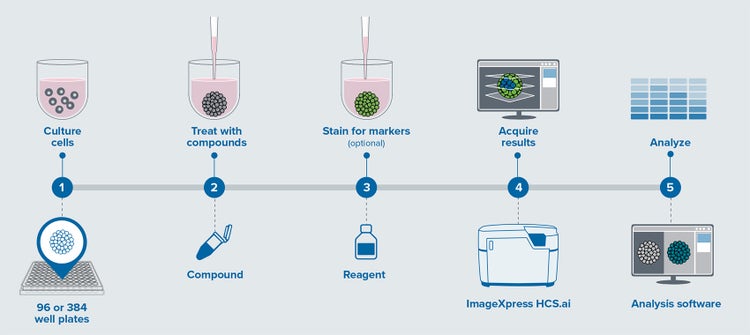
Figure 1. Workflow outlining the assay
Image acquisition and analysis
Images were acquired on the ImageXpress HCS.ai Advanced High-Content Screening System using 10X magnification, the standard confocal disk (60 µm pinhole size). Z-stack of 10 images, 10 µm apart was acquired. For each sample, maximum projection images were analyzed. Spheroid analysis was performed using the IN Carta® Image Analysis Software with the Custom Module Editor (CME). Nuclei within the spheroid were segmented using the “count nuclei objects” algorithm (using Hoechst stain). Nuclei were then defined as positive or negative for Cas3/7 (“cell scoring object” algorithm) as a measurement representing the amount of apoptosis in the spheroid. For analysis based on brightfield images, the SINAP deep learning segmentation module was used to train a model to segment spheroids. Decision-tree classifier was used to further refine the segmentation results. Measurements were exported and analyzed in Microsoft Excel.
Results
Robust autofocus for U bottom spheroid plates
Reliable focus detection and stability are fundamental to the performance and reproducibility of high-throughput imaging systems. There are a variety of hardware and software-based solutions available. In general, hardware based autofocus detects the location and surfaces of labware and then applies a relative offset. The ImageXpress HCS.ai System uses a dedicated LED light source and sensor to detect surfaces such as the bottom of the imaging plate, well bottom, and bottom of well inserts. Combined with rapid multi-peak detection, robust XY stage positioning enables an automated focusing approach that is compatible with a wide range of labware—including U-shaped wells, Transwell® plates, and microscope slides.
Here, spheroids were seeded and cultured in a 384-well U-shaped bottom plate. In MetaXpress® Acquire HighContent Image Acquisition Software, plate measurement tools are available to support custom configurations for plates with an SBS footprint (Figure 2). The round-bottom plate measurement tool enables automated detection and adjustment of the A1 center, measurement of well bottom thickness and its variation, and compensation for plate inconsistencies. Users can also specify whether the plate has a segmented or continuous bottom, allowing automatic adjustment for water immersion objective lenses. Additionally, autofocus parameters can be fine-tuned by modifying the focus search range and defining the focus peak. Following automated U-bottom measurement, image acquisition was successfully achieved across all wells, with an average focus time of 0.52 seconds per well.
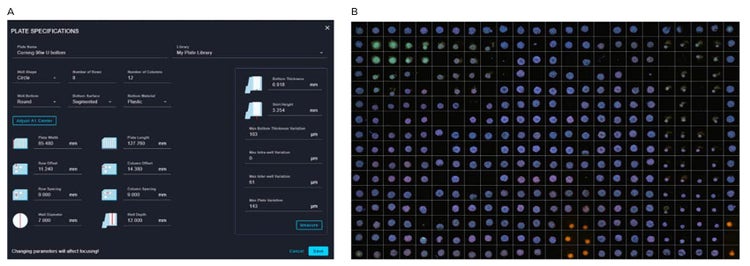
Figure 2. Robust and fast autofocus that is customizable. A) View of the plate configuration set up in MetaXpress Acquire. The automated Measure tool identifies plate bottom thickness, skirt height, inter-well variation and plate variation in Z dimension. Option to define the well bottom further (continuous or segmented) optimizes the setup for compatibility with water immersion objectives. B) Plate overview display of spheroids cultured in 384W U shape plate. Note that all spheroids are in focused. (Some spheroids were lost during handling – as shown by some empty wells).
Two-fold improvement in image quality of 3D images
The optical light path in the ImageXpress HCS.ai System was designed to maximize the signal-noise ratio (SNR). To assess the image quality of 3D structures on this system, spheroids formed in U-bottom plate were fixed and stained with a nuclei marker (Hoechst), and imaged. SNR was calculated and shown in Figure 3. On average, we achieved a signal-to-noise ratio (SNR) of 3.5—more than twice that of the legacy imager. This higher SNR significantly improved overall sensitivity, enabling the detection of at least 2× more nuclei. Additionally, the enhanced camera sensitivity reduced exposure times by approximately 50%, which is especially advantageous for dim or low-signal applications and contributes to faster acquisition times.
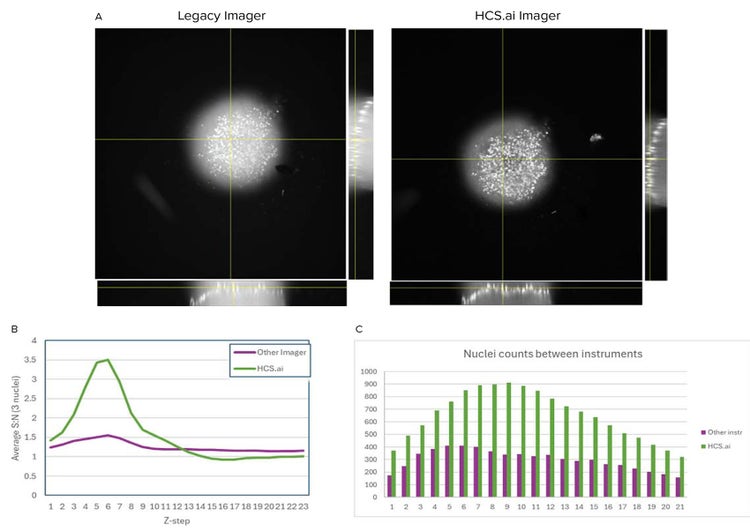
Figure 3. Evaluation of SNR in 3D samples. A) Representative spheroids (single plane at 42um, 10x) shown here with their corresponding orthogonal sections. The images are displayed with similar scaling settings. Note the improved contrast with images acquired on the HCS.ai system in comparison to the legacy instrument. B) Plot showing the average SNR of 3 nuclei in Z. Step size of each Z-plane is 6µm. C) Spheroid images were analyzed and the number of nuclei quantified in each Z-plane shown. Note that the number of detectable nuclei is at least twice that of the legacy imager.
Compound-treated HCT116 spheroids show dose dependent effect on apoptosis
HCT116 spheroids were treated with compounds and then assayed for activation of apoptosis. Apoptosis is a type of programmed cell death that involves a series of molecular steps, including activation of caspases (capase 3 and 7), leading to cell shrinkage, membrane blebbing, and DNA fragmentation. The EarlyTox Capase3/7 (Cas3/7) kit is generally recommended for use in a microplate reader but with some optimization, we find that the reagent is also compatible with image based assays. Fixed spheroids were imaged on the ImageXpress HCS.ai System capturing images in the DAPI (Hoechst stain for nuclei), FITC (stain indicating caspase activation), TRITC (ethidium homodimer stain for cell death) and in brightfield (Figure 4). For image analysis, the total number of Caspase-3/7–positive nuclei and all Hoechst-positive nuclei were quantified using an intensity-based approach in the IN Carta® Image Analysis Software. The proportion of Caspase-3/7–positive nuclei relative to total nuclei was used to evaluate compound-induced apoptosis in the spheroids. Spheroids treated with 5-FU, Adavosertib, and Trametinib exhibited high levels of apoptosis, showing a dose-dependent response compared to untreated controls.
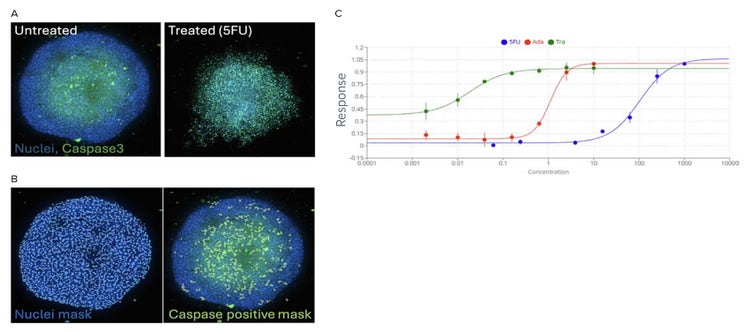
Figure 4. A) Spheroid images were collected with Z-stacking in 10X. Representative images shown here (Maximum projection). B) Analysis was carried out in IN Carta CME. Segmentation mask from analysis shown here. C) Dose response curve (caspase positive cells/total number of cells). EC50: 5FU (Fluorouracil) 103 µM; Adavosertib 1.13 µM; Trametinib 0.018 µM.
Compound-treated HCT116 spheroids show dose dependent effects on morphology
Image analysis follows the general steps of image preprocessing, segmentation and then post-processing. Image segmentation is one of the most important and challenging steps in bioimage analysis – the ability to partition an image into biologically relevant structures such as nuclei, cell or other subcellular structures allows for objective quantification. Conventional segmentation is largely dependent on the pixel intensities representing the biology of interest, which makes it challenging to use in cases where the perturbation/treatment affects the dye intensity. For instance, in this assay, spheroids treated with Doxorubicin show very little signal in the DAPI channel, rendering it unsuitable for segmentation set-up (Figure 5A). To overcome this issue, we used images from the brightfield channel with an Artificial Intelligence (AI)–based approach to segment the spheroids. The highly variable nature of brightfield images makes it difficult to segment objects using a fixed set of input parameters. To effectively identify spheroids, the SINAP (Segmentation Is Not A Problem) deep learning module in IN Carta® was used (Figure 5). A model was trained using approximately 20 annotated images. To further refine the segmentation results, SINAP was paired with a decision tree classifier to eliminate debris. Spheroid size, morphology, and fluorescence intensities in the DAPI, FITC, and TRITC channels were then measured to evaluate compound effects.
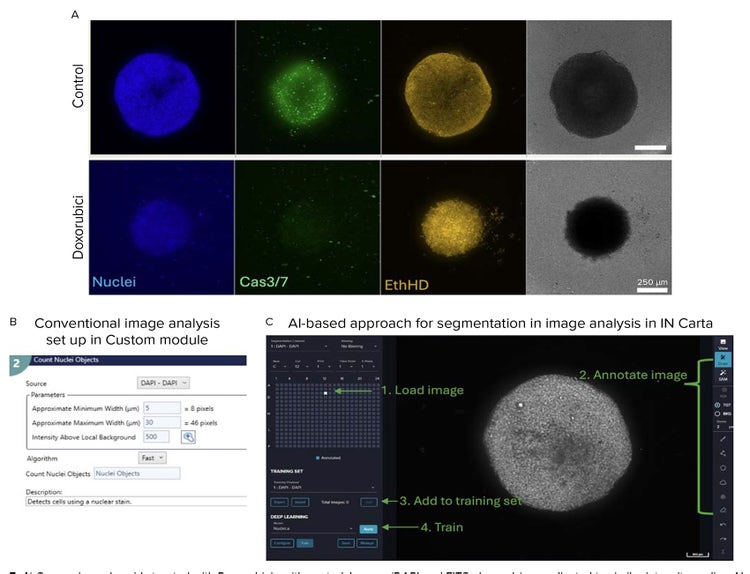
Figure 5. A) Comparing spheroids treated with Doxorubicin with control. Images (DAPI and FITC channels) are adjusted to similar intensity scaling. Note the very low signal in the nuclei stain (Blue) DAPI channel, making it unsuitable for segmenting nuclei. Scalr bar = 250 µm. B) Comparing the non-AI and AI based approach in image segmentation. Conventional image analysis strings together a series of building blocks to correctly create a segmentation mask from which measurements are extracted. Shown here is an example of one of the steps in CME. The Count Nuclei objects requires user to enter some parameters to help define the object to interest. The challenge here is to find a set of parameters that is suitable for the entire experiment. With AI based approach, the user supplies a set of annotated images and fed into a neural network which ‘learns’ how to segment the object of interest. Shown here is the SINAP interface in IN Carta. 1. Images are loaded in the main panel. 2. Users select one of the annotation tools on the right to mark the object of interest. 3. Annotated image is saved to the training set. Steps 1–3 are repeated until a desired number of images are in the training set. 4. Training. The training produced a model which is then saved and used in image analysis
5FU, adavosertib and trametinib treated spheroids led to increased Cas3/7 staining suggesting increased apoptosis activity compared to control spheroids (Figure 6B). These observations are consistent with studies that showed 5FU, adavosertib and trametinib induces apoptosis3, 4, 5. Doxorubicin treated spheroids showed high levels of EthHD staining, but almost undetectable levels of cas3/7 signal that suggests a non-apoptotic, cell death pathway. Indeed, doxorubicin has been reported to induce cell death via mitotic catastrophe, in which membrane integrity is lost in the early stages6.
Effects of compounds on spheroid size were quantified (Figure 6C). No significant change in size was observed in chloroquine and cisplatin treated spheroids. Trametinib treatment (all doses) resulted in spheroid size two times smaller than the negative controls. 5FU and adavosertib treatment showed reduced spheroid sizes and increased apoptosis in a dose dependent manner. Taken together, the data suggests that the increased apoptosis observed in 5-FU– and Adavosertib-treated spheroids likely contributed to the reduction in spheroid size, whereas Trametinib appears to have a direct and/or more pronounced effect on suppressing cell growth.
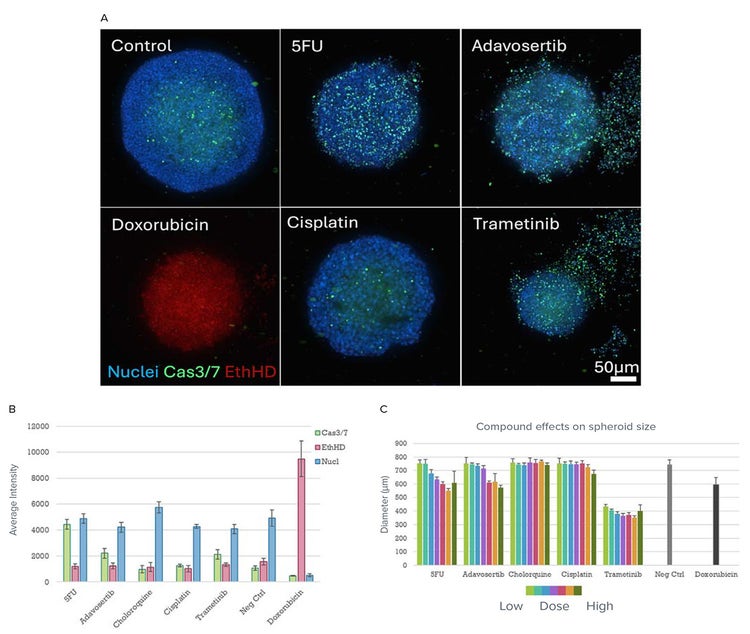
Figure 6. A) Representative spheroid images from treated and untreated groups (Maximum projection), scale bar = 50 µm. Note the change in spheroid structure and differential Cas3/7 between the different treatments. Doxorubicin in particular showed high levels of cell death. B) Average intensities per spheroid were quantified. Graph shows results of compound treatment at the maximum dose. Doxorubicin treatment resulted in high signal intensity in the Tritc channel. 5FU, adavosertib and trametinib treatments resulted in more Fitc signal (cas3/7) compared to negative controls. C) Effect of compounds on spheroid sizes was observed in some cases.
Summary
The ImageXpress® HCS.ai High-Content Screening System is a next-generation platform designed for automated high content imaging of 3D cell models. In this study, we demonstrate enhanced image quality at depth and robust autofocus performance for spheroids cultured in U-shaped wells. Using a combination of AI-based and traditional analysis methods, we present a proof-of-concept spheroid assay that highlights the system’s capabilities. These results showcase the utility of the ImageXpress HCS.ai system as a true end-to-end solution for high-throughput image acquisition and analysis of 3D cell models.
References
- Nath, S. & Devi, G. R. Three-dimensional culture systems in cancer research: Focus on tumor spheroid model. Pharmacol. Ther. 163, 94–108 (2016).
- Santini MT, Rainaldi G, Romano R, et al. MG-63 human osteosarcoma cells grown in monolayer and as three-dimensional tumor spheroids present a different metabolic profile: a (1)H NMR study. FEBS Lett. 2004;557(1–3):148-154.
- Zhang JT, Zhou WL, He C, Liu T, Li CY, Wang L. 5-Fluorouracil induces apoptosis of colorectal cancer cells. Genet Mol Res. 2016;15(1):15017326
- Roering P, Siddiqui A, Heuser VD, et al. Effects of Wee1 inhibitor adavosertib on patient-derived high-grade serous ovarian cancer cells are multiple and independent of homologous recombination status. Front Oncol. 2022;12:954430.
- drugbank.com/drugs/DB08911Trametinib: Uses, Interactions, Mechanism of Action | DrugBank Online
- Eom, YW., Kim, M., Park, S. et al. Two distinct modes of cell death induced by doxorubicin: apoptosis and cell death through mitotic catastrophe accompanied by senescence-like phenotype. Oncogene 24, 4765–4777 (2005)
- Fischbach C, Chen R, Matsumoto T, et al. Engineering tumors with 3D scaffolds. Nat Methods. 2007;4(10):855-860.