
Application Note
Machine-learning-enabled, fully automated assay for compound toxicity evaluation using 3D mouse intestinal organoids
- Consistency and scalability: Automated workflows for culturing intestinal organoids ensures consistency and scalability for compound toxicity testing.
- Enhanced imaging: High-resolution, confocal imaging of organoids captures phenotypic changes across organoids with enhanced speed and clarity.
- Accurate data analysis: Machine learning tools facilitate image analysis enabling robust classification of organoid phenotypes and providing sensitive and accurate quantification of toxicity effects.
Oksana Sirenko, Krishna Macha, Auguste Kersulyte,
Zhisong Tong, Misha Bashkurov | Molecular Devices, LLC
Introduction
Three-dimentional (3D) organoid models are becoming increasingly popular in research and drug discovery due to their ability to better represent the complexity of tissue biology. In contrast to traditional 2D cell models, organoids contain several types of cells representing the tissue, organization, and structure, and resemble at least some aspects of tissue functionality. Organoid models provide a useful tool for studying tissue development, testing drug candidates, or toxicity evaluation. However, the practical adoption of organoid models is still limited due to the complexity of protocols and difficulties when trying to scale up production. In this application note, we describe an automated compound-testing protocol and imaging methods for evaluating toxicity effects using mouse intestinal organoids.
Mouse intestinal organoids are a valuable model for understanding species to human translation. Animal species organoids provide a valid approach for modeling translational efficacy and safety between in vivo data and human in vitro data as the industry transitions to a reduced dependency on animal models as recommended in the recent FDA announcement.1
Instrumentation
Organoids were cultured, passaged, and expanded in Matrigel domes within 24-well plates using the CellXpress.ai® Automated Cell Culture System. Media changes and transmitted light (TL) imaging were automatically performed every 24 hours to monitor organoid growth. For compound screening, organoids were automatically seeded into 96-well plates and treated with 10 anti-cancer drugs known to cause toxicity to intestinal cells.
To evaluate toxicity-induced phenotypic changes, we utilized the ImageXpress® HCS.ai high-content screening system (Molecular Devices). This advanced imaging platform, equipped with spinning disk confocal optics, offers enhanced speed, robust autofocus, and an optimized optical path, enabling higher throughput and improved signal-to-noise ratio. Post-treatment, organoids were stained with dyes marking nuclei, mitochondria, and cytoskeletal integrity. Imaging was performed with the confocal option at 10X magnification, capturing Z-stacks for comprehensive 3D analysis.
Images were analyzed using the machine learning enabled IN Carta® Image Analysis Software. Organoids were segmented, and individual cells were resolved based on nuclear staining. Multi-parametric feature extraction enables quantification of concentration dependent phenotypic changes across various markers. These features were processed using the Phenoglyphs™ Software Module, a machine-learning classifier that first used unsupervised learning to identify phenotype classes automatically, followed by supervised training to differentiate affected from unaffected organoids. This AI-driven approach enables automated toxicity assessment, reduces manual processing, and enhances assay scalability and reproducibility, making it highly suitable for efficient compound screening in 3D organoid models.
Integrating assay automation with high-content imaging and artificial intelligence (AI)-based analysis further enhances the productivity and scalability of complex 3D assays.
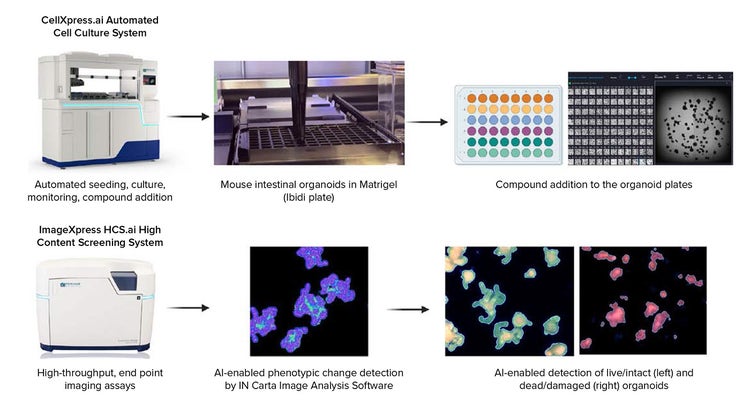
Figure 1. Workflow for drug screening in mouse intestinal organoids. Organoids were seeded into 96-well IBIDI plates using the CellXpress.ai system, monitored by transmitted light imaging every 24 hours, treated with anti-cancer compounds on Day 2, and live-imaged on Day 5 using the ImageXpress HCS.ai system with Hoechst, Mito Tracker Orange, and Calcein AM staining. Endpoint analysis was performed with AI-driven phenotypic profiling via IN Carta, followed by fixation and phalloidin staining for cytoskeletal imaging.
Methods
Automated organoid culture and compound screening assay using 3D organoids
Primary mouse intestinal organoids (StemCell Technologies, Vancouver, Canada, Catalog # 70931) were cultured in Matrigel domes using IntestiCult™ Organoid Growth medium ( Vancouver, Canada, Catalog # 06005), following the manufacturer’s protocols. During culture, automated media exchanges and transmitted light imaging were performed every 24 hours. The organoids self-organized and developed as expected, forming structures characteristic of their phenotype, including a polarized epithelium with all expected mature intestinal cell types and distinct crypt-like domains. For the toxicity evaluation assay, organoids were seeded into 96-well IBIDI (IBIDI, Gräfelfing, Germany, Cat. No: 89626, µ-Plate 96 Well Square) plates with 15 μL of 50% Matrigel per dome, each containing approximately 50 organoids. Plating was carried out using the CellXpress.ai system. Compounds were added after 48 hours of initial culture. Treatments were applied in a 7-point, 5-fold serial dilution series, starting at 100 μM for all compounds except staurosporine, which started at 10 μM. Organoids were exposed to test compounds for three days. Following treatment, organoids were stained with Hoechst (2 μg/mL) and MitoTracker Orange (500 nM), Calcein AM (2 μM), then fixed with 4% formaldehyde and further stained with Alexa Fluor 488 Phalloidin (5 μM) in the presence of 0.05% Triton X-100. All drugs sourced from Tocris Bioscience, and dyes were sourced from Thermo Scientific. Note: The addition of staining solutions was performed automatically, but using 4% formaldehyde is typically not recommended for liquid handlers.
Imaging organoids
Organoids were imaged using the ImageXpress HCS.ai system with confocal option (60’ µm pinhole) in three fluorescent channels: DAPI, FITC, TRITC, and 10X magnification. 9 sites (3x3) per well were taken at 10X magnification to cover the entire dome area. Additional images were taken using 4X magnification; in this case, 4 tiled images were used to cover the organoid dome area. Z-stacks of 16 images were taken at 8 μm intervals, covering a z-range of 160 μm. Maximum projection 2D images were used for analysis.
High-content image analysis
Image analysis was completed using 2D maximum projection images using the IN Carta software. Within the IN Carta software, the Custom Module Editor (CME) tool was used to create a multi-step protocol that defined organoids as “blobs” using the DAPI channel (nuclear stain). The number of organoids, average organoid area, and average organoid fluorescent intensities for DAPI (Hoechst stain), FITC (Alexa488 Phalloidin), and TRITC (MitoTracker) were measured. First, a pre-processing of images was done with a Gaussian filter used to blur the Hoechst signal to facilitate the segmentation of organoids. Next, nuclei were segmented and used to define cells. Cells were then scored as positive or negative depending on the signal intensities for Phalloidin (actin cytoskeleton) or MitoTracker (mitochondria). Thresholds for positive and negative cell scoring were set empirically using control (untreated) samples and samples treated with a toxic compound. Cells that were scored positive for actin or mitochondria were defined as having an intact cytoskeleton or intact mitochondria, respectively. Positive and negative cells per organoid were counted, and the average area and average intensity of positive cells were measured. After analysis, concentration dependencies for different readouts were plotted as a 4-parametric curve fit (for 0.06-100uM concentration range) to calculate EC50s for compound toxicity effects. SoftMaxPro Software (Molecular Devices) was used for the curve fit and calculations of EC50s.
Using Phenoglyphs for organoid classification
After analysis and feature extraction was performed by either CME or by Flexi-Protocol applications, measurements were further processed either for evaluation of individual readouts, or for classification via Phenoglyphs. The classification process using Phenoglyphs involved first unsupervised, automated clustering of organoids into up to 20 distinct phenotypes. Then we used supervised learning by defining manually selected phenotypes of organoids. After manual reassigning classes, training processes were applied with typically several iterations. The selection of Live/ Dead organoid classes, or Live, Cytostatic, and Cytotoxic classes, was successfully used for the classification of all organoids into those few classes. Classification analysis data (e.g., % of Live organoids) were used to define IC50s for compound effects.
Results
Automated growth, monitoring, and compound treatment of 3D intestinal organoids
A fully automated toxicity screening workflow for intestinal organoids was developed using the CellXpress.ai system for 3D culture and compound treatment, while the endpoint assay was performed by the ImageXpress HCS. ai system using high-content confocal imaging and AI-powered phenotypic analysis. Figure 1 shows the workflow of the assay protocol.
The CellXpress.ai system enables full automation of complex biological assays, including automation of organoid protocols. The system contains a liquid handling component, an automated incubator, an embedded imager, also automated tools providing transport plates from the incubator to the imager or liquid handler and back. The system is able to perform all tasks necessary for cell culture, including cell plating, media exchanges, passaging, monitoring by imaging, and automated decision making based on imaging data. Consumables stored on the deck, as well as media containers, enable independent functioning of the system without supervision. The CellXpress.ai system software manages the entire system with a user-friendly interface and workflows that allow scientists to create and modify multiple protocols from predesigned steps (Figures 2 and 3).
We developed and optimized the protocols for automated seeding and compound treatment of organoids in Matrigel domes. The CellXpress.ai system enabled automated seeding of organoids in Matrigel, as well as organoid culture, including media exchanges that occurred every 24 hours. TL imaging was performed every 24 hours, enabling continuous, non-invasive monitoring of organoid growth and morphology. Handling Matrigel and organoids is typically challenging, especially for process automation. Matrigel solidifies fast, domes may be variable in size and organoid distribution, which can complicate the endpoint analysis. The chilling platforms on the liquid handling deck allowed handling 50–80% Matrigel solutions without solidifying, while optimized mixing and pipetting steps allowed flexibility of settings defined not only by pipetting steps and volumes, but also the flow rates and mixing repetitions. In this protocol, we opted for using Ibidi 96-well plates that have a wider area, which simplified organoid plating and imaging. The protocol set-up user interface allows selection of desired plate formats, media, and steps of the workflow that allow building multistep protocols from pre-designed phases, like Seeding, Feeding, Compound addition, etc. Protocols can be saved, optimized, also modified at any time in the experiment. Figure 2 shows the steps for organoid Seeding and then the feeding and monitoring steps.
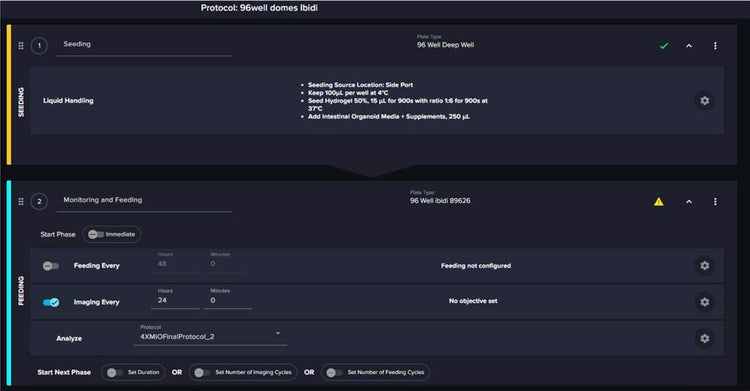
Figure 2. This figure shows a two-step protocol used in an experiment for seeding mouse intestinal organoids in 15µl Matrigel domes into 96-well IBIDI plates. After seeding, domes were polymerized at 37°C on deck and subsequently routinely monitored, capturing organoid morphology via imaging in Z-stacks at 24-hour intervals.
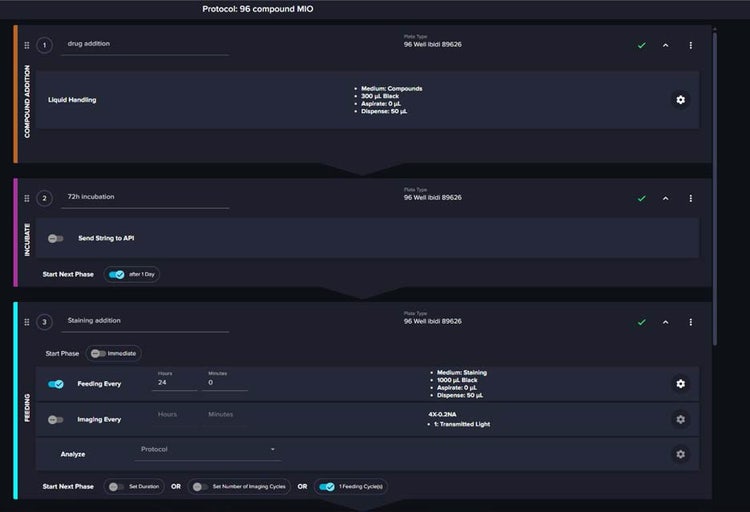
Figure 3. The CellXpress.ai system protocol continuation demonstrates a three-phase compound addition, incubation, and dye addition steps. Organoids were first treated with 50 µL of compound-containing medium. Following a 72-hour incubation, 50 µL of staining solution was added.
The CellXpress.ai system enables precise seeding of organoids at approximately 100 organoids per dome, into the 96-well IBIDI plates with 15 µL Matrigel domes per well. They were uniformly distributed across the plate (Figure 4). Throughout the culture (2–3 days), the organoids self-organized, proliferated, and developed characteristic structures consistent with their phenotype, including crypts and a functional lumen surrounded by intestinal epithelial cells.
The next phase in the protocol was compound addition into assay plates from the compound plate. Drug treatment included a three-phase automated protocol (Figure 3). First step: Compound Addition applied pre-diluted compounds from the compound plate to the organoid plates. The compound plate contained seven-point serial dilutions of eight intestinal-toxic compounds. Organoid plates were incubated with compounds for 3 days using the Incubate step of the protocol. Then, organoids were either stained live using Calcein AM, Hoechst, and MitoTracker dyes, or were fixed after the addition of Hoechst and MitoTracker, and then additionally stained with AF-488 conjugated Phalloidin. Dye solutions were added automatically using the Feeding step in the protocol.
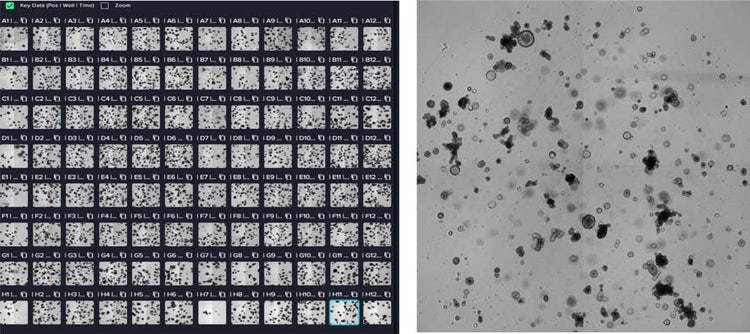
Figure 4. Figure represents a screenshot from one of the plates used for compound screening. Images were taken in transmitted light, 4X magnification.
Toxicity assessment using 3D mouse intestinal organoids
Intestinal organoids were seeded into 96-well IBIDI plates with the CellXpress.ai system. Organoids selforganized and developed crypts as expected for organoid phenotypes. After 48h in culture, organoids were treated with 10 selected anti-cancer compounds that were also added automatically, then stained and imaged as described in the Methods section.
We selected several markers for cytotoxicity assessment. Mitochondria play a critical role in cytotoxicity assessment, and mitochondrial dysfunction is often used as an indicator of cellular toxicity. The actin cytoskeleton is crucial in maintaining cell shape, motility, and intracellular transport, and disruption can indicate cellular stress or toxicity. Also, disturbances in actin dynamics can signal toxicity-induced apoptosis or necrosis. Nuclear staining is also an established marker for cytotoxicity, particularly in assays that assess cell viability, apoptosis, and necrosis.
After a 72-hour compound exposure with compounds, organoids were stained for end-point toxicity evaluation using the Feeding step. In this step, staining solution containing a mix of 3 dyes was added for one hour. Dyes were added at 5X concentration. The washing step was performed using PBS (1/2 of the volumes were exchanged). The pipetting step was set at a low speed of liquid flow (20 µL/sec), and the pipette tip was set 4 µm above the bottom. Organoids were stained with a mix of three dyes: Hoechst (nuclei), MitoTracker Orange (mitochondria), and Alexa-488 Phalloidin (cytoskeleton integrity). Importantly, the Matrigel and organoids allow drugs and dyes penetration, but the processes takes longer than for 2D culture. We used higher concentrations of dyes that are typically used for 2D culture (approximately 2X higher) and allowed at least 2 hours for staining. Imaging was conducted using the ImageXpress HCS.ai system with a 10X confocal objective. Z-stacks of 15 optical sections at 8 µm intervals were captured to cover ~120 µm in depth, followed by using 2D maximum projection images for analysis.
Figure 5 shows a variety of phenotypic changes caused by compounds. The number of compounds, including idarubicin, mitomycin, staurosporine, and doxorubicin, caused a notable disruption of the actin cytoskeleton, which can be noted by a decrease in the phalloidin staining intensity. Interestingly, while some compounds preserved organoid shape, some have caused the disintegration of organoids. Cisplatin, cytarabine, and etoposide did not cause a strong decrease in actin or mitochondria stains, but organoid shapes were significantly affected: crypts were decreased, and overall sizes of organoids (areas) were reduced. Staurosporine, doxorubicin, and idarubicin also caused a decrease in the nuclear intensity staining, consistent with the fact that those compounds target DNA-replication machinery
To quantify phenotypic effects of compounds, we used high-content imaging, a powerful method widely used in drug discovery that characterizes compound effects through the quantification of image-based features that describe cellular changes within cell populations.
Green – AF488 Phalloidin
(actin, cytoskeleton integrity)
Red – MitoTracker orange
(viability, mitochondria integrity)
Blue – Hoechst nuclear stain
(DNA content)
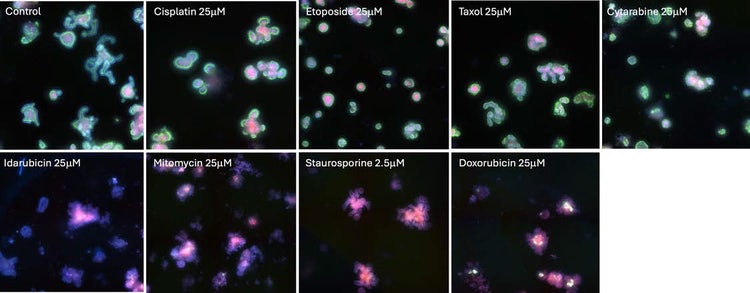
Figure 5. Intestinal organoids were treated with cytotoxic compounds for 72h, with 5X dilutions, 0–100 µM concentration range, in triplicate. Then stained with Hoechst, MitoTracker, and AF488 Phalloidin. Changes in morphology and viability were measured by High Content Imaging. Organoids were imaged using the confocal option (60” disk) of the HSC.ai instrument with 10X magnification. A Z-stack of 21 confocal images was taken 8 μm apart, covering approximately 160 μm, then maximum projection images were used for analysis.
Image analysis and machine learning based classification of compound toxicity effects
High-content imaging and analysis enables quantification of the number of organoids in the dome and measures the organoid size (area) and fluorescent intensities with different markers. In addition, it allowed us to identify individual cells and score those cells as positive or negative for individual markers.
Organoid image analysis was performed using the IN Carta software, which provides tools for feature extraction from images and incorporates machine learning-based phenotypic classification through Phenoglyphs.
First, we applied the Custom Module Editor that identified organoids using the DAPI channel (nuclear stain). The number of organoids, average and total organoid areas, and average organoid fluorescent intensities for DAPI (Hoechst stain), FITC (Alexa488 Phalloidin), and TRITC (MitoTracker) were measured. A Gaussian filter was applied as a pre-processing step to blur the Hoechst signal to improve the segmentation of organoid objects. Next, nuclei were segmented to mark individual cells, and then cell boundaries were identified via phalloidin staining. Cells were scored as positive or negative depending on the signal intensities for Phalloidin (actin cytoskeleton) or MitoTracker (mitochondria). Thresholds for positive and negative cell scoring were set empirically using control (untreated) samples and samples treated with a toxic compound. Cells that were scored positive or negative for phalloidin or mitochondria were defined as intact (live) or damaged, respectively. Then the positive and negative cells per organoid were counted, and the average areas and average intensities for positive cells were measured. In addition, a number of other measurements related to intensity distribution, linear measurements, or distances were extracted. After analysis, concentration dependencies for different readouts were plotted as a 4-parametric curve fit (for 0.06-100µM concentration range) to calculate EC50s for compound toxicity effects. Figure 8 shows the concentration-dependency of the total live cell area for cells in organoids defined as positive for phalloidin staining. Figure 8 shows concentration-dependence on nuclear intensity. Similar plots were obtained for mitochondria (not shown) and other readouts. Notably, EC50s for various single readouts are typically not matching exactly, depending on the mechanism of action. For example, EC50 for doxorubicin was lower for nuclear intensity than for cytoskeleton disruption, indicating that the mechanism of action is likely related to DNA damage, while cytoskeleton disruption is a secondary effect.
This approach measures phenotypic changes and defines effective concentrations of compounds using individual measurements. However, due to the complexity of morphological changes, compound effects cannot be evaluated by a single readout, so multi-parametric evaluation of compound effects is essential.
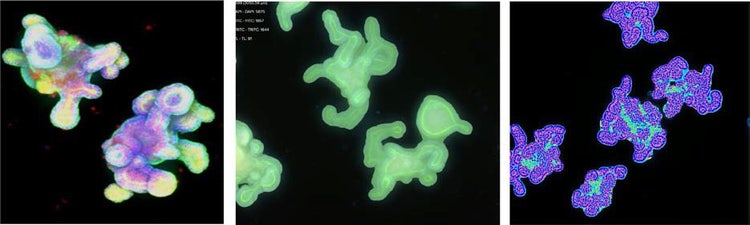
Figure 6. Organoids stained with Hoechst, MitoTracker, and AF-488 Phalloidin. Organoids were segmented and analyzed in different fluorescent channels, then individual cells were identified within organoids, analyzed, and scored as positive or negative for different markers.
Machine-learning classification by Phenoglyphs
Machine learning and AI take away time-consuming and labor-intensive tasks, providing automated reasoning, an unbiased approach for image analysis, and consistency of data.
Machine learning also provides a powerful tool to integrate multi-parametric measurements and assign organoids into different classes, depending on their unique set of measurements. Following analysis using the Custom Module Editor, 67 measurements in total were extracted from each organoid and were processed via the Phenoglyphs module. Phenoglyphs is a machine learning-based image analysis tool used for phenotypic classification of biological samples in high-content imaging workflows. It enables the identification and categorization of subtle morphological differences across cells, tissues, or organoids based on quantitative image features.
The Phenoglyphs workflow begins with unsupervised clustering, grouping organoids based on phenotypic similarity. Phenoglyphs analysis provided the first unsupervised clustering of organoids into 10 classes, using measurements provided by custom module analysis. This was followed by supervised learning, where we (users) assign biological meaning to each cluster and then trained a model to classify organoids across the dataset. We consolidated clusters into just two classes: Intact (Live) organoids, and Damaged (Dead) organoids; and after this, the training process was initiated. After the Training run was complete, we reviewed the classifications and corrected classes by manual re-assignment of images into either the Intact or Damaged categories. Several cycles of model correction and refinement were completed which shifted the classification score close to 1. As a result, we obtained an accurate classification of objects as % of Live or Dead organoids. Therefore, the machine learning -based protocol allowed for correct recognition of either intact or damaged organoids. The % Live Organoids numbers were decreasing with increasing concentrations of compounds and were showing the trends expected for the effects of the tested compounds.
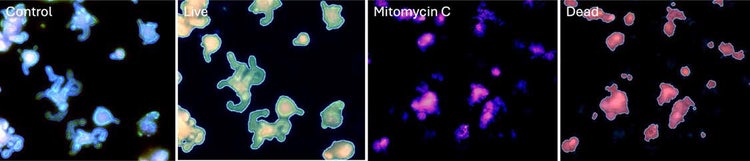
Figure 7. Intestinal organoids stained with AF–488–conjugated Phalloidin, Hoechst nuclear dye, and MitoTracker orange. Live (intact, green mask) and Dead (deteriorated, red mask) organoids after treatment with Mitomycin C, indicated by software and marked with green and red masks, respectively.
Concentration dependencies of organoids phenotypes based on AI-classification or cellular measurements
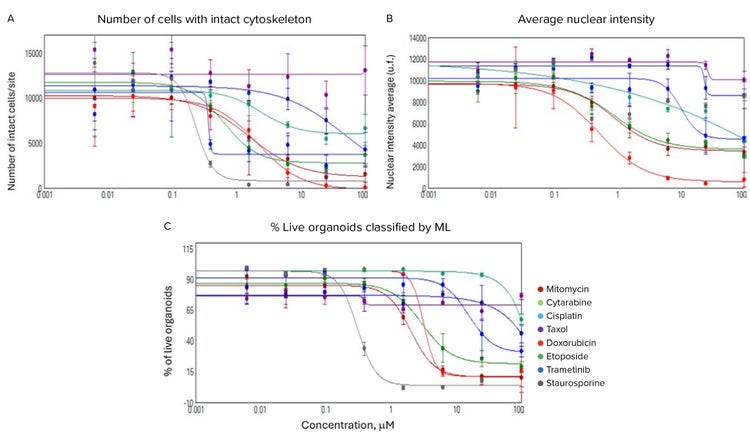
Figure 8. Concentration-dependent effects and effective concentrations for selected readouts reflecting phenotypic changes induced by toxic compounds. A. Organoids were classified by machine-learning analysis as Live (intact) or Dead (deteriorated). Plots show a concentration-dependent decrease in the percentage of live (intact) organoids with increasing drug concentrations. B & C. Plots depict concentration-dependent plots for single measurements obtained by conventional analysis (custom module editor). Note decreases in the number of cells with intact cytoskeleton (Phalloidinpositive) or reductions in nuclear intensity (Hoechst stain) with increasing drug doses. Concentration-dependencies between results obtained by classification or individual readouts vary depending on compound mechanism of action (indicated by arrows). For instance, DNA-intercalating agents cause a pronounced reduction in nuclear intensity (Hoechst stain) without immediate deterioration of organoid morphology
100* means effect was observed only at highest concentration
Table 1. IC50s were obtained from concentration dependencies from Live/Dead phenotypic classification of organoids, as well as from concentration dependencies for other readouts obtained from High Content Imaging.
EC50s determined from phenotypic classification by Machine Learning Phenoglyphs module represent changes in phenotypes of interest. i.e., the intact vs deteriorated phenotypes. This approach provides more general phenotypic profiling that is not limited to individual readouts but represents the complexity of various morphological changes. EC50s from phenotypic classification may or may not correlate with selected single readouts, depending on the mechanism of action of a compound or the phenotype selected for analysis.
Summary
This study demonstrates an automated, high-content workflow for compound toxicity screening using mouse intestinal organoids cultured in 3D Matrigel domes. The automated workflow ensures consistency in seeding and scalability for compound toxicity testing, providing scientists with reliable and reproducible results. High-resolution confocal imaging captures detailed phenotypic changes across multiple fluorescent markers, allowing scientists to gain deeper insights into tissue biology and drug effects. AI-driven analysis detects organoids and extracts multi-parametric data to quantify toxicity related alterations. Machine learning classifiers distinguish live versus damaged organoids and provide numbers to calculate IC50 values, empowering scientists to make informed decisions based on comprehensive data analysis.
The combination of automated culture, advanced imaging, and AI-based phenotypic profiling represents a powerful approach for efficient, scalable screening of drug-induced intestinal toxicity using physiologically relevant organoid models.
References
HUB Organoid Technology used herein was used under license from HUB Organoids. To use HUB Organoid Technology for commercial purposes, please contact bd@huborganoids.nl for a commercial use license.