
Application Note
Automated iPSC culture with machine learning-enabled cell passaging control and automated differentiated cell detection
- Enhanced efficiency: Machine learning-enabled automated iPSC culture significantly reduces the time and effort required for cell culture processes— allowing scientists to focus on more critical tasks and accelerate their research and development timelines.
- Scalability and flexibility: The method allows to scale up research by increasing number of plates and samples.
- Improved consistency: Leveraging advanced machine-learning algorithms ensures precise detection stem cell colonies and differentiation of iPSCs. This minimizes human error and enhances the reliability of experimental results,
- Cost savings: Automation of iPSC culture processes leads to reduced labor costs and resource utilization.
Oksana Sirenko, Krishna Macha,
Auguste Kersulyte | Molecular Devices, LLC
Introduction
Induced Pluripotent Stem Cells (iPSC) technologies are widely used for developing various human cell types and tissue modelling. iPSC can be derived from individuals carrying disease-related genetic mutations, or genetic mutations can be introduced by CRISPR technologies. The process of manually culturing and passaging iPSCs is labor-intensive, but it is suitable for process automation. The CellXpress.ai® Automated Cell Culture System automates this process from initial seeding through passaging, enabling automated plating of iPSCs, media exchanges, periodic monitoring by imaging, and an automated process for cell passaging.
The instrument consists of several components, including a liquid handler, an embedded imager, an automated incubator, and scheduling and analysis software that can enable process control based on imaging and image analysis.
The instrument provides liquid handling functionality that enables media exchanges and cell passage protocols, and imaging capabilities for periodic monitoring of cell culture. Machine-learning enabled image analysis can recognize iPSC colonies as well as differentiated areas, and based on image analysis, can make decisions about next step in the process: proceeding with iPSC passaging, ignoring wells to save time and cell culture media in case of appearance of differentiated cells, and/or simply informing the user to check in on the experiment.
In this application note, we describe a method to automate machine learning-assisted iPSC culture. Specifically, the CellXpress.ai system protocols trigger cell-passaging automatically according to user-defined values for stem cell colonies confluency. Additionally, a secondary analysis protocol identifies regions of differentiated cells, enabling either user notification or automatic exclusion of wells containing these cells. This method provides a walk-away solution for culturing iPSCs.
Methods
Automated iPSC culture
iPSC culture ATCC 201B7 (ATCC-ACS-1023)1 was performed using mTeSR Plus media (Catalog # 100-1130) and a basic workflow provided by STEMCELL Technologies, Vancouver, Canada.2 Cell passaging was performed using a cluster passaging method with ReLeSR reagent (ReLeSR, STEMCELL Technologies, Cat. # 100-0484). Briefly, cells were cultured in vitronectin-(Vitronectin XF, STEMCELL Technologies, Catalog # 100-0763) coated 6-well plates (12). The coating was done at a final concentration of 10 µg/mL, at least 1 hour before the passage, and can be stored at 4 °C for up to a week prior to passage. The cell plates were then periodically monitored by imaging every 23 hours, and media exchanges were carried out every 24 hours. Passaged at approximately 70% confluence, typically 5 days after seeding.
Image analysis
The image analysis utilized a machine learning-based protocol in the CellXpress.ai system software, which was pre-trained to recognize undifferentiated iPSC colonies. A second analysis protocol was pre-trained to specifically recognize areas of differentiated cells, which is an unwanted event during iPSC culture. Based on image analysis, decision-making rules were set in the protocol to enable both automated iPSC culture passaging and to exclude wells where differentiation was present.
Cell staining for characterization of iPSCs
After the third passage on the CellXpress.ai system, iPSCs were seeded into 6-well plates and grown to confluency. Cells were fixed with 1 mL of Fixative Solution (4% formaldehyde in DPBS, Cat. No. A24344) for 15 minutes at room temperature, followed by permeabilization with 1 mL of Permeabilization Solution S (1% saponin in DPBS, Cat. No. A24878) for 15 minutes. Blocking was performed with 1 mL of Blocking Solution (3% BSA in DPBS, Cat. No. A24353) for 30 minutes at room temperature.
Cells were incubated with primary antibodies diluted in Blocking Solution: 5 µL of anti-SSEA4 (mouse IgG3, Cat. No. A24866) and 2.5 µL of anti-OCT4 (rabbit, Cat. No. A24867) in a total volume of 1 mL for 3 hours at 4°C. Following three washes with 1 mL of 1X Wash Buffer (Cat. No. A24348); then cells were incubated with 2 µL Alexa Fluor™ 488 goat anti-mouse IgG3 and 2 µL Alexa Fluor™ 555 donkey anti-rabbit in 1 mL Blocking Solution for 1 hour at room temperature. During the final wash, NucBlue™ DAPI (Cat. No. R37606) was added and incubated for 5 minutes. All the reagents for staining are from Thermo Fisher Scientific. Imaging was performed at 10X magnification using the CellXpress.ai system.
Results
Automated method for iPSC culture and passaging
The automated protocol for iPSC culture and passaging was previously described in our Automation of iPSC culture, passaging, and expansion with the CellXpress.ai system application note. Here we describe the fully automated protocol that includes automated passage and expansion of iPSCs.
The protocol was based on the “Feeding with Passaging” phase, which included periodic media exchanges and imaging (Figure 1A, B). The media exchanges included complete removal of media from wells, washing with PBS, and re-addition of 2 mL of media into each well. After lid removal and tilting of plates on the deck of the liquid handler, media exchanges were performed with a pair of one ml pipette tips. Imaging the iPSC culture was done under 4X magnification, 6X6 sites per well. Image analysis was performed on the fly using previously defined protocols.
Passaging steps are not set periodically but can be either actively triggered within the CellXpress.ai system software by the user or triggered automatically based on image analysis. Passaging includes the following steps:
- Preparation of destination plates: Plates with coating are moved from the on-deck consumables area to the working area. The pre-coating solution is removed, and fresh media is added to the new plates. The plates are then moved to the incubator before seeding.
- Treatment of source plates: plates containing iPSCs are moved from the incubator to the deck area, treated with pre-warmed ReLeSR reagent, media added, then cells re-suspended with repeated pipetting.
- Cell seeding: destination plates are moved to the deck area; the cell suspension from step (2) is distributed to the plates from step (1) at user-defined cell volumes. The cell suspension is distributed into several sites across the well, not into just one spot, which ensures a more even distribution of cells. Plates were then shuttled across the entire liquid handling deck in a motion to ensure uniform mixing, then transported to the incubator. Important note: the pipetting volumes, liquid flow rates, pipette dispense distance to the well bottom and mixing and distribution steps are user parameters that can be optimized to ensure the best performance and efficiency.
Detection of stem cell colonies and confluency by image analysis and triggering automated iPSC passaging
While manual estimation of iPSC confluency or differentiation is often subjective and can vary between users, automated imaging and analysis help reduce this variability by providing a more objective assessment. The image analysis utilized a machine learning-based protocol that was pre-trained to recognize undifferentiated iPSC colonies. The analysis protocol provided multiple readouts, including intensity, texture, areas, and area uniformity measurements, including the confluence of iPSC colonies that can range between 0–1 (corresponding to 0%–100% confluency). A value of 0.7 (70% confluency) was initially used as a trigger for automated passaging of iPSC cells during iPSC maintenance or expansion. However, during assay optimization, we found that 0.6 was a better value for the longer-term passage protocols.
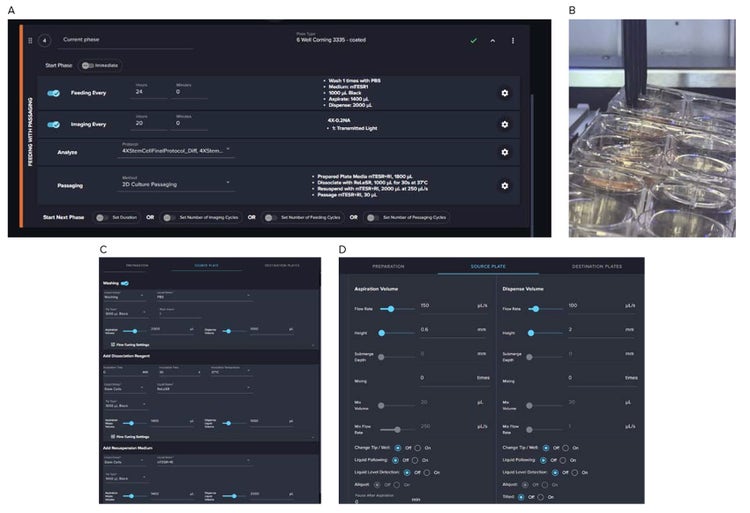
Figure 1. A. Software screenshot of the automated iPSC culture protocol that includes Feeding, Imaging, Analysis (with decision-making), and Passaging steps. B. Image of media exchange step highlighting plate tilting on the liquid handling deck of the instrument. C. Detailed steps for processing iPSC plates. D. Example of Fine-tuning steps for optimization of the protocol.
Stem cell colonies and analysis masks are used to identify stem cell areas (Figure 2A). The protocol’s decision rule was based on stem cell confluency. A “Per well” rule was set up to detect when individual wells reached a specified threshold, and to notify the user accordingly.
Notifications were sent when iPSC colonies (StemCellPatches) in a well reached 70% confluency, prompting the user to review the results and decide whether to initiate cell passaging. Cell passaging could also be triggered automatically, without user input (Figure 2B).
To trigger passaging automatically based on imaging results, a “Per plate” rule was used, where passaging was triggered once 70% of the wells on a plate reached the desired confluency. This allowed for fully automated iPSC culture management (Figure 2D).
Importantly, decision rules and trigger thresholds can be adjusted during the experiment. For instance, if passaging is not triggered due to a threshold being set too high, users can either trigger it manually or lower the threshold. As an example, the initial confluency threshold of 0.7 was later reduced to 0.6 after visually reviewing culture images (Figure 2C).
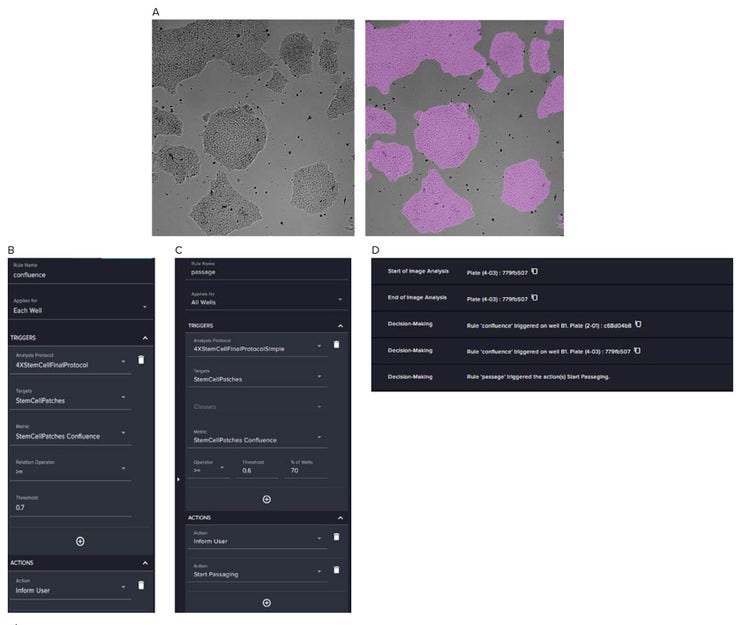
Figure 2. A. Images of iPSC colonies with image analysis masks identifying stem cell areas (in pink). B. Decision-making rule defining a per-well decision to notify the user when confluency in an individual well reaches 70% (0.7). C. Decision-making rule defining a per-plate decision to notify the user and proceed with passaging when 70% of wells reach the confluency threshold. D. Screenshot of the system log showing the trigger of the passaging step.
Cells were kept in culture and tracked for their confluence through a stem cell analysis protocol over the course of culture (Figure 3A). After several weeks in culture and passaging, cells were fixed and assessed for pluripotency markers. Immunofluorescence staining demonstrated expression of SSEA4, a surface glycolipid marker indicative of undifferentiated pluripotent stem cells, and nuclear localization of OCT4, a transcription factor critical for maintaining stem cell self-renewal and pluripotency.
The presence of both markers confirms that the cells retained their undifferentiated state and developmental potential. DAPI staining revealed intact nuclei and high cell density across colonies. Imaging performed on the ImageXpress® HCS.ai High-Content Screening System at 10X magnification showed well-defined, densely packed colonies with uniform and specific marker expression (Figure 3B).
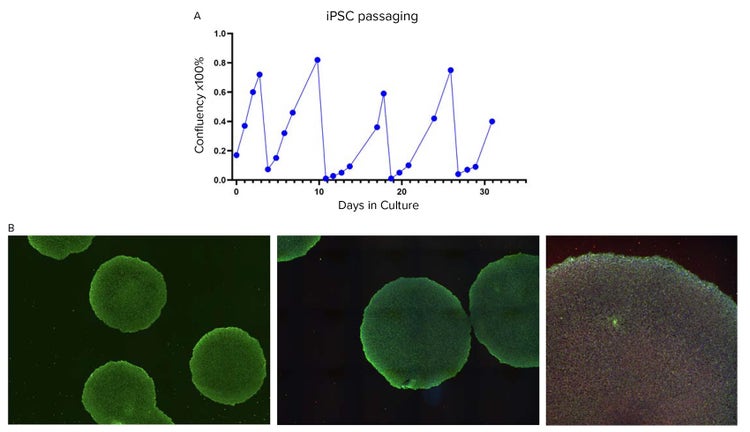
Figure 3. A. Confluency graph of iPSCs during automated culture and passaging on the CellXpress.ai system. B. Immunofluorescence staining of iPSC colonies post-third passage, showing expression of pluripotency markers: SSEA4 (green), a surface marker, and OCT4 (red), a nuclear transcription factor; nuclei were counterstained with DAPI (blue). Images were taken and montaged during acquisition at 10X magnification using the ImageXpress HCS.ai system
Image analysis provides quality control and detection of differentiated areas. Wells with present differentiation were excluded/ ignored by the automated decision.
A second analysis protocol was trained to specifically recognize areas of differentiated cells, which is an unwanted event during the iPSC culture. This analysis was developed in IN Carta® Image Analysis Software using a pre-trained model (in SINAP) that specifically recognized differentiated cells and patches of differentiated cells and marked those with a mask covering differentiated cell areas (Figure 4A).
Image analysis monitored iPSC growth and morphology and triggered a well-ignoring action when the userdefined criteria (confluency of differentiated cell patches) were met. We selected the value 0.1 (10% confluency) of area covered with differentiated cells as a trigger to ignore the corresponding well (Figure 4 B and C). Options to both notify the user and automatically exclude wells from further culture were selected. Once the user-defined well-threshold of 0.1 (10% confluency of differentiated areas) was reached, those wells were excluded from further processing, plus notifications were sent to the user. Figure 4E shows plates with wells ignored (greyed out). During the passaging of plates with differentiated/ignored wells, the passaging pattern was automatically re-adjusted to avoid empty wells. For example, if wells A1 and B1 of 6 well plates are ignored, the remaining wells were passaged into a reduced number of plates.
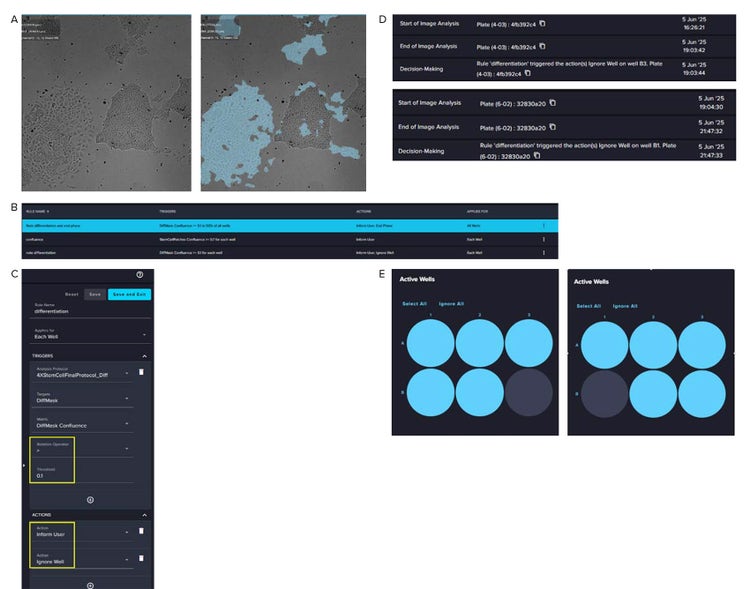
Figure 4. A. Images of differentiated patches and analysis masks covering differentiated areas (in blue). B. Decision-making rules are defined in the Analysis section. C. Decision-making rule settings for flagging and exclusion of wells with differentiation present. D. Even log showing decisions to exclude indicated wells. Every well displaying patch differentiated cells reaching equal or greater than 0.1 (10%) of confluency was recognized by the CellXpress.ai system software. A user-notification email was sent, and the wells were excluded (Ignored) from further culture of processing (imaging, feeding, and passaging). E. Plate maps show the active wells. Excluded corresponding wells have been grayed out.
Summary
Culturing iPSCs is a labor-intensive process that requires expertise and close attention to detail. In this study, we demonstrated a fully automated iPSC culture workflow using imaging-based analysis and automated decision-making for passaging. This approach reduces manual workloads and enables hands-free maintenance and expansion of iPSC cultures. In addition, imaging-based decision-making helps to identify wells showing signs of differentiation, which when excluded from downstream processing, helps ensure the purity of cells and preserves reagents.
References
- KYOU-DXR0109B Human Induced Pluripotent Stem (IPS) Cells [201B7] (ATCC ACS-1023)
- Takahashi K, et.al. Induction of pluripotent stem cells from adult human fibroblasts by defined factors. Cell 131(5): 861–872, 2007. PubMed: 18035408