
Application Note
PMT gain adjustment for an extended dynamic range with fluorescence and luminescence measurement
- Save time: No dilution needed
- Peace of mind: No result readjustments depending on the PMT Gain needed
- Easy to use and full automatically
- Results are always comparable and reproduceable over time
Introduction
Microplate readers and spectrophotometers uses a PhotoMultiplier Tube (PMT) to detect a fluorescence and luminescence signal. During these processes, photons are emitted at specific wavelengths. The PMT first converts photons into electrons and then amplifies the signal so it can be detected and expressed in Relative Fluorescence/ Luminescence Unit (RFU, RLU).
This Technical Note is focused on PMT with xenon flash lamp-based microplate readers and show our unique patented AutoPMT™ functionality for data normalization.
How does PMT work?
The PMT counts incoming photons hitting the photocathode and convert them into electrons. First, the electrons are deflected to hit the primary dynode and are then amplified over a series of subsequent dynodes (Figure 1). The number of generated electrons increases with the voltage or gain applied to the PMT and is proportional to the number of incoming photons.
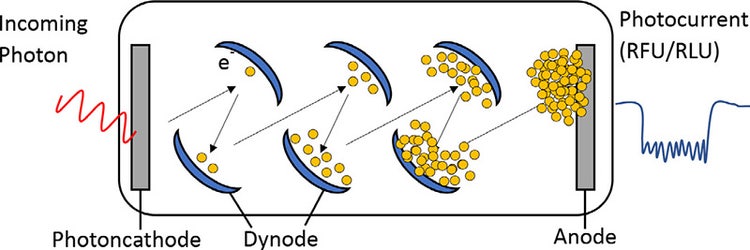
Figure 1. Diagram of a photomultiplier tube (PMT). PMT convert photons into electrons and amplify the signal.
Material and methods
- 96-well plate
- 10 μM fluorescein in 1 x phosphate-buffered saline (PBS)
- SpectraMax M5e Multi-Mode Microplate Reader
To show the different aspects of PMT gain and data normalization, an initial concentration of 10 μM fluorescein in 1x PBS was used for the standard curve to obtain a final concentration of 0.1 nM fluorescein. The samples were plated in triplicates and PBS as Blank was included. The plate was read 4 times using either the Auto, High, Medium or Low PMT at an excitation wavelength of 485 nm and an emission wavelength of 525 nm with a cut-off filter of 515 nm. All endpoint measurements were performed on the SpectraMax M5e Microplate Reader. RFUs were acquired and displayed using SoftMax® Pro 7.1 Software.
PMT gain adjustment
In order to have the best sensitivity and dynamic range for the assay, the PMT gain should be adjusted according to the signal generated by the well. Low sample concentrations emit few photons and require a higher PMT gain or voltage. Whereas high sample concentrations emit more photons and require a lower PMT gain or voltage.
For most plate readers or spectrophotometers, the gain of the PMT is set manually or automatically to a fixed value and is used to read the entire plate. Our data analysis software, SoftMax Pro enables a selection of pre-defined PMT Gain (options vary depending on plate reader model) such as automatic, high, medium or low setting and a manual option (Figure 2).
When the Manual PMT Gain is selected, a PMT gain value can be entered and set between 200 and 1000 volts for the SpectraMax M Series and the Gemini Microplate Readers, and between 500 and 1000 volts for the SpectraMax i Series Multi-Mode Microplate Readers (i3x, iD3 and iD5).
The high, medium or low PMT gain options each provide a nominal dynamic range of three decades. The purpose is to select a voltage setting high enough to maximize sensitivity, yet low enough to avoid PMT saturation (Figure 3). Optimally, the PMT gain is the highest value that still avoids PMT saturation with the highest signal samples. If the PMT fails to detect the signal due to saturation the result is shown as ‘#SAT’ in the SoftMax Pro and the exported data. In contrast, reading lower concentrated samples with a low PMT setting leads to a reduced sensitivity at low signal intensities (Figure 3). Therefore if the range of fluorescence intensities within a single microplate is greater than 3–4 orders of magnitude, the Automatic PMT gain option should be selected.
The Automatic PMT gain option uses our patented AutoPMT™ feature unique to Molecular Devices microplate readers (M series, Flex, i3x, iDx and Gemini). It allows to read a wide range of fluorescence signal intensities within the same plate in a single read. With the AutoPMT™, the optimal gain is automatically determined for each well. A Pre-read of the microplate is done at high PMT, and if no wells saturate, the reads are done at High PMT. If any wells saturate, those wells are read at Medium PMT. Finally, if any wells still saturate, these wells are read with Low PMT. Thus, in AutoPMT™ mode, a 6 or higher decades dynamic range can be automatically obtained in a single plate read (Figure 3).
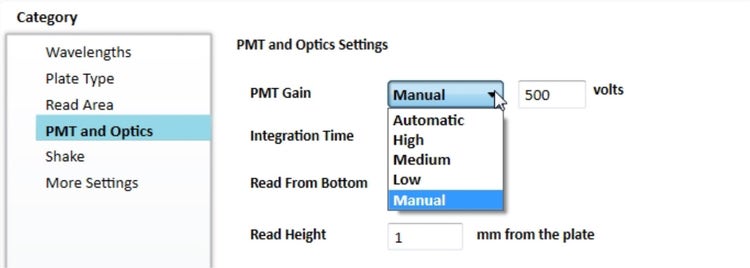
Figure 2. Adjustable PMT Settings in SoftMax Pro.
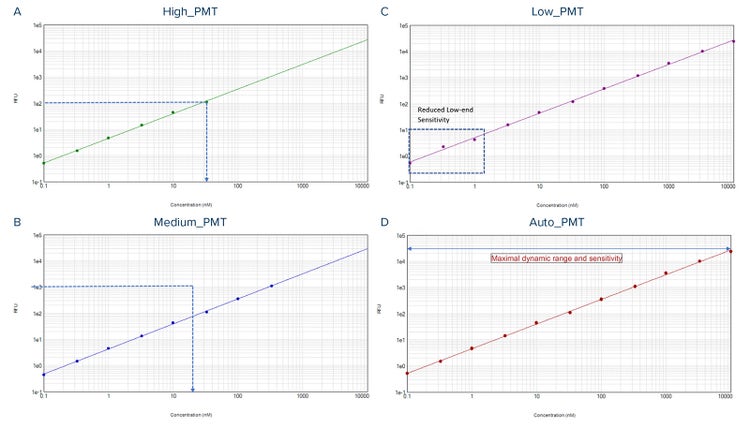
Figure 3. Standard curve with pre-defined PMT Settings compare to AutoPMT™. A. High PMT Gain show a quick saturation of the PMT at a concentration of 33nm. B. Medium PMT gain show a saturation at a concentration of 333nM, PMT Low can read the full concentration range but is losing sensitivity at low concentration. D. Automatic PMT allows maximal dynamic range with high sensitivity at all concentrations.
Data normalization
If the same samples are read with different PMT gains, the resulting un-normalized RFU values will differ for the same sample and give different standard curves as shown in Figure 4 (A). Samples read with a higher PMT gain will report a higher RFU values compare to these same samples read at a lower PMT gain. The differences in the RFU values makes it difficult to compare data from the same assay depending on the concentration range used on the plate.
Therefore, it is necessary to normalize RFU so it becomes independent of the voltage. Molecular Devices microplate readers use the PMT calibration coefficient that is determined by measuring a fluorescent sample of known intensity (fixed within the instrument) for the signal normalization. The SoftMax Pro software offers a full and automatic normalization of the data (Figure 4 B).
There is no need for additional data adjustment after the measurements. This fast and automatic normalization without the need of multiple measurements in different PMT settings saves time and is easy to use. The collected data are simultaneously normalized to achieve full linearity over a maximal dynamic range.
An important benefit of this normalization is for kinetic assays, where the signal intensities change over time, from day-to-day or with different assay conditions. For kinetic read, the PMT settings have to be fixed and it is recommended to start with a Medium PMT. It can be adjusted to Low PMT if some wells saturates or to High PMT if the signal generated by all wells is low. Since the collected data are simultaneously normalized, kinetic curves and final results can be compared regardless of the PMT gain used for the different experiments.
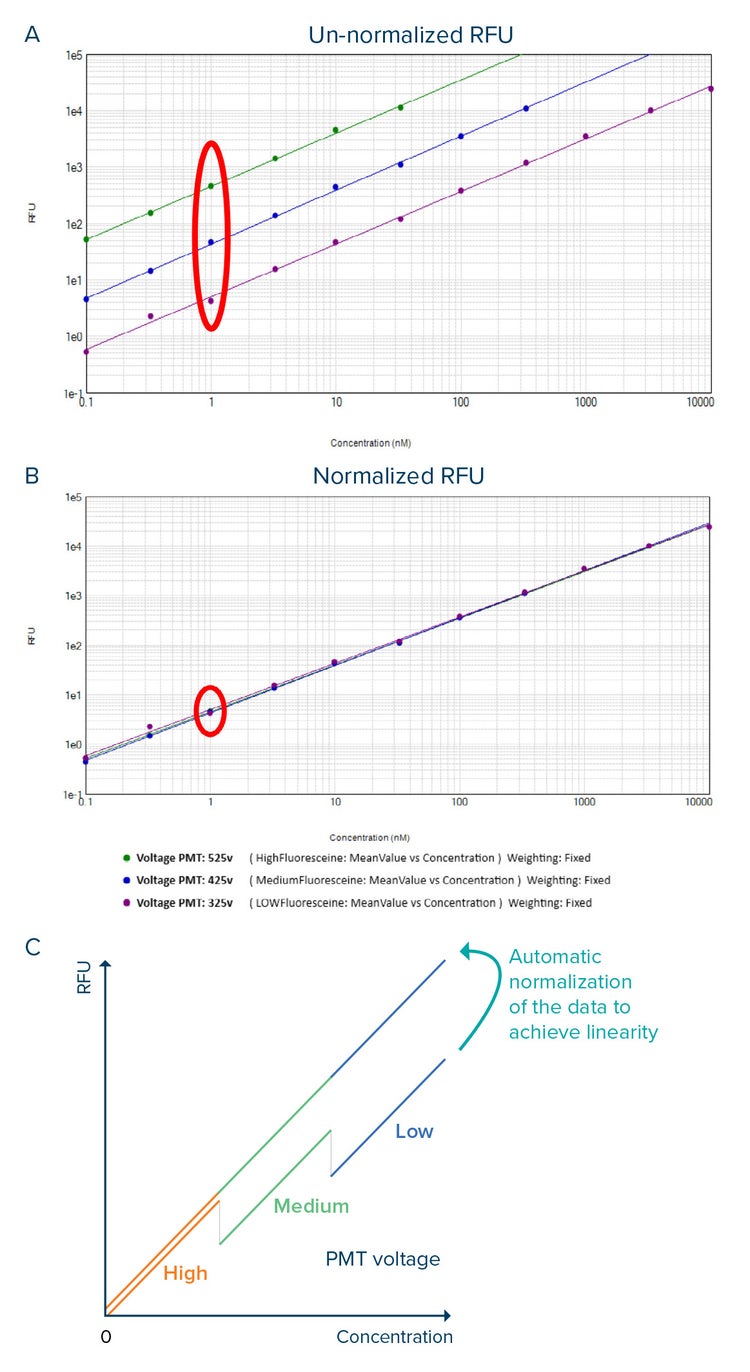
Figure 4. Standard curve reed at 3 different PMT gain (325 V, 425V and 525 V) without data normalization (A, Un-normalized RFU) and with data normalization (B, Normalized RFU). C. Graph showing the data normalization for each PMT voltage when the Automatic PMT option is used.
Conclusion
It is commonly known that results slightly vary from day-today and instrument to instrument, due to the sensitivity of the PMT, the lamp, the monochromator efficiency to name only a few. The AutoPMT™ supporting microplate readers compensates for all these factors with its instrument design, calibration and full RFU normalization to obtain comparable high-quality fluorescence data and the best reproducibility over time.