
Application Note
Getting more information from 3D cultures: A high-throughput assay for human alanine transaminase (hALT)
- Analyze biomarker concentrations while preserving integrity of 3D cultures for additional studies
- Generate 4 times the data in 90 minutes using Abcam’s 384-well SimpleStep ELISA® format
- Simultaneous 384 well plate washing using the AquaMax® 4000 Microplate Washer
- Read ELISA plates 8X faster with SpectraMax® ABS Plus Microplate Reader’s 8-channel read head
Cathy Olsen, Prathyushakrishna Macha, Oksana Sirenko | Molecular Devices
Laurence Loi, Chelcie Eller | Abcam
Judi Wardwell, Olivier Frey | InSphero
Introduction
3D human cell cultures, often comprised of multiple cell types and capable of organizing into tissue-like structures, are enabling new models for research that are considered more biologically relevant than monolayer (2D) cell cultures. Characterization of 3D cultures’ responses to candidate drug treatment using imaging and other high-content assay methods is a powerful research tool that provides a wealth of detailed information. However, non-destructive quantitative methods like the enzyme linked immunosorbent assay (ELISA) for secreted analytes continue to be a major route to gain insight on disease related biomarkers while preserving the integrity of the original 3D sample for further studies.
Here, we demonstrate the use of a 384-well quantitative assay for human ALT (hALT) in liver microtissue culture supernatant. This single-wash assay could be completed in 90 minutes, enabling a high-throughput workflow applicable to screening. Individual microtissues grown in wells of a 384-well microplate were assayed for the release of hALT, serving as an indicator of decreased liver cell viability in response to drug treatment. Quantitative analysis of results allowed assessment of the effects of a set of reference compounds on hALT release as a biomarker of cell viability.
Materials
- 3D Insight™ Liver microtissues grown in Akura™ 384 Spheroid Microplates (provided by InSphero)
- Automation components for plate and liquid handling:
- Microlab® STAR™ Liquid Handler (Hamilton)
- PreciseFlex™ 400 sample handler (Brooks)
- Genera scheduling software (Retisoft)
- Human ALT SimpleStep ELISA kit, 384-well format (Abcam cat. #ab234578)
- AquaMax 4000 Microplate Washer with 384-well wash head (Molecular Devices)
- SpectraMax ABS Plus Microplate Reader (Molecular Devices).
- SoftMax® Pro Software (Molecular Devices)
Methods
Process automation
3D Insight™ Liver microtissues provided by InSphero were grown in Akura™ 384 Spheroid Microplates, with media exchange, compound addition, and supernatant collection performed using a Microlab® STAR™ Liquid Handler. A PreciseFlex 400 sample handler and Genera scheduling software were used to transfer the microplate from incubator to liquid handler and back.
Microtissue treatment and sample collection
Microtissues were received in maintenance medium, which was exchanged for TOX medium upon receipt, and at the next media exchange, compounds in TOX medium were added to the wells. Compound additions were done from a 96-well master plate to quadruplicate assay wells of the 384-well culture plate. Microtissues were incubated with compounds for five days without additional media exchange, after which 25 μL of supernatant were collected from each well and transferred to a 384-well polypropylene microplate for short-term storage (Figure 1).
Human ALT SimpleStep ELISA
Supernatant from each microtissue culture well was diluted 1:2 in sample diluent and then pipetted to wells of the 384-well assay plate. Antibody cocktail was then added, and the plate was incubated for one hour with shaking. Wells were washed using the AquaMax® 4000 Microplate Washer with 384-well wash head, which washes all 384 wells at once, and TMB development solution was added to all wells. Absorbance at 600 nm was monitored, and before wells containing standards reached an OD600 of 1.0, stop solution was added, and the absorbance of all wells at 450 nm was read on a SpectraMax ABS Plus Microplate Reader, which has an 8-channel read head that dramatically reduces read times (Figure 2).
Analysis of hALT released
From the hALT standard curve, the concentration of hALT present in liver microtissue samples was interpolated using SoftMax Pro Software. For samples yielding quantifiable hALT levels, results were plotted, and compound EC50 values were calculated by the software.
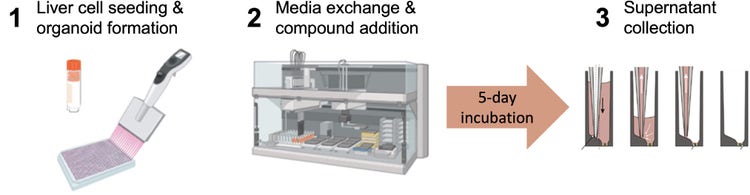
Figure 1. Automation of sample handling. Cell seeding and formation of microtissues, automation of media exchange, compound addition, and supernatant collection in 384-well format was performed using an automated liquid handling system.
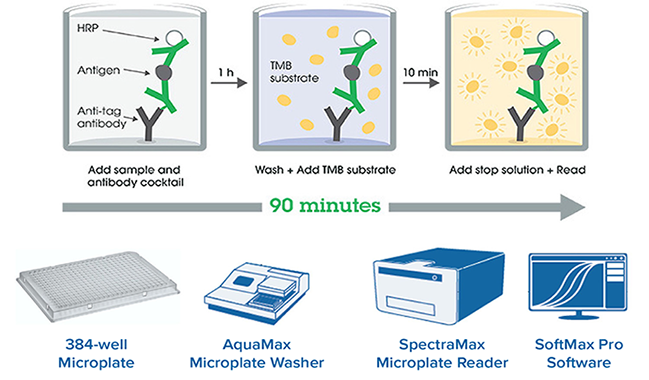
Figure 2. High-throughput ELISA. The SimpleStep ELISA in 384-well format accommodated the 384- well experimental layout used to culture and treat liver microtissues. 25-μL supernatants from each well were collected and diluted 1:2 prior to assay with the human ALT ELISA. A single wash step was performed with the AquaMax 4000 Microplate Washer equipped with a 384-well wash head that enabled simultaneous, rapid washing of all wells. Detection was performed with the SpectraMax ABS Plus reader, which reads 8 wells at once for shorter read times
Results
The SimpleStep ELISA in 384-well format facilitated the quantitation of 100 to 7,000 pg/mL of hALT. Standards were plotted using the quadratic curve fit in SoftMax Pro Software (Figure 3). A pre-set protocol in the software’s protocol library was used to interpolate the hALT concentrations of samples from the standard curve, and to plot the results using the 4-parameter logistic in the software’s dropdown list of curve fit options. Each 4P curve fit was evaluated in the software using the Calculate Parameter Dependencies option in the Statistics tab of the Curve Fit Settings (see Selecting Curve Fit in SoftMax Pro 7 Software | Molecular Devices). Several of the compounds tested yielded 4P curves with a high degree of independence (Figure 4, A) and therefore reliable EC50 values, while others showed a low degree of independence (Figure 4, B). A lower degree of independence may serve as a useful cue to repeat an experiment using, e.g., a higher or lower range of compound concentrations. Table 1 displays the EC50 values for each test compound calculated from its 4P curve.
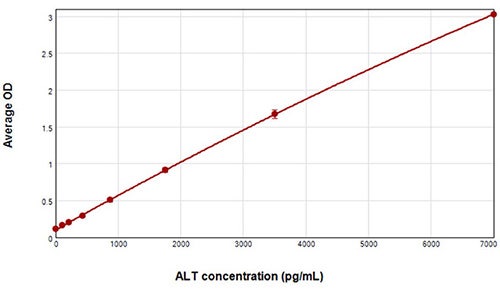
Figure 3. hALT standard curve. Curve fitting in SoftMax Pro Software enabled the selection of the best fit for hALT standards used for this ELISA (r2 = 1.000), for accurate quantitation of sample hALT concentrations.
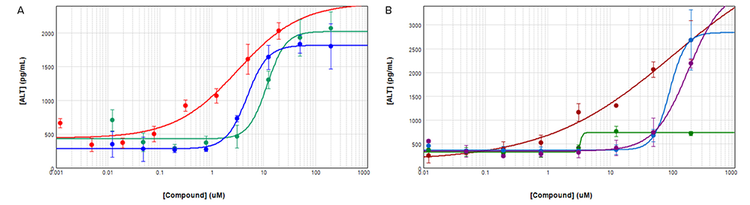
Figure 4. Compound-induced hALT levels. hALT concentrations were interpolated from the standard curve and plotted vs. compound concentration, with 4-parameter curve fitting performed using SoftMax Pro Software. A, 4P curves with good statistics and reliable EC50 values; B, 4P curves with poorer statistics.
*Compounds with lower calculated parameter independence.
Table 1. EC50 values calculated using SoftMax Pro Software.
Conclusion
The 384-well quantitative hALT SimpleStep ELISA from Abcam provides the means to get more information from 3D culture models grown in a 384-well format. Here we show how culture supernatant can be assayed, leaving the microtissues intact for further interrogation with high-content imaging or other methods. The assay’s sensitivity and 384-well miniaturized format enable the use of small volumes of precious samples. Automation of the liquid handling steps involved in microtissue culture and supernatant sample collection assures greater reproducibility. Together with the AquaMax 4000 washer, SpectraMax ABS Plus reader, and SoftMax Pro software, hands-on and analysis times are decreased for faster results.