
Application Note
The QPix FLEX Microbial Colony Picker ensures colony picking accuracy and efficiency in a contamination-free environment, preventing microbial cross-transfer
- The instrument leverages advanced imaging technology and ultrasonic agar sensing to achieve high-precision picking accuracy, enabling detailed colony evaluation based on morphology and color for optimized downstream processing.
- Maintains full sterility throughout colony picking, ensuring adherence to Good Laboratory Practice (GLP) guidelines. UV decontamination, ultrasonic tip cleaning, and optional HEPA filtration minimize contamination risk, safeguarding data integrity throughout the workflow.
- The ability to reuse sanitized pins reduces consumable costs, ensuring an economically sustainable approach to microbial operations.
- For handling microbes that are challenging to sanitize, the system supports disposable plastic picking pins, providing an added layer of flexibility.
Sushmita Sudarshan | Molecular Devices, LLC
Introduction
The QPix® FLEX™ Microbial Colony Picker transforms microbial research by automating labor-intensive processes such as colony picking, plating, streaking, and liquid handling within a space-efficient design that fits seamlessly on a benchtop or inside a hypoxic chamber. By streamlining essential microbial workflows and ensuring optimal sample selection from the outset, the QPix FLEX system enhances research efficiency, minimizes manual effort, and enables scientists to transition rapidly from experimentation to publication, freeing up time for transformative discoveries.
Sterility is a fundamental requirement in laboratory workflows, as outlined by Good Laboratory Practices (GLP), to prevent environmental/cross-contamination and ensure reliable, reproducible results. Contaminated samples can compromise data integrity, affect experimental outcomes, and lead to regulatory non-compliance.
This study aims to validate sterility, picking accuracy (>95%) and picking efficiency (>99%) during automated colony picking using the QPix FLEX. The system is designed for accuracy and efficiency, integrating sterility assurance measures to minimize microbial transfer risks. The system incorporates several sterility features, including UV light for interior sanitization, pin washing stations, and ultrasonic washing. The study evaluates key factors such as contamination control mechanisms, picking accuracy, efficiency and speed.
- Contamination control measures: Several wells within the destination plates designated as negative controls and plate blanks, to assess contamination.
- Accuracy assessment: The accuracy of colony picking assessed by the number of colonies physically picked by the picking pins vs the colony count stated by the software as successfully picked.
- Efficiency assessment: The efficiency of colony picking was assessed by the count of well(s) inoculated with bacterial colonies that exhibited visible growth following incubation. The efficiency was measured as >95%.
By demonstrating the above the findings will reinforce the reliability of automated microbial workflows in laboratory research and development.
Materials
- Biological sample: E. coli (JM109)
- Source plate type: 8-Well divided/Undivided Omni Tray Nunc/Petri Dish 9cm
- Destination plate type: Costar (3370)
- Source media: LB Agar media, w/o antibiotics
- Destination media: LB Broth media, w/o antibiotics
Methods
Basic picking with high-speed using sterilizable metal pins
The process contains several steps:
- Sample preparation: Two source plates (8-Well/ Undivided Omni Tray Nunc) 40 ml were used for colony selection. Colonies were transferred into three 96-well SBS destination plates.
- Picking process: Each destination plate underwent two distinct colony picking procedures to assess sterility and accuracy:
- Picking run: Actively transferred E. coli colonies into the designated wells containing LB Broth and the run was carried out with a single pin calibration at the beginning of the cycle as well as 1 inoculation dip into destination well.
- Control run: Ensured sterilizable pins did not retain or carry over bacterial contamination by dipping them into additional control wells with sterile media, without picking actual colonies.
- Sterilization: The sterilization process followed the 5-1-1 cycle, consisting of:
- 5 seconds in 0.1% bleach for microbial decontamination.
- 1 second in water to remove residual disinfectant.
- 1 second in 70% ethanol for further sterilization and rapid drying.
- Incubation: All destination plates were incubated overnight at 37°C, followed by optical density (OD 600 nm) measurements to evaluate bacterial growth to assess efficiency and sterility.
Basic picking with high-speed using disposable plastic pins
The process contains several steps:
- Sample preparation: Two source plates (Petri Dish 9cm- pre-poured) with single colonies of E. coli were used for colony selection. Colonies were transferred into three 96-well SBS destination plates.
- Picking process: Each destination plate underwent two distinct colony picking procedures to assess sterility and accuracy:
- Picking run: Actively transferred E. coli colonies into the designated wells containing LB Broth and the run was carried out with pin calibration only at the beginning of the cycle as well as a 1 inoculation dip into destination well.
- Sterilization: Disposable picking pins were used, which do not require a sterilization cycle.
- Incubation: All destination plates were incubated overnight at 37°C, followed by optical density (OD 600 nm) measurements to evaluate bacterial growth to assess efficiency and sterility.
Results
Basic picking with high-speed using sterilizable metal pins
Colony picking was performed in triplicate across three independent QPix FLEX instruments to assess reproducibility and performance. Escherichia coli colonies ranging from 0.5 to 2 mm in diameter were selected from source trays and transferred into destination wells containing 180 µL of LB Broth. Each destination plate comprised 68 wells inoculated with bacterial samples, 8 control wells containing only media to monitor for environmental contamination, and 16 wells designated for cross-contamination assessment. Picking accuracy was evaluated by comparing the number of colonies physically transferred by the picking pins to the number reported as successfully picked by the instrument software. Manual verification was conducted using ImageJ analysis (Figure 1). Efficiency and contamination rates were determined based on the presence or absence of bacterial outgrowth in the respective wells (Figure 2), as detailed in the Methods section. A summary of the results is presented in Table 1.
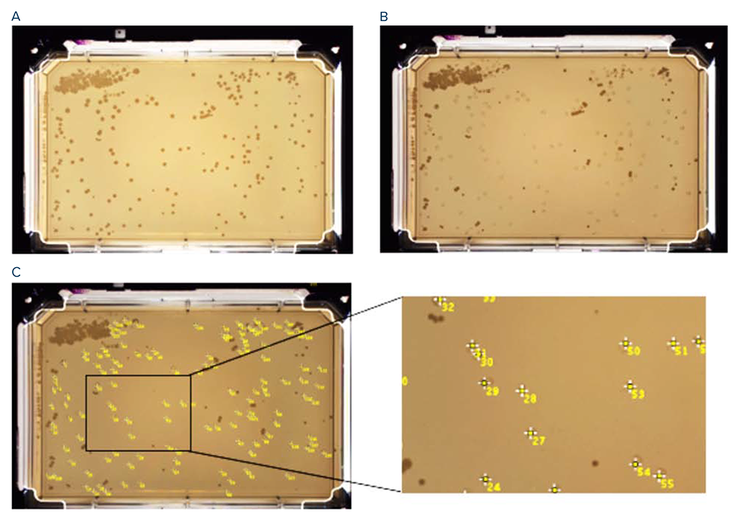
Figure 1. Pre-pick (A) and post-pick (B) images of the source plate for picking process. Picked colonies counted with ImageJ software (C).
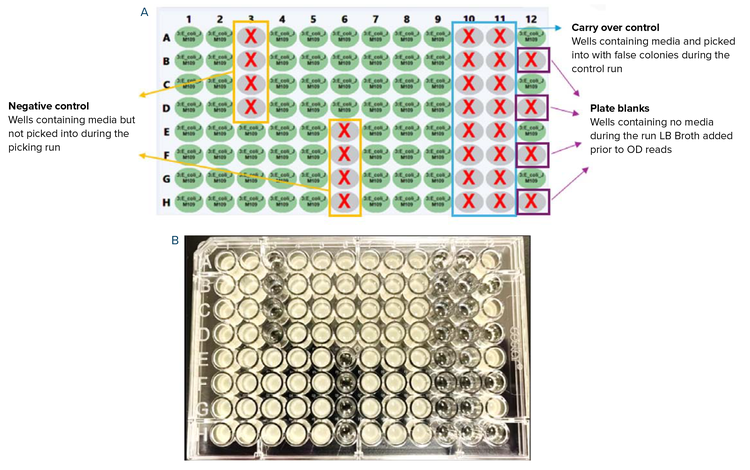
Figure 2. Destination plate map (A) and example destination plate (B) from basic picking with high speed, sterilizable metal pins.
Table 1.
Basic picking with high-speed using disposable plastic pins
Colony picking was performed in triplicate across three independent QPix FLEX instruments to assess reproducibility and performance. Escherichia coli colonies ranging from 0.4 to 1 mm in diameter were selected from source petri dishes and transferred into destination wells containing 180 µL of LB Broth. Each destination plate comprised 80 wells inoculated with bacterial samples, 8 control wells containing only media to monitor environmental contamination. Picking accuracy was evaluated by comparing the number of colonies physically transferred by the picking pins to the number reported as successfully picked by the instrument software. Manual verification was conducted using ImageJ analysis (Figure 3). Efficiency and contamination rates were determined based on the presence or absence of bacterial outgrowth in the respective wells (Figure 4), as detailed in the Methods section. A summary of the results is presented in Table 2.
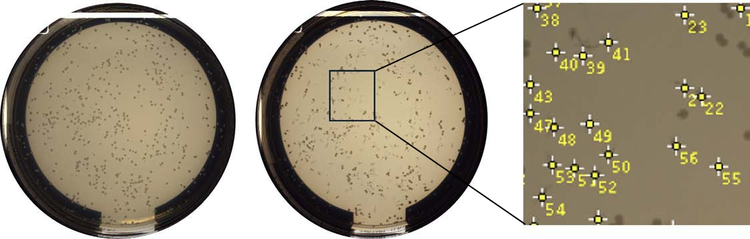
Figure 3. Pre-pick (A) and post-pick (B) images of the source plate (Petri dish 9cm) for picking process. Picked colonies counted with ImageJ software (C).
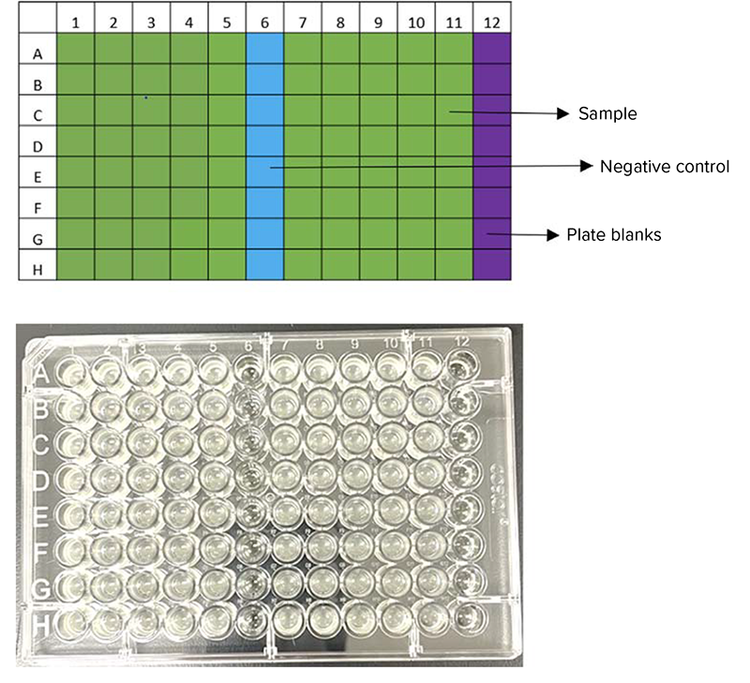
Figure 4. Destination plate map (A) and example destination plate (B) from basic picking with high speed, disposable plastic pins.
Table 2.
Discussion
Achieved accuracy (> 99%)
The automated colony picking system demonstrated exceptional precision, with the number of colonies physically transferred by the picking pins matching the colony count recorded by the software. This consistency validates the reliability of the picking mechanism, ensuring that selected colonies are accurately deposited into destination wells without discrepancies, minimizing potential errors in microbial workflows.
Achieved efficiency (> 95%)
The system exhibited excellent efficiency, as confirmed by the number of wells inoculated with bacterial colonies that showed growth after incubation (>95% of the colonies that were picked showed visible growth after overnight culture). The high success rate of colony transfer and subsequent bacterial proliferation underscores the effectiveness of the picking process in optimizing throughput while reducing manual intervention.
Sterility
The implementation of the sterilization cycle effectively eliminated any cross-contamination risks throughout the picking process. Control wells remained free of bacterial growth, confirming that sterilizable picking pins did not retain or transfer unwanted microorganisms.
The combination of automated cleaning protocol and environmental contamination control measures (UV) ensured that colony selection was conducted in a sterile environment, reinforcing compliance with laboratory sterility standards.
Conclusions
This study validated the sterility, accuracy, and efficiency of the automated colony-picking system, demonstrating its reliability for microbial handling while ensuring contamination-free workflows for research and bioprocess applications.
All instruments demonstrated optimal performance across triplicate tests, achieving 100% accuracy, 100% efficiency, and 0% contamination. Additionally, the picking speed remained within the specified threshold (250 colonies per hour for picking with metal pins and 350 colonies per hour for picking with plastic pins), ensuring throughput and reliability.