|
High Quality Automated Patch Clamp

With the PatchXpress 7000A each channel is independently controlled for optimal recording
quality. For example, independent pressure control means better gigaseal formation on
each channel, because the time to form the gigaseal can vary so much from cell to cell.
Independent channels mean recordings with less noise. Independent pressure control also
translates to lower whole cell access resistance values, with finer control of this
important membrane parameter.
Automated pressure control for optimal membrane parameters
During a patch clamp experiment, the seasoned electrophysiologist keeps a close eye on
important membrane parameters including Rm, Ra and holding current. Changes in these
membrane parameters signal the patch clamper that something could be wrong with recording
quality. In the worst case, changes in current amplitude occur that relate to the changes
in the membrane parameter values and not to changes in the biology of the cell. The
smart patch clamper will use pressure control or voltage "zaps" to optimize these
parameters and ensure reliable measurements during the life of the recording.
The membrane resistance value, Rm, relates to the initial gigaseal achieved and the
input resistance of the cell (in general, larger cells have a lower input resistance
because they have more channels open at rest or "leak" channels). Independent and
automated pressure control in the PatchXpress affords tight gigaseals at the onset
of each experiment. Tight gigaseals are critical for low noise, stable, and
long-lasting whole cell recordings.
The access resistance value, Ra, relates to the initial electrode resistance plus the
internal resistance of the cell. For example, if internal organelles clog the opening
of the planar patch clamp electrode, the Ra value will increase. If the Ra value is
too high and the measured current amplitude is greater than 1 nA, a significant voltage
error occurs because of Ohm's Law (Voltage = Resistance * Current). For example, if
the Ra value reaches a point of 20 MΩ during a recording and the current amplitude
is 1 nA the resulting voltage error would be 20 mV! One can easily see how this could
lead to a false positive or false negative during a compound screening experiment.
The PatchXpress system uses automated pressure control to its advantage to
maintain a relatively constant Ra value throughout the recording period.
Fluidics for recording ligand-gated and voltage-gated ion channels
 |

Screenshots of the PatchXpress animation
|
|
PatchXpress includes the following fluidics:
- Disposable pipettes for placing cells in the SealChip16 electrode wells.
- Disposable pipettes for applying test compounds.
- Washout probes for automatic washout of test compounds with buffer solutions.
|
Compound application can be timed precisely to occur at just the right moment in the
sequence of the experiment. Disposable pipette tips ensure no cross-contamination
between drug applications. The fluidics system can be configured for single applications
or for cumulative dose-response applications.
As shown in Figure 1, the application of test compound is rapid enough for
both ligand-gated and voltage-gated ion channel studies. The figure shows results
from experiments done with RBL cells that endogenously express inward rectifying
potassium channels. The holding potential was -80 mV and a high potassium external
solution was added to change the holding current. The time to 90% exchange is in the
order of hundreds of milliseconds and is indicated by the time taken to reach the new
holding level. Washout is achieved with a separate buffer line and reaches its peak
and plateaus in about 100 ms (see Figure 1).
Figure 1.
Screening Both Voltage and Ligand-gated Channels is a Breeze
It is reasonable to expect an automated patch clamp system to record currents from
both voltage and ligand-gated channels. The unique PatchXpress planar electrodes and
fluidics system afford quality patch-clamp recordings of both ion channel types.
Figure 2 shows an example of voltage-activated currents through Kv1.1 potassium
channels expressed in CHO cells (from Dr. William Thornhill, Fordham University).
Panel A (blue traces) shows uncorrected or raw Kv1.1 data in response to a family
of voltage steps from -60 to +60 mV in increments of 10 mV. Panel B (red traces)
shows data corrected with software controlled linear leak and capacitance correction
(P/4 routine). As shown in the I-V curves in Panel C, the recordings are stable and
similar with or without the P/4 routine.
Figure 2. Kv1.1 potassium channel currents with (A) raw data and (B) P/4 linear leak
and capacitance subtracted data. Panel C shows the I-V relationship from both
experiments. Data courtesy of Drs. Jia Xu and Antonio Guia (AVIVA Biosciences).
Figure 3 shows an example of desensitizing ligand activated currents in response
to direct application of 100 µM and 1 mM acetylcholine (Ach) in the same cell
patch-clamped with a planar electrode. Automated whole cell patch clamp recordings
(holding potential -80 mV) started with a gigaseal (> 1 GΩ). Transition to
whole cell mode was under also under automated control using a software controlled
amplifier (MultiClamp 700A) and pressure controller. Inward currents were recorded
in response to ACh applied using PatchXpress robotic fluidics system. The contact
time with ACh is indicated by the length of the bar. The well was washed out using
perfusion pipes sited in close proximity to the base of the recording well in order
to achieve a rapid wash out.
Figure 3. Ligand activated currents in response to direct application of
100 µM and 1 mM Acetylcholine.
PatchXpress Software Monitors Patch Clamp Experiments: A Virtual Electrophysiologist

The central nervous system of the PatchXpress is its software. Beside the straightforward control
of the PatchXpress hardware systems, the PatchXpress program makes critical decisions while an
experiment is actually running-just like a seasoned patch clamper—in order to keep the
experiment on track.
The PatchXpress software makes experimental setup intuitive and user-friendly. It is
even possible for pCLAMP users to import their familiar episodic parameter files.
During experiments, the PatchXpress software masterfully controls all of the robotic
instrumentation while seamlessly displaying useful information to the user about the
status of the patch clamp experiments on each of the 16 channels.
Following is a sequence of events during a typical experiment under the control of
the PatchXpress software:
- load SealChip16 electrode
- load electrodes with internal solution
- apply cells
- apply just the right amount of pressure to obtain a gigaseal
- apply pressure until the whole cell configuration is achieved
- start voltage step protocol and record baseline currents
- monitor membrane parameters throughout
- apply test compound
- start voltage step protocol and record currents
- washout test compound
- start voltage step protocol and record currents
- create quality control log file with detail information about the experiment (see example figure)
|
The step "monitor membrane parameters throughout" is highlighted because it deserves
clarification. Before each screen, the user predefines the acceptable criteria
for a successful recording. For example, the tolerance for Ra and Rm may be
15 MΩ and 500 MΩ, respectively.
In this case, if Ra goes above 15 MΩ and/or Rm dips below
500 MΩ the PatchXpress software needs to act quickly. The
first step would be to apply suction (negative pressure) in an effort to clear any
obstruction (i.e., internal organelle) that could be responsible for the
increase in Ra. In the best-case scenario, this negative pressure would also improve
the seal and cause Rm to go back (or remain) above 500 MΩ.
In the worst-case scenario, the software would make a note that the criteria for a
successful recording have not been met and this would be apparent at the user interface.
Importantly, in the latter case, valuable test compound would not be applied to this cell.
The PatchXpress software and pipetting robotics work together to apply test compounds only
to cells that meet the criteria for a successful recording.
Data output from the PatchXpress will be in the form of standard text files and Axon
Binary Files (ABF). These ABF files can be imported to DataXpress for automated
analysis or to Clampfit for detailed manual analysis. Some on-line analysis, such
as peak current amplitudes, is also available during PatchXpress experiments (and
exported as text files).
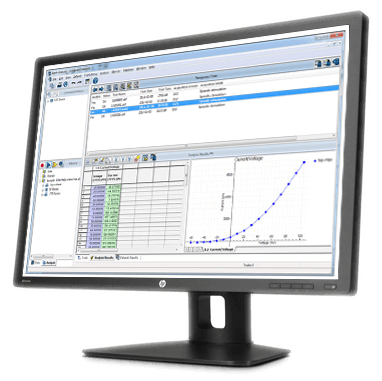
DataXpress is a database program designed exclusively for eCLAMP, OpusXpress and PatchXpress
for automatically organizing and analyzing data files. DataXpress will automatically generate
IV and dose-response graphs. On-line data from PatchXpress experiments can be ported directly
to DataXpress where hits and misses in a drug screen are displayed.

Figure 4. An example of the membrane parameters recorded during a
planar patch clamp experiment that shows the quality of the recording. In this
example, Ra remained below 15 MΩ and Rm stayed above
500 MΩ for longer than 15 minutes. Holding current
and whole-cell capacitance values are also displayed.
Two Decades of Experience

The PatchXpress 7000A emerges from years of Axon's experience as the world leader in
electrophysiology hardware and software. For the past two decades, Axon provided
tools for electrophysiologists performing cutting edge ion channel research in both
academic and pharmaceutical company laboratories. The PatchXpress 7000A builds on
these core technologies and includes the revolutionary SealChip
technology that allows recordings from many cells in parallel for increased throughput
for ion channel screening.
MultiClamp Amplifiers: the Silent Workhorses
Tucked away in the PatchXpress 7000A are eight MultiClamp 700A amplifiers, each
connected with two CV-7A headstages. These computer-controlled patch clamp amplifiers
have been proven in the field for over two years and are ideal for automated patch
clamping because there are no knobs and buttons. The PatchXpress software controls
the settings on each amplifier channel, allowing the user to make choices such as the
following:
- current clamp vs. voltage clamp
- 50 MΩ, 500 MΩ, 5 GΩ, or 50 GΩ feedback resistors for voltage clamp
- 60 lowpass Bessel filter settings
By incorporating MultiClamp amplifiers, the PatchXpress 7000A gives you the flexibility
to perform detailed research mode experiments or higher throughput screening experiments:
both with the same high fidelity and data quality Axon customers have enjoyed over the
years.
Patch Clamp Data Acquisition: Our Specialty
Ask any electrophysiologist what the industry standard is for electrophysiology
software, and the answer will undoubtedly be pCLAMP. Developing
flexible and user-friendly electrophysiology software is a daunting task. We have
achieved this with pCLAMP, with nearly two-decades of experience behind each new
update version. This same expertise went into developing PatchXpress software.
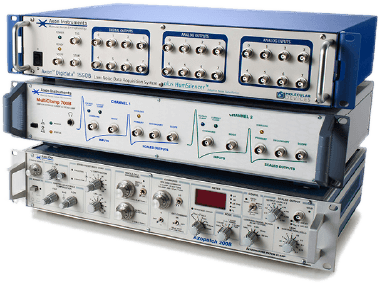
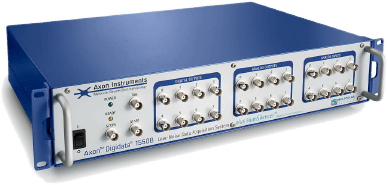
For conventional patch clamp applications, the Digidata 1322A (see figure) facilitates
communication from the computer to the amplifiers (Digital-to-Analog or "D to A"
conversion) as well as from the amplifiers to the computer (Analog-to-Digital or
"A to D" conversion). The PatchXpress incorporates a modified Digidata that has
16 Analog Inputs and Outputs (the Digidata 1322A has only two analog outputs).
The PatchXpress 7000A also builds upon experience gained by the
OpusXpress 6000A, the world's first parallel
electrophysiology recording system. In developing the OpusXpress, Axon gained
valuable experience in fluidics and electrophysiology acquisition software for
ion channel screening applications. The following quote from OpusXpress user
Dr. Roger Papke (Univ. Florida), describes the advantage of using high-quality,
automated voltage clamp systems:
|
"With the PatchXpress and OpusXpress product lines, Axon has brought the quality
of academic research to the high throughput needs of drug research and development.
At the same time, it offers an unprecedented level of potential productivity to
the academic researcher who has access to these systems. Our laboratory was
fortunate to participate in the OpusXpress beta test program. In the course of
a month we completed a project that otherwise might have taken as long as two years."
|
Features and Specifications

The PatchXpress is an automated high-throughput electrophysiology workstation.
- Automated parallel patch-clamp recording of multiple mammalian cells simultaneously
- Gigaseals (cell-attached resistance > 1 GΩ) to start each recording
- True whole-cell recordings
- Low access resistance (Ra) values achieved by 16 independent pressure controllers
- 16 independent patch clamp amplifiers
- High-fidelity 16-channel input/output digitizer based on the proven technology of the Axon Instruments Digidata 1322A
- Dimensions: 58" wide x 30" deep x 66" tall (plus 24" monitor attached to the side)
- High speed whole-cell voltage and current clamp capability
- 8 MultiClamps with 16 CV-7A headstages (a proven technology)
- 4 different feedback resistors in voltage clamp mode allow versatile high fidelity recordings whether currents are in the pA or nA range
- Current clamp is true and fast because the CV-7A headstages include voltage-follower circuitry
- Single use planar patch clamp electrode substrate (16-channel)
- Aviva chips with very high whole-cell recording success rate (gigaseal, 15 minute duration, Ra < 15 MΩ (uncorrected) and Rm > 200 MΩ)
- Planar format allows compound addition from the top
- Disposable electrode/chamber means no cross-contamination
- Integrated and intelligent fluidics facilitate drug application during recordings
- Test compounds are added only to cells with successful recordings to eliminate waste of precious materials
- Washout of chamber supported
- Rapid solution exchange
- Small volumes of test compounds (~ 50 µl)
- Disposable tips eliminate cross-contamination
- Cumulative dose-response experiments supported
- Integrated acquisition and analysis software
- 16 scope windows for live views of recordings in all 16 channels
- "Chart-recorder" windows for viewing on-line statistics, such as peak amplitude over time
- Wide-screen monitor for easy viewing of 16 scope windows and "chart-recorder" windows
- Text file output showing hits based on user criteria
- Analysis software for data management, quick I-V graphs, and quick dose-response curves
Ordering Information

PatchXpress 7000A
- Integrated hardware and software package comes complete with all hardware, electronics,
and software required for full operation, including a computer fully configured with
PatchXpress software.
|