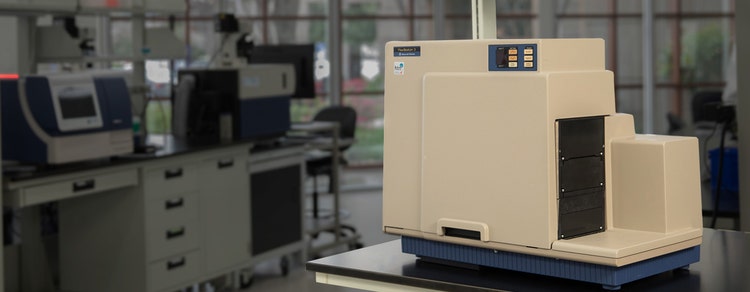
Adapting to biochemical- and cell-based application requirements while streamlining assay throughput is a challenge faced by many drug discovery and research laboratories. Multidetection platforms often provide assay flexibility, however, throughput is often compromised—especially for applications that require integrated fluid transfer, such as calcium mobilization or other fast applications. To address this concern, Molecular Devices offers the FlexStation® 3 multi-mode benchtop reader. FlexStation 3 combines Molecular Devices’ SpectraMax M5e performance with an integrated 8- or 16-channel pipettor into one compact benchtop reader. This integrated system provides users with a multidetection platform capable of increasing the liquid handling throughput and flexibility for biochemical- and cell-based kinetic assays.
Flexible Liquid Transfer
Using an 8- or 16-channel pipettor, FlexStation 3 offers added assay flexibility over dispenserbased systems by transferring reagents from 96 or 384 distinct wells in a source plate to a read plate, simultaneously. In addition, users can define individual reagents and concentrations to be delivered to each well. The direct transfer capability reduces reagent consumption and allows more assay conditions to be explored in a single microplate, making the system more amenable to agonist and antagonist assay formats.
Automated Pipetting
FlexStation 3 offers automated pipetting using the 8- or 16-channel pipettor to improve assay quality and increase throughput. For instance, liquid transfer for endpoint and slow kinetic assays can be automated to initiate a response at user-defined points of time. Automated pipetting ensures consistent addition times and minimizes pipetting errors, thus providing tighter assay CVs within and between experiments. For fast, kinetic cell-based assays, throughput is increased when a column of wells are pipetted, read, and analyzed simultaneously rather than one well at a time.
Assay Optimization
With the FlexStation 3 system’s pipettors, users can adjust parameters to optimize the assay’s robustness. The dispense parameters can be optimized for each reagent addition to accommodate cells with different adherence characteristics, such as adjusting dispense velocity to prevent cell dislodging. The ability for the system to allow multiple additions enables secondary controls to be added to each well. In addition, trituration (i.e., the mixing of well contents through repeated aspiration and dispensing using the pipettor) can improve the assay two ways: resuspending compounds that have settled at the bottom of the wells in the source plate, or quickly mixing reagents to promote an even, rapid response with minimal assay variability.
Superior Optics
FlexStation 3 optics are designed to easily adapt to changes in assay requirements while maintaining the optimal performance of a single mode reader. Based on Molecular Devices’ SpectraMax® M5e platform, this five-mode reader addresses multiple application technologies including: absorbance, fluorescence intensity, fluorescence polarization, luminescence and time-resolved fluorescence. Dual monochromators allow users to target the optimal assay excitation and emission wavelengths and eliminate the need to change expensive band pass filters between experiments. Dual PMTs provide flexibility to detect multiple detection modes, while a separate PMT provides additional sensitivity for luminescence applications. Reference diodes automatically adjust to slight fluctuations in excitation intensity to reduce measurement noise. Absorbance applications are enhanced using top-quality UV grade fibers to provide high light transmission in the lowest wavelengths.
Instrument and Software Validation
SpectraTest™ absorbance and fluorescence validation packages are available to determine the optical characteristics of the system. FlexStation 3 exclusively offers fluid transfer validation using Molecular Devices’ patented† PathCheck® technology to quantify the integrated 8- and 16-channel pipettor head performance. These tools can be used in conjunction with SoftMax® Pro Validation Package and IQ/OQ/PQ Validation protocols for FDA 21 CFR Part 11 compliance.
Applications
Superior optics in FlexStation 3 allow homogenous and heterogeneous biochemicalor cell-based microplate assays to be detected through a variety of readouts. When utilizing 8- or 16-channel pipettors, assays are expanded to include fast absorbance, fluorescence and
luminescence applications. Alternatively, automated liquid transfer can be incorporated into numerous endpoint and kinetic applications
in five detection modes. Applications include:
Calcium mobilization assays
Membrane potential assays
Dual Luciferase® Reporter (DLR™) Assay
DNA/RNA/protein quantitation and purity
PicoGreen®/NanoOrange®/Bradford assay
ELISAs/enzyme kinetics (e.g. Km, Ki, etc.)
Drug dissolution profiles
Live/Dead® Viability/cytotoxicity assays
Caspace-3 and protease assays
CatchPoint® cAMP assays
IMAP® kinase assays
Intrinsic trytophan fluorescence
Green fluorescent protein
FRET and TR-FRET assays
HTRF assays
Reporter gene assays
ADME-Tox assays
Membrane Permeability assays (PAMPA)
FluoroBlok™ cell migration assays
DELFIA® assays
Technical Specifications *
General Photometric Performance
Plate formats
6, 12, 24, 48, 96, 384 wells
Light source:
Xenon Flash Lamp
(1 joule/flash)
Detectors:
2 photomultiplier tubes
Shaker time:
0 to 999 seconds
Temp. control*:
2°C above ambient to 45°C
Temp. uniformity*:
< 1°C at 37°C set point
Temp. accuracy*:
±1°C at 37°C set point
Flex reading:
Abs + fluidics
FI + fluidics
Lum + fluidics
Endpoint reading:
All modes + fluidics
Kinetic reading :
All modes + fluidics
Spectral scanning:
All modes
Well scanning:
Abs, FI, TRF, Lum
* Temperature is regulated in the Read Chamber.
Fluidics (96- & 384-Well Plates Only)
8-channel
Max. volume:
200 μL
Precision @ 50 μL:
2% CV
Precision @ 5 μL:
8% CV
Dispense max. rate:
208 μL/sec.
16-channel
Max. volume:
30 μL
Precision @ 10 μL:
3% CV
Precision @ 1 μL:
5% CV
Dispense max. rate:
52 μL/sec.
Absorbance Photometric Performance
Wavelength range:
200–1000 nm
Wavelength selection:
Monochromator, tunable
in 1.0 nm increments
Wavelength bandwidth:
≤4.0 nm
Wavelength accuracy:
±2.0 nm
Wavelength repeatability:
±0.2 nm
Photometric range:
0–4.0 OD
Photometric resolution:
0.001 OD
Photometric accuracy:
< ±0.006 OD ±1.0%,
0–2 OD
Photometric precision:
< ±0.003 OD ±1.0%,
0–2 OD
Stray light:
< 0.05% @ 230 nm
Fluorescence Intensity Performance
Reading capabilities:
Top- or bottom-read
Wavelength range:
250–850 nm
Wavelength selection:
Monochromators, tunable
in 1.0 nm increments
Bandwidth (EX, EM):
9 nm, 15 nm
Sensitivity:
< 5 pM fluorescein in 96
wells, < 20 pM in 384 wells
Fluorescence Polarization Performance
Reading capabilities:
Top-read
Wavelength range:
400–750 nm
Wavelength selection:
Monochromators, tunable
in 1.0 nm increments
Bandwidth (EX, EM):
9 nm, 15 nm
Precision:
< 5 mP standard deviation
at 1 nM fluorescein in 96
and 384 wells
Time-Resolved Fluorescence Performance
Reading capabilities:
Top- or bottom-read
Wavelength range:
Wavelength range:
Wavelength selection:
Monochromators, tunable
in 1.0 nm increments
Bandwidth (EX, EM):
9 nm, 15 nm
Precision data collection:
1–100 flashes, delay of
0–600 μsec. before read,
integration time-selectable
between 50–1500 μsec.
Sensitivity:
100 fM europium in 96
or 384 wells with top-read
Luminescence Performance
Reading capabilities:
Top- or bottom-read
Wavelength selection:
All wavelengths or with
selected wavelengths
Wavelength range:
250–850 nm
Sensitivity:
< 2 fg/well lower detection
limit for firefly luciferase in
96- and 384-well top read
Cross-talk:
< 0.3% in white 96- and
384-well microplates
Typical Read Times (minutes:seconds)*
96 wells
384 wells
Absorbance
0:18
0:49
Fluorescence Intensity
0:17
0:48
Fluorescence Polarization
0:42
2:03
Time-Resolved Fluorescence
0:17
0:48
Luminescence
2:00
7:00
* With 3 flashes/well in absorbance and fluorescence modes, and 1 sec./
well integration in luminescence.
General Specifications
Dimensions (in.):
23 (W) x 19 (H) x 16 (D)
Dimensions (cm):
58 (W) x 49 (H) x 40 (D)
Weight:
50 lbs. (22.7 kg)
Power consumption:
500 VA
Power source:
90–240 Vac, 50–60 Hz
*FOR RESEARCH USE ONLY. NOT FOR USE IN DIAGNOSTIC PROCEDURES.
Ordering Information
FlexStation 3 Microplate Reader
Part Number: Flex 3 System
FlexStation 3 Base System
SoftMax Pro Software
1-year warranty
FlexStation 3 Pipettor Head Kit, 8-channel (96)
Part Number: 0200-6182
8-channel pipettor
(10) racks of 96-well, FlexStation Pipet Tips (Black)
96-well yellow plate
FlexStation 3 Pipettor Head Kit, 16-channel (384)
Part Number: 0200-6183
16-channel pipettor
(10) racks of 384-well, FLIPRTETRA® Pipet Tips
(Clear)
384-well yellow plate
Consumables
96-Well, FlexStation Pipet Tips (Black)
Part Number: 9000-0911
200 μL capacity
(10) racks/box
96-Well, FlexStation Pipet Tips (Clear)
Part Number: 9000-0912
200 μL capacity
(10) racks/box
384-Well, FLIPRTETRA Pipet Tips (Black)†
Part Number: 9000-0764
30 μL capacity
(50) racks/case
384-Well, FLIPRTETRA Pipet Tips (Clear)†
Part Number: 9000-0763
30 μL capacity
(50) racks/case
Reagents
FLIPR® Calcium Assay Evaluation Kit
Part Number: R8172
(3) vials* Component A of FLIPR Calcium
Assay Kit
(3) vials* Component A of FLIPR Calcium 3
Assay Kit
(3) vials* Component A of FLIPR Calcium 4
Assay Kit
(1) bottle Component B
* Each vial sufficient for 1 plate (96 or 384)
IMAP® Fluorescence
Polarization Evaluation Kit
Part Number: R8155
Beads and buffers for 800 data points in
standard 384-well plate
IMAP TR-FRET Evaluation Kit
Part Number: R8161
Beads and buffers for 800 data points in
standard 384-well plate
QBT™ Fatty Acid Uptake Assay Explorer Kit
Part Number: R8132