Molecular Devices Home
(Now part of MDS Analytical Technologies)
Careers  |  Contact Us  |  Search:   


Introduction to Data Acquisition and Analysis

Molecular Devices offers hardware and software tools to condition, digitize, and analyze your neurophysiological signals. Our Axon Instruments data acquisition software allows you to create protocols to control your microelectrode amplifier (or other instrument), signal conditioner, and digitizing hardware, and to acquire data to a file on your computer. Axon data analysis software offers an extensive list of processing and analysis functions, as well as plotting and presentation output.

Signal Conditioning and Data Acquisition

To get the best quality data, changing the gain and offset, using low-pass, high-pass and notch filtering, are typical ways used to condition a physiological signal. A low-pass filter, typically a Bessel filter for laboratory signals, retains the components of a signal below the cut-off frequency of the filter (fc). All parts of the signal above fc are attenuated. For example, a 5 kHz low-pass Bessel filter lets through all parts of a signal below 5 kHz, and attenuates all components of the signal greater than 5 kHz. A high-pass filter does the reverse of a low-pass filter; it only lets through frequencies above the fc. The rate of attenuation is directly related to the number of poles in the filter. An 8-pole filter attenuates much more rapidly from fc than a 4-pole filter. Notch filters eliminate a single frequency component (and possibly harmonics) of a signal, typically at 50 or 60 Hz. This is important in cases where the AC power line signal ("hum") gets coupled into the measured signal due to inadequate grounding or shielding. The primary purpose of all filtering is to remove as much of the obscuring components of a signal as possible, without compromising the desired signal.

Once an analog signal has been conditioned, it needs to be converted by a data acquisition system to a digital form for display and storage on a computer. The conditioned signal is connected to the analog input of a digitizer which uses an Analog-to-Digital Converter to take samples of the signal voltage at a user-determined rate. The analog samples are converted to digital values which are then transferred to the computer for display and storage.

Software programs are central to modern data acquisition and control systems. Software programs orchestrate all of the experimental control, data acquisition and analysis. Software can, for example, set the gain, offset and filters on computer-controlled signal conditioners and analog input and output channels. During the experiment itself, the software would issue the voltage waveform commands through the analog output and digital outputs, acquire and display the digitized signal, and store the data to disk. The software is also crucial in analyzing the data and creating files and plots from the results of the analysis.


pCLAMP Data Acquisition for Windows

pCLAMP is a sophisticated Windows product that provides the full power of a superior Windows application. Clampex, part of the pCLAMP software suite, is the well-known Axon Instruments application for data acquisition and control. Clampfit, the analysis member of the suite, contains a complete set of analysis functions for electrophysiological data. Also included in the suite is AxoScope, a scaled down version of Clampex, which provides for background chart or oscilloscope recording to the main Clampex recording sessions. Clampex, Clampfit and AxoScope are all true 32-bit Windows programs that run under Windows 2000 and XP Pro.

The heart of Clampex is its episodic data acquisition and control mode, which offers specialized electrophysiology functions such as versatile waveform generation, online conditioning trains, P/N leak subtraction and online peak detection for both voltage- and current-clamp experiments. Clampex also includes several easy-to-use passive acquisition modes for performing continuous, event-detected and oscilloscope-style data acquisition, with features such as thresholding, signal averaging and a derived Math channel.

Clampex excels in the real-time monitoring and control of experiments. The Membrane Test monitors seal resistance for gigohm seal formation, and can chart several important whole-cell parameters, such as membrane capacitance, during a recording. A complex experiment can be automated by setting up a sequence of protocol files, Membrane Tests, digital output patterns and holding levels. A variety of triggering and tagging options are available for interaction between the researcher, Clampex and various other pieces of equipment such as stimulators and perfusion systems. Telegraphing provides for automatic and dynamic gain control by microelectrode amplifiers manufactured by Molecular Devices (Axon Instruments brand) and other companies.

Online analyses include Shape Statistics on evoked activity such as peak amplitude, area, rate of rise or decay, and many more. Long-Term Potentiation and Depression can be tracked over time. A Threshold-Based Statistics section monitors passive acquisition parameters such as event frequency and mean open and closed times. "Quick" I-V curve generation can be enabled to occur in Clampfit during recording sessions.

Clampex has many features designed to help both the novice user and the pCLAMP veteran. Pull-down menus, tool bars with configurable tool buttons, short-cut keys and context-sensitive right-click mouse menus all make navigation through the program very easy. In addition, extensive online help is provided through a searchable Help facility, a Quick Start Guide and an internal Web link to the latest information on Clampex.

Clampex supports the Digidata 1440A, 1322A, 1321A, and 1320A data acquisition systems.

pCLAMP Data Analysis for Windows

Clampfit is a premier electrophysiology analysis program which allows you to follow a complete path from pre-processing of data, to event detection, data analysis, and plotting and layout presentation.

Data can be pre-processed with a variety of methods, including software high- and low-pass and line-noise filtering, interpolation or decimation of data points, baseline offset adjustments, trace and file averaging, and normalization.

Curve fitting is one of the major components of Clampfit. A large variety of standard curve-fitting algorithms have been implemented, as well as a user-defined equation parser. Fits, components and residuals are all available for display and analysis.

For the mainstay whole-cell analysis I-V (Current-Voltage) curve generation, peak statistics are automatically processed and plotted in either an online or offline fashion.

All measurements and statistics are sent to a Results window spreadsheet for further statistical processing or direct graphing of the results. The Graph window allows you to customize all aspects of its plots, while the Layout window handles page layout and annotation for creating presentations.

An integrated event detection mode dynamically ties together threshold- or template-detected events from the raw data, the derived statistics, scatter plots and a spike-sorting window. This is mainly used for the analysis of spontaneous data such as action potentials or miniature end-plate voltages and currents.

Single-channel patch-clamp and bi-layer transitions are analyzed directly within Clampfit. You can detect up to 8 open-state levels. Convenient features include manual or automatic accepting or rejecting of events and baseline drift correction. Binning, histogramming and fitting, as well as Popen and burst and latency analysis, all operate directly upon the same pool of idealized data.

Clampfit has all of the same types of Windows aids found in Clampex, such as shortcuts, context-sensitive right-click mouse menus and configurable toolbars. An extensive on-line Help with index makes searching for help very easy. Tutorials are included in the printed manual, as well as all algorithms.

AxoScope Data Acquisition for Windows

AxoScope is a flexible data acquisition software replacement for chart recorders, FM tape recorders and digital storage oscilloscopes. AxoScope provides up to 16 channels of acquisition in four different passive acquisition modes: stream data to disk with simultaneous display in gap-free mode; set a threshold to trigger fixed- or variable-length acquisition segments; or record data in high-speed oscilloscope mode.

AxoScope supports the Digidata 1440A, 1322A, 1321A and 1320A digitizers. However, as part of the pCLAMP suite, AxoScope also provide simultaneous low-frequency background chart recording using the MiniDigi 1 digitizer (bundled with pCLAMP). AxoScope runs under Windows 2000 and XP Pro.


Data Acquisition Hardware

Digitizer

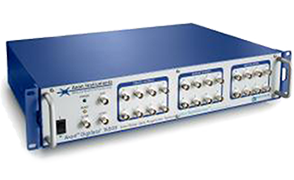
The Digidata 1440A digitizer is a high-speed, low-noise data acquisition system designed to allow fast continuous data recording to disk. One of the main attractions of the Digidata 1440A digitizer for scientific use is the low noise of the system: just 1 mV average peak-to-peak noise on the analog inputs. The combination of 16-bit performance and low noise adds up to a very high effective resolution.

The Digidata 1440A has a maximum 250 kHz analog input sampling rate, sustainable over all 16 input channels, with a ±10V analog input range. Additional BNCs include four analog outputs, eight digital outputs, "Tag" and "Start" trigger inputs, and an oscilloscope-style trigger output.

The complete system consists of a rack-mount ready BNC interface, a USB 2.0 cable, a USB 2.0 PCI adapter (for computers without USB 2.0), and an external power supply. The AxoScope program is supplied for use with Windows 2000 and XP Pro.

Signal Conditioners

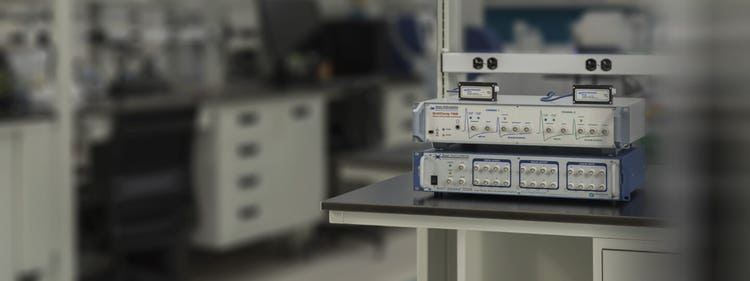
The CyberAmp 380 and 320 computer-controlled signal conditioners are used in conjunction with any laboratory data acquisition and control system. Both provide Bessel low-pass filtering (4-pole on the CyberAmp 380 and 8-pole on the CyberAmp 320), AC/DC coupling, notch filtering, variable gain, and baseline correction. There are eight independent analog channels on the CyberAmp 380 and two independent channels on the CyberAmp 320. In addition to a BNC analog input, each channel can accept a SmartProbe which automatically identifies the attached electrode or transducer to the control software. An audio monitor, chart recorder outputs and calibration signal outputs are included on the CyberAmp 380.

The AI 400 series SmartProbes contains a range of differential amplifiers, a current-to-voltage converter, and a passive adapter for EMG, ECG and EEG. SmartProbe Kits can be used to create adapters for most popular physiological transducers for pressure, temperature, fluid flow, displacement, etc.