Molecular Devices Home
Careers  |  Contact Us  |  Search:   


Introduction to Microelectrode Amplifiers

Molecular Devices offers a complete line of microelectrode amplifiers for voltage recording, current and voltage clamping, and patch clamping. The wide choice of headstages designed for specific applications and the various features incorporated into these amplifiers make them ideal instruments upon which to base an electrophysiology workstation.

This introduction provides basic characteristics and requirements of microelectrode amplifiers, and the many important features that enable MDC's Axon Instruments amplifiers to meet your requirements.


Amplifier Functions

Electrophysiological measurements involve amplification of small, fast signals. In order to be useful, these measurements must be accurate, low in noise, stable and reliable. A microelectrode amplifier measures current or voltage and passes that measurement on for recording and analysis. Most often, this requires that the amplifier reliably amplify a signal, since the voltages and currents of interest are usually very small. Microelectrode amplifiers must also control current and voltage in current-clamp and voltage-clamp mode. MDC amplifiers incorporate many features that take them far beyond these minimal requirements. Additional features such as series resistance compensation, capacity compensation, low-pass filters, square-wave generators, holding potential control, automatic telegraphing of gain and capacitance settings to acquisition equipment, and audio monitors make Axon amplifiers the central component of microelectrode and patch-clamp workstations.

Extracellular Voltage Recording

A common requirement in electrophysiological research is voltage recording. Single-unit recordings and field potentials in brain or brain slice, electrocardiograms, myograms, encephalograms and oculograms all require measurements of small biological potentials. These are often less than a millivolt in amplitude. The Axoclamp-2B, GeneClamp 500B and MultiClamp 700B microelectrode amplifiers may be used for such experiments. The CyberAmp signal conditioner is also designed for voltage recording.

Voltage Clamp

The goal of a voltage clamp experiment is to measure membrane current. To do this, one monitors the membrane voltage and injects current to attain and maintain the desired voltage. Hence, a voltage-clamp amplifier must be able to: 1) measure voltage and 2) pass current in order to regulate the cellular voltage. The Axoclamp-2B, Axopatch 200B, GeneClamp 500B, and MultiClamp 700B amplifiers are all excellent voltage-clamp amplifiers.

Patch-Clamp

Patch-clamp refers to the technique of using a blunt pipette to isolate a patch of membrane. Patch-clamp recording can measure the individual ion channel currents that contribute to whole-cell currents. The patch-clamp technique is compatible with current-clamp and voltage-clamp recording modes. If the patch of membrane underneath the pipette is ruptured or otherwise made permeable, the technique is further referred to as "whole-cell patch-clamping." In this case, the currents passing through the entire cell membrane are recorded. This is equivalent to intracellular recording with sharp microelectrodes, but has the advantage that it can be applied to even very tiny or flat cells that would be impossible to impale otherwise.

The Axopatch 200B and MultiClamp 700B are excellent amplifiers for both modes of patch-clamp recording. A separate patch-clamp headstage is available for the GeneClamp 500B to enable it for single-channel measurements. The Axoclamp-2B is capable of performing whole-cell voltage clamp with its continuous Single-Electrode Voltage Clamp (cSEVC) mode.

Most single-channel patch-clamp amplifiers, including the MultiClamp 700B and GeneClamp 500B, use resistive headstages. For the ultimate in low-noise recording, a capacitor-feedback (or integrating) headstage is standard with the Axopatch 200B. This amplifier offers the dual advantages of lower noise and wider bandwidth than resistive headstages. With the introduction of the innovative active cooling of headstage circuit components, the Axopatch 200B achieves the lowest noise levels ever.

Two-Electrode Voltage Clamp

The magnitude of the transmembrane current varies greatly between cell types. Two electrodes, one for passing current and one for measuring voltage, are best for clamping large cells with large currents. The Axoclamp-2B and GeneClamp 500B amplifiers are specifically designed for such measurements using the Two-Electrode Voltage-Clamp (TEVC) mode.

Current Clamp

Current-clamp amplifiers are designed to control the current and measure the corresponding membrane voltage. It is common to pass current to stimulate a cell or modify its resting potential during intracellular voltage recording. The Axoclamp-2B, GeneClamp 500B and MultiClamp 700B amplifiers are able to pass current while in voltage-sensing (i.e., current-clamp) mode. The Axopatch 200B patch-clamp also offers a current-clamp mode, which can be used to monitor membrane potentials and to follow (with some distortion) action potentials. The current-clamp performance of the Axopatch is not as fast as the aforementioned amplifiers, because the circuitry was not specifically designed for following voltage.

Discontinuous Clamp

The Axoclamp-2B amplifier offers special recording modes referred to as "discontinuous," applicable to both voltage clamp (dSEVC) and current clamp (dCC). In this mode the instrument divides its time in passing current and recording voltage. The advantage of this mode is that the recording is free from the usual error due to the voltage drop across the electrode resistance. It also can be used with a conventional intracellular microelectrode. On the other hand, dSEVC is much harder to set up than cSEVC and requires frequent fine-tuning of the controls as the microelectrode resistance drifts. The amount of noise in dSEVC is about two to three times greater than in cSEVC.

Ion-Selective Electrodes and Electrochemistry

Ion-selective electrodes, voltammetry and constant-voltage amperometry have been used to measure levels and small changes in ion, neurotransmitter and hormone concentrations in tissues or in and near cells. These techniques require the ability to record small potentials and pass large currents.

Ion-selective electrodes require differential input, low leakage current and high-impedance voltage following. With appropriate headstages, the Axoclamp-2B amplifier is well suited to this application. The electrochemical techniques of voltammetry and constant-voltage amperometry are used to measure fast changes in neurotransmitter concentrations. These techniques require a voltage-clamp amplifier with a command voltage range extended to ±1V. The Axopatch 200B, GeneClamp 500B and MultiClamp 700B amplifiers are all capable of delivering such a command.


Amplifier Features

In addition to their unequaled low-noise amplification performance, Axon amplifiers offer many features that provide exceptional versatility and convenience. Some of these features are described below. For more detailed information, see specifications for each amplifier on their respective web pages. Also consult The Axon Guide, an indispensable reference that is downloadable from this web site.

Series Resistance Compensation

This is a standard feature of the Axoclamp-2B, Axopatch 200B and MultiClamp 700B that reduces the voltage-clamp error due to the voltage drop across the resistance of the electrode.

Capacitance Compensation

This function compensates for the capacitance associated with the pipette and the input of the operational amplifier. If left uncompensated, the capacitance results in a reduction of the recording bandwidth. This feature is standard on the Axoclamp-2B, GeneClamp 500B and Axopatch 200B amplifiers and contributes to their excellent noise and bandwidth characteristics. The Axopatch and MultiClamp amplifiers offer two pairs of pipette capacitance compensation controls, and in addition, compensation for cell capacitance in the whole-cell mode.

Low-Pass Filters

Filters allow the recording bandwidth to be optimized for a particular acquisition rate or phenomenon of interest. The Axopatch 200B, GeneClamp 500B and MultiClamp 700B amplifiers include built-in low-pass filters with a wide range of available settings that allow digital acquisition directly from the amplifier without need for additional external signal conditioning.

Telegraphs

Telegraph information simplifies experimental procedures and ensures accurate scaling and record keeping. These outputs convey gain, low-pass filter and whole-cell capacitance settings to a computer from the Axopatch 200B or GeneClamp 500B amplifiers. The MultiClamp 700B offers additional information, including scaling factors and operating mode (voltage or current clamp). Telegraphs are supported in Axon's pCLAMP data acquisition software.

Buzz, Clear and Zap

These features make cell penetration and patch rupture easier and more reproducible. Buzz drives a brief, high-frequency oscillatory current through the microelectrode which assists penetration. Clear drives a large positive or negative current through the microelectrode, either to assist in cell penetration or to clear blocked microelectrode tips. These features are available with the Axoclamp-2B and MultiClamp 700B amplifiers. Zap applies a large potential to the membrane patch, which is often sufficient to rupture the patch and begin recording in whole-cell mode. Zap is available with the Axopatch 200B and MultiClamp 700B amplifiers.

Blanking

This prevents the stimulus artifact from entering the amplifier circuit, and enables recording to begin immediately after the stimulus terminates. This feature is offered with the Axoclamp-2B and Axopatch 200B amplifiers.

Bridge Balance

This offset procedure eliminates the voltage drop that would otherwise occur across an uncompensated electrode resistance in current-clamp mode. The Bridge Balance feature is available on the Axoclamp-2B and MultiClamp 700B amplifiers. With the Axopatch 200B, the Series Resistance knob can be used in current-clamp mode to accomplish the equivalent.

Bath Headstages

Allow for measurement, compensation and control of the voltage drop across the bath resistance, an important consideration when measuring large currents. The Axoclamp-2B, GeneClamp 500B and MultiClamp 700B amplifiers offer such headstages, allowing accurate measurement of currents as large as 10 microamperes.

Capacitance Measurements

The Axopatch 200B includes a capacitance dithering feature that provides the capability to measure small changes in cell membrane capacitance. With the included series resistor dither, one can use phase tracking to continuously monitor cell capacitance.


Choosing the Best Amplifier for Your Application

Molecular Devices makes the best microelectrode and patch-clamp amplifiers available. To quickly compare the features of all the amplifiers, go to the Amplifier Comparison Table.

MultiClamp 700B
resistor-feedback patch clamp and true current clamp

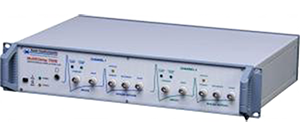
A computer-controlled patch-clamp and current-clamp amplifier can be switched in either of two headstages. Offsets, series-resistance and capacitance compensation can be performed automatically in software. Built-in command generators (including Seal Test), a variable-cutoff low-pass Bessel filter, leak subtraction, variable output gain, RMS noise monitor, Track, Zap, and an audio monitor are all standard features. The MultiClamp 700B has four different feedback resistors for single-channel or whole-cell voltage clamp, and three different current-passing ranges in current clamp.

Axopatch 200B
capacitor-feedback patch clamp

The Axopatch 200B patch-clamp amplifier achieves ultra-low noise in single-channel mode with its cooled, capacitor-feedback design. It features excellent bandwidth in single-channel, whole-cell and current-clamp modes - all with one standard headstage. Membrane capacitance and electrochemical measurements capability are standard. An enhanced series resistance compensation circuit allows separate control of prediction and correction. Its improved current clamp circuit includes series resistance compensation and a choice of "normal" and "fast" for increased stability. The Axopatch 200B's features include Zap, scaled output gains, variable low-pass filters and leak subtraction.