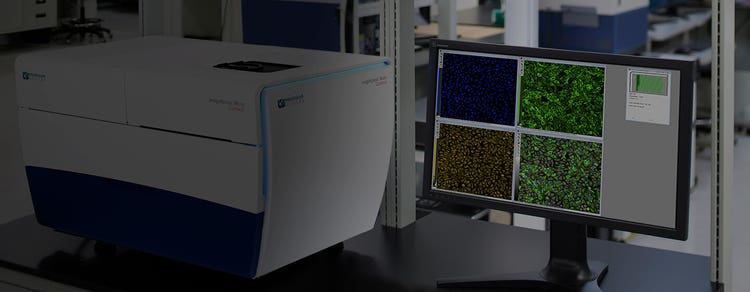
18 Application Modules allow MetaXpress Software users to automate common analysis routines and accommodate 100's of applications (see the applications tab).
Interactive Environment guides users through the determination of features of interest.
 |
| 1. Objects are measured in the image then optimized with interactive plots, histograms, and color coded overlays for individual classifications. 2. Cell-by-Cell Display of classifications and data enables researchers to optimize settings based on positive and negative control images. 3. Settings saved within MDCStore™ Database can be used to re-analyze a set of wells or multiple plates using MetaXpress® Software, or for faster processing, the MetaXpress® PowerCore™ Software. |
Adaptive Background Correction mitigates poor sample quality while improving image segmentation.
 |
| All MetaXpress Software Application Modules are equipped with an adaptive background correction algorithm to mitigate poor sample quality while improving image segmentation. (Left) Unevenly stained sample before segmentation (Center) after conventional segmentation, some of the features are not identified (Right) with Adaptive Background Correction, all the features are identified. |
Field-by-Field Data, Cell-by-Cell Data, and Segmentation Overlays are made available to ensure in-depth downstream analysis such as gating cell populations or reviewing accuracy of segmentation (Note: The Transfluor® HT, Cell Proliferation HT and Nuclear Translocation HT Application modules have been optimized for speed and do not provide cell-by-cell data or segmentation overlays).
 |
|
Field-by-field (summary) data, cell-by-cell (cellular) data, and segmentation overlays are made available to ensure in-depth downstream analysis.
|
Customization of Application Modules for research and assay development can easily be achieved by amending journals to Application Modules (Note: the resulting analysis will not be compatible with analysis with the MetaXpress PowerCore Software).
Speed for Screeners with a series of option to acquire and analyze data faster, including on-the-fly cell counting and high-throughput image analysis using the MetaXpress® PowerCore Software.
The MDCStore™ Data Management Solution seamlessly integrates the Molecular Devices complete set of tools for image acquisition, image analsyis and cellular informatics, providing off-the-shelf capabilities to generate and interrogate data.
AdTech Global Solutions provides validated and optimized hardware and services for the Molecular Devices software applications. Designed and purpose built for high performance and heavy workloads, these workstations and servers provide reproducible high quality results and are supported with Professional Services and Support centers catering to the needs of Molecular Devices customers.
Images acquired using the dedicated IsoCyte Software can be imported into the MDCStore Data Management Solution via the MetaXpress Software for analysis.
- IsoCyte Laser Scanning Cytometer for high speed, whole well imaging
Also see applications for the ImageXpress® Micro and the ImageXpress® Ultra Systems.
| Application |
MetaXpress Software Application Module |
| Tube/vessel formation/inhibition in angiogenesis or development |
Angiogenesis tube formation
|
| Cell Viability, Membrane potential, Cytotoxicity, Apoptosis |
Live/dead, Cell cycle, Multi Wavelength Cell Scoring, Cell Health
|
| Cell Cycle, Mitosis, Apoptosis, Cell proliferation |
Mitotic Index, Cell cycle, Count nuclei, Cell Proliferation HT, Live/dead |
| Cell migration |
Count nuclei, Cell Proliferation HT |
| Cell counting |
Count nuclei, Cell Proliferation HT |
| Determination of cell health and proliferation in populations of mono-, bi- and multi-nucleated cells |
Micronuclei |
| Micronuclei and genotoxicity analysis |
Micronuclei |
| Kinase activation |
Cell scoring, Multi Wavelength Cell Scoring |
| Fatty acid uptake, Adipogenesis |
Cell scoring, Multi Wavelength Cell Scoring |
| Transfection efficiencies |
Cell scoring, Multi Wavelength Cell Scoring |
| Protein Expression |
Cell scoring, Multi Wavelength Cell Scoring |
| Cell Signaling by translocation |
Translocation, Nuclear Translocation HT and Multi Wavelength Translocation |
| Pathway analysis and multiplexing |
Multi Wavelength Cell Scoring |
| Studying intracellular structures |
Transfluor, Transfluor HT and Granularity |
| Receptor internalization |
Transfluor, Transfluor HT and Granularity |
| Punctate staining |
Transfluor, Transfluor HT and Granularity |
| Clustering of target molecules |
Transfluor, Transfluor HT and Granularity |
| Process extension, neurodegenerative or neuroregenerative disease research |
Neurite Outgrowth |
| Protein movement |
Translocation, Nuclear Translocation HT and Multi Wavelength Translocation |
| Cell pathway analysis |
Translocation and Nuclear Translocation HT |
| Protein modification (e.g. phosphorylation) |
Cell scoring, Multi Wavelength Cell Scoring |
| Mitochondrial localization |
Translocation |
| Detect monopolar spindles |
Monopole Detection |
| RNAi (treatment of cancer, neurological disorders, viral infection, hemophilia, and premature aging) |
Cell Health, Cell Cycle, Micronuclei, Neurite Outgrowth, Angiogenesis Tube Formation, Translocation and Multi-wavelength cell scoring |
| Embryonic/induced pluripotent stem cells, cell differentiation |
Neurite Outgrowth, Translocation, Cell scoring and Multi Wavelength Cell Scoring |
| Budding Yeast |
Micronuclei |
Micronuclei Application Module classifies micro-nucleated cells with great details for genotoxicity applications but is also ideal for cell health and multi-nucleated cell populations with additional markers for analysis of apoptosis, necrosis or to distinguish any small structure next to a large one such as a yeast bud.
- Highly accurate classification of micro- and multi-nucleated (mono-, bi-, etc.) cells achieved with proprietary algorithm to discriminate phenotypes based on cell morphology, number of nuclei, distance of micronuclei from nucleus, micronuclei vs. "blebs" or "buds".
- Only requires a single fluorophore (nuclear stain) to identify cells in various classifications, eliminating the requirement for a cytoplasm stain, thereby reducing sample preparation, image acquisition and analysis time.
- Use of two additional markers facilitates further phenotypic analysis, such as transfection markers to identify transfected cells or kinetochore markers to differentiate micronuclei originating from clastogens (which create acentric chromosomal fragments) from aneugens (which cause whole chromosomal losses).
 |
| Micronuclei Application Module: Images of cells before (left) and after (right) image segmentation with the Module. Examples detected by the application module are indicated. In total, more than 60 measurements per image and 30 measurements per cell are available to assist with identification of the wide range of phenotypes associated with micronuclei studies |
Neurite Outgrowth Application Module is designed to measure and characterize outgrowths (length and branching), the extension of axonal processes from the cell body, which are natural parts of neuronal development. Inhibition or stimulation of neurite outgrowth is implicated in a broad range of CNS disorders or injuries including stroke, Parkinson's disease, Alzheimer's disease, and spinal cord injuries.
- Unique assay that cannot be performed without imaging.
- Provides consistent results faster than manual tracing and counting.
 |
 |
| Neurite Outgrowth Application Module: (Left) After image acquisition. (Right) After image segmentation. Each filament is assigned to a cell body. All the filaments and cell bodies are then measured. (Courtesy of Kris Poulsen and Davide Foletti, Rinat Neuroscience Corporation). |
Angiogenesis Tube Formation Application Module facilitates the acquisition and analysis of tube formation experiments, a model system for angiogenesis in research focused on the promotion or inhibition of blood vessel formation (cancer, diabetes and other vascular disease research). Specific kits available from leading manufacturers and this area of research increasing in popularity with success of drugs such as Genentech's Avastin which blocks VEGF activity (Reference and list available of other similar drugs in clinical trials).
- Captures the three-dimensional behavior of tubes utilizing Z-stack acquisition available through the MetaXpress Software. A best focus image is calculated from the stack and tubes and nodes are identified and quantified from that image.
 |
 |
 |
| Angiogenesis Tube Formation Application Module: Human Mammary Epithelial Cells (HMEC-1) tube formation. (a) 3D Acquisition (b) Best focus algorithm (c) image analysis with the module (Data courtesy of BD Biosciences) |
Mitotic Index Application Module is designed for the quantitative discrimination of mitotic and interphase cells, a critical tool for oncology drug discovery programs, providing insight into potential anti-cancer therapeutics that rely on arresting mitosis in cancerous cells to prevent uncontrolled proliferation.
 |
| Mitotic Index Application Module: (Left) CHO-K1 cells treated with Nocodazole for 18 hours before staining with anti-phospho-Histone H3 (Ser28). 50 ng/mL Nocodazole. (Right) green: mitotic, red: interphase. |
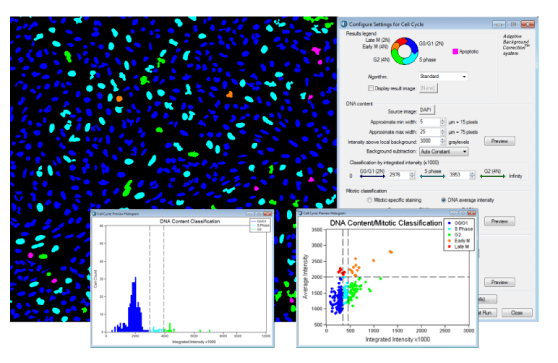
Cell Cycle Application Module classifies and quantifies cells in various stages of the cell cycle to investigate cell cycle progression. In healthy non-cancerous cells, challenges with DNA damage, hypoxia, metabolic changes or spindle disruption result in the triggering of checkpoints and cell cycle arrest. Cancerous cells commonly lose checkpoints and divide uncontrollably, even in challenging conditions. With the appropriate tools, researchers can screen for drugs that cause cell cycle arrest or cell death in cancerous cells.
- Differentiates 5 phases of the cell cycle using only a nuclear stain (G0/G1, S, G2, Early or Late M).
- Optional detection of mitosis with specific fluorophores to better distinguish M-phase cells when using low magnification.
- Optional detection of apoptotic markers to detect conditions that trigger apoptosis.
- Interactive color-coded graphs to easily set classification cutoffs.
 |
| Cell Cycle Application Module: classification and quantification of cells in 5 phases of the cell cycle; additional use of an apoptotic marker to determine the apoptotic status of cells. Interactive color coded graphs allow to easily set classification cutoffs. |
Monopole Detection Application Module monitors the disruption of the formation of bipolar spindles, a successful mechanism used by drugs such a Monastol to stop the progression of cancerous cells through mitosis. The module quantifies mitotic cells with monopolar or bipolar spindles in cells stained with a DNA probe and a microtubule probe.
 |
 |
| Monopole Detection Application Module: (Left) 3T3-L1 mouse fibroblast cells treated with monastrol and stained with mouse anti-beta tubulin primary antibody detected with a FITC conjugated goat anti-mouse secondary antibody. Nuclei are stained with Hoechst 33342. (Right) the module identifies interphase cells (red), bipolar spindles (blue) and monopoles (green). |
Cell Scoring Application Module is a general and flexible solution to identify subpopulations of cells tagged with a second fluorescent probe and is ideal to examine transfection efficiencies, kinase activation (pathway analysis) or adipogenesis.
Multi Wavelength Cell Scoring Application Module enhances the functionality of the Cell Scoring Application Module to include configuration of your own custom module to score populations of cells.
- Customize wavelength to match your research.
- Interactive graphics link scoring data between individual wavelengths and full multi-wavelength profiles to help optimize settings
- Up to 7 probes (including Nuclear probe) to customize your analysis of 7 markers (or analyze the same marker with different settings)

Count Nuclei, Cell Proliferation HT Application Module automate accurate counting of nuclei for most types of cells and are ideal for the study of cell proliferation, cell counting or cell migration (chemotaxis assays using BD FalconTM HTS FluoroBlock assay). These advanced modules count nuclei even when the background is uneven, providing superior segmentation compared to simple thresholding.
- All modules identify nuclei, taking into consideration nuclear size and varying background and splitting touching objects.
- More consistent between users and faster than manual counting.
- Cheaper than radioactive counting
- Easier and faster than flow cytometry, which requires trypsinization of cells and is a low throughput method.
- Cell Proliferation HT Application Module is a high throughput version of the Count Nuclei Application Module, (about 1 minute for 96-well plate at one site per well without the MetaXpress® PowerCoreTM Software) with a simplified detection algorithm, which provides site summary data only (not cell-by-cell) and does not save segmentation overlays to the MDCStore Database.
 |
| Count Nuclei Application Module: (Left) Image has uneven illumination and touching cells (Right) the module identifies touching cells as separate objects (as indicated by the red arrow). Adaptive Background CorrectionTM compensates for the variable background intensity - even when background intensity in one area of the image is greater than nuclei intensity in another area. |
Cell Health Application Module classifies cells in viable, early apoptosis, late apoptosis or necrosis.
- Validated with most common flow cytometry kits such as Vybrant #7 from Molecular Probes, Annexin V detection, or JC-1 combined with Hoechst to study loss of mitochondrial potential.
 |
 |
| Cell Health Application Module: (Left) Cells were treated with 1 μM Staurosporine for 12 hours and stained with Hoechst 33342, YO-PRO-1 and PI (Right) Image analysis results are shown as a colored overlay on the source image. Viable nuclei are shown in green. Early apoptotic nuclei are shown in blue. Late apoptotic nuclei are shown in purple. Necrotic nuclei are shown in red. |
Live Dead Application Module is compatible with commercially available Live/Dead assay kits designed to study cell proliferation or death. Common applications monitor cell proliferation associated with cancer, premature cell death involved in neuromuscular diseases such as Alzheimer's and Parkinson's, in addition to cytotoxicity and apoptotic events.
- Probes can target any part of cell, does not require a nuclear marker
 |
| Live Dead Application Module: (Left) 1 µM Staurosporine. CHO cells in one 96-well plate at ~10,000 cells per well. Cells were incubated for ~24 hours and apoptosis was induced by incubating different concentrations of Staurosporine for 6 hours. Assay kit used: Molecular Probes, Vybrant Assay Kit #7. (Right) Live/dead cells are identified simultaneously. |
Granularity, Transfluor and Transfluor HT Application Modules facilitate the analysis of punctate structures such as the one observed during clustering of target molecules for receptor internalization or within the nucleus or even the punctate patterns of mitochondria.
- Granularity, Transfluor® and Transfluor® HT Application Modules all detect punctate structures
- Transfluor Application Module detects both pits and vesicles simultaneously and is optimized for the Transfluor universal GPCR assay.
- Transfluor HT Application Module is a high throughput version of the Granularity Application Module for fast screening (about 1 minute for 96-well plate at one site per well without the MetaXpress® PowerCoreTM Software) with a simplified detection algorithm, which provides site summary data only (not cell-by-cell) and does not save segmentation overlays to the MDCStore Database.
 |
 |
| Transfluor Application Module: (Left) using standard thresholding can result in incorrect grain counts (orange). (Right) with the module, Pits (white), vesicles (red) and nuclei (green) can be simultaneously segmented, saving analysis time. Grains are accurately identified even in cells with high background (red arrow). Images courtesy of Xsira Pharmaceuticals. |
 |
 |
| Transfluor HT Application Module: (Left) Phagocytosis is detected by a fluorescently labeled antibody in green. Cells are detected with a nuclear dye in blue. (Right) The module identifies nuclei in blue and phagocytic structures in red. |
Translocation, Translocation-Enhanced, Multi-Wavelength Translocation and Nuclear Translocation HT Application Modules quantify the correlation between probes and compartments with four modules available to fit your needs.
- The Translocation Application Module is ideal to study general cellular component movement from the cytoplasm to the nucleus and needs a minimum number of adjustments.
- The Translocation-Enhanced Application Module offers increased functionality over the Translocation Application Module with finer definition of regions for translocation and the option to study translocation in and out of non-nuclear compartments such as mitochondria.
- The Nuclear Translocation HT Application Module is for the fast analysis of translocation in and out of the nuclear compartment (about 1 minute for 96-well plate at one site per well without MetaXpress® PowerCoreTM Software) with a simplified detection algorithm, which provides site summary data only (not cell-by-cell) and does not save segmentation overlays to the MDCStore Database.
- The Multi-Wavelength Translocation Application Module lets you analyze the translocation of up to 6 probes simultaneously (or the same probes with various settings), in addition to the nuclear probe.
 |
 |
 |
| Translocation Application Module: (Left) no translocation, (Center) translocation, (Right) green indicates positive for translocation. Courtesy of Michael Sjaastad. |
- Cell Cycle Application Module, 9500-0040
- Cell Health Application Module, 9500-0035
- Cell Proliferation HT Application Module, 9500-0042
- Cell Scoring Application Module, 9500-0037
- Count Nuclei Application Module, 9500-0017
- Granularity Application Module, 9500-0032
- Live/Dead Application Module, 9500-0034
- Micronuclei Application Module, 9500-0045
- Mitotic Index Application Module, 9500-0036
- Monopole Detection Application Module, 9500-0039
- Multi Wavelength Cell Scoring Application Module, 9500-0038
- Multi Wavelength Translocation Application Module, 9500-0044
- Neurite Outgrowth Application Module, 9500-0015
- Nuclear Translocation HT Application Module, 9500-0041
- Transfluor Application Module, 9500-0033
- Transfluor HT Application Module, 9500-0043
- Translocation Application Modules, 9500-0014
- Any 5 Application Modules, 9500-0117
- Any 10 Application Modules, 9500-0118
- Any 15 Application Modules, 9500-0119