 |
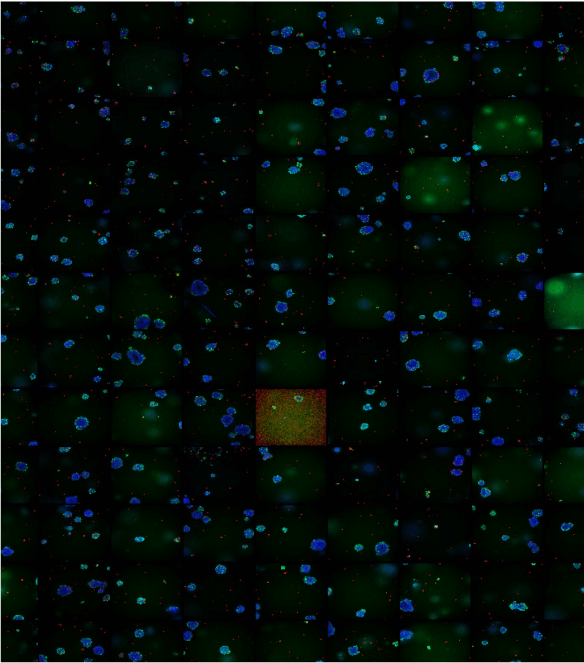
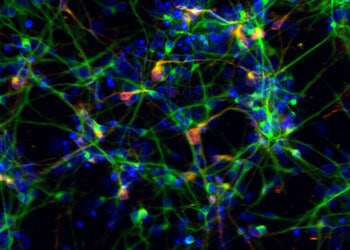
Images of Neurons were acquired and tiled from 6 sites. Each site is a long scan to capture a larger area. Note that the neurites perfectly align across mutiple sites for easy quatification with our software algorithms. |
- Software configurable field-of-view simplifies imaging of large objects like model organisms (c. elegans and zebrafish) and long structures similar to neuronal processes.
 |
|
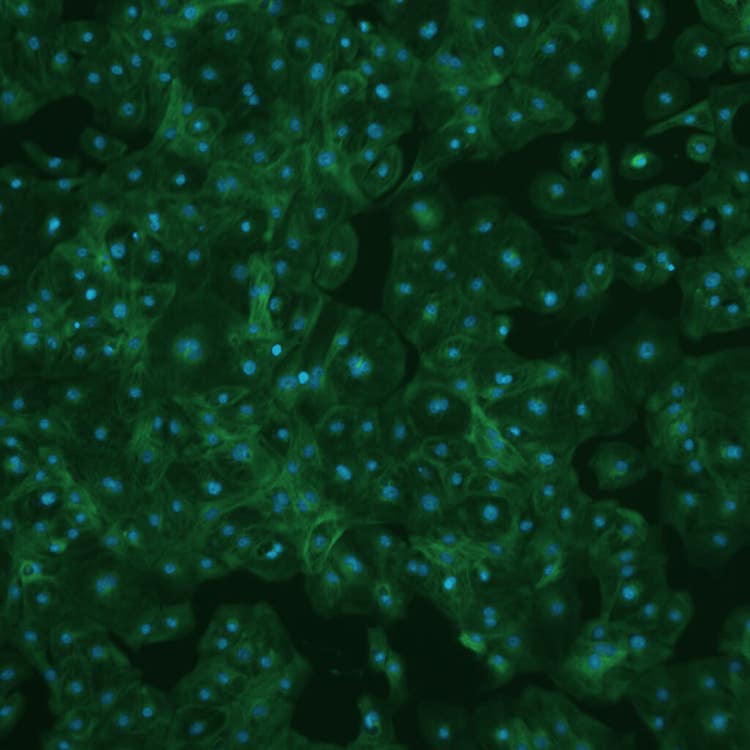
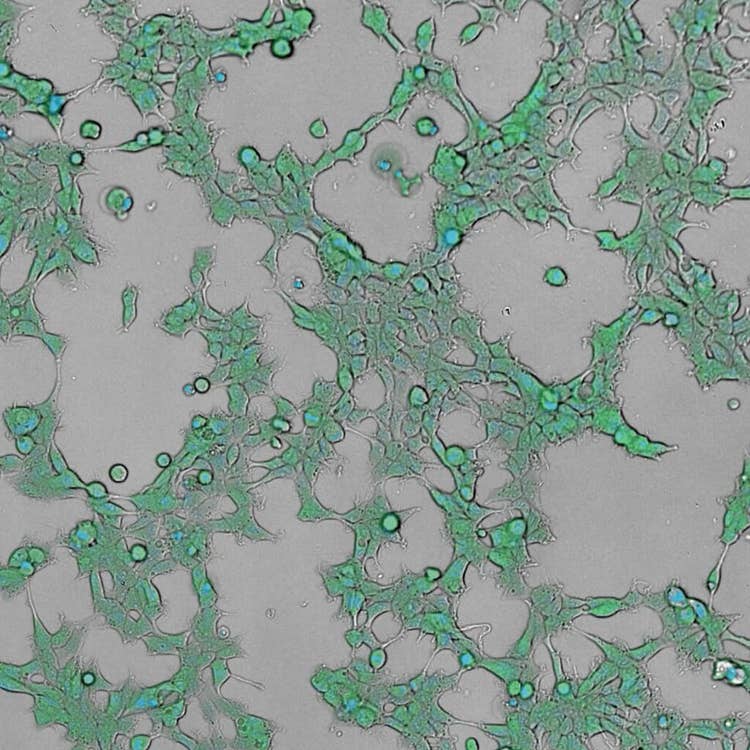
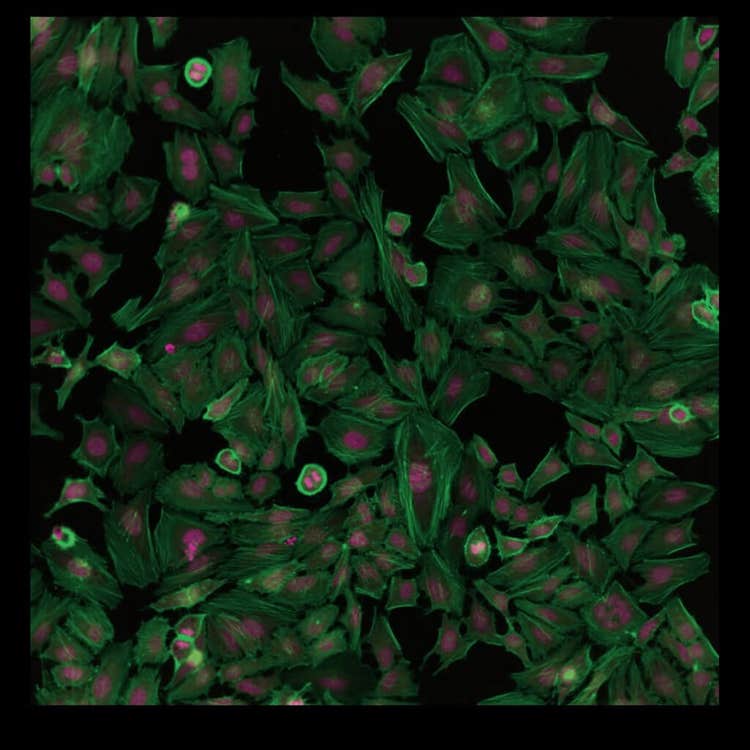
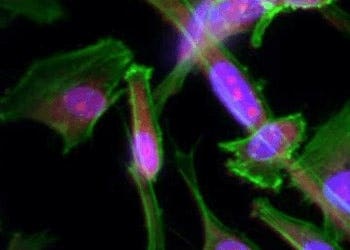
Long scan of cells stained with a cytosolic marker (green) and nucle (red). With a 20X objective scan lengths of up to 25.6 mm are possible
|
- Industry-leading autofocus option provides fast, reliable focusing with a dedicated 690 nm focus laser and ultra-fast sensors that will not bleach your sample while decreasing read times up to 5-fold.
- Custom design for screening enables capturing 25,000 wells per day in a 384-well microplate assay with a two color high quality assay (e.g., Transfluor ® beta-arrestin translocation assay). Lower resolution assays can be performed in excess of 100,000 wells / day.
- 4-position automated objective changer eliminates manual objective changes and allows automated switching of magnifications during a single experiment.
- Universal plate holder facilitates image acquisition using any clear bottom plate from 6-well to 1536-well, in standard height, low profile, or low volume.
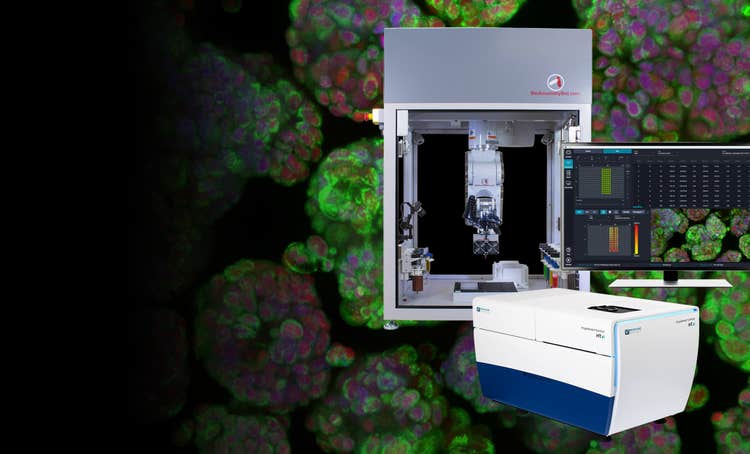
- Walk-away, 24/7 automation is achieved with the Thermo CRS CataLyst Express robotic plate handling system, enabling users to schedule multiple runs of one to three batches of 15 plates.
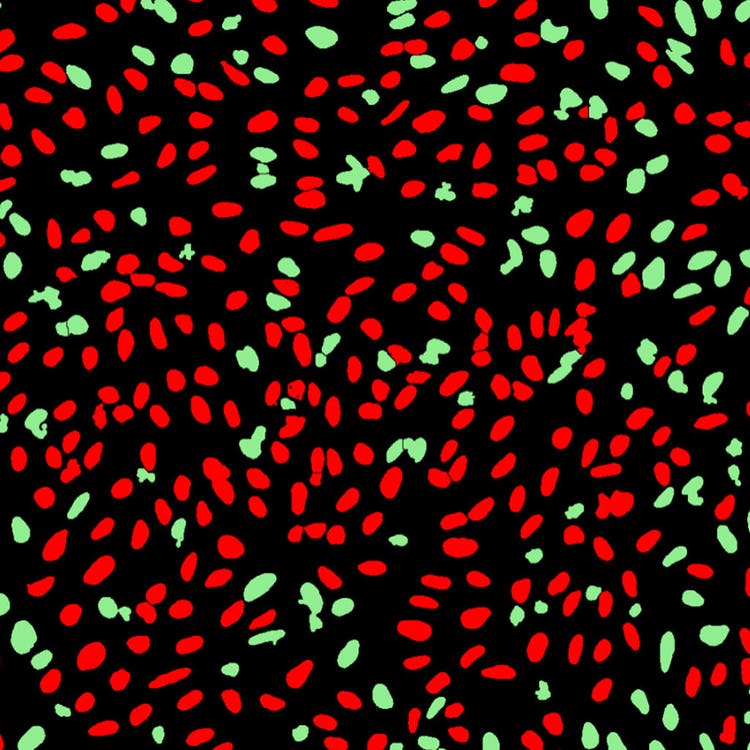
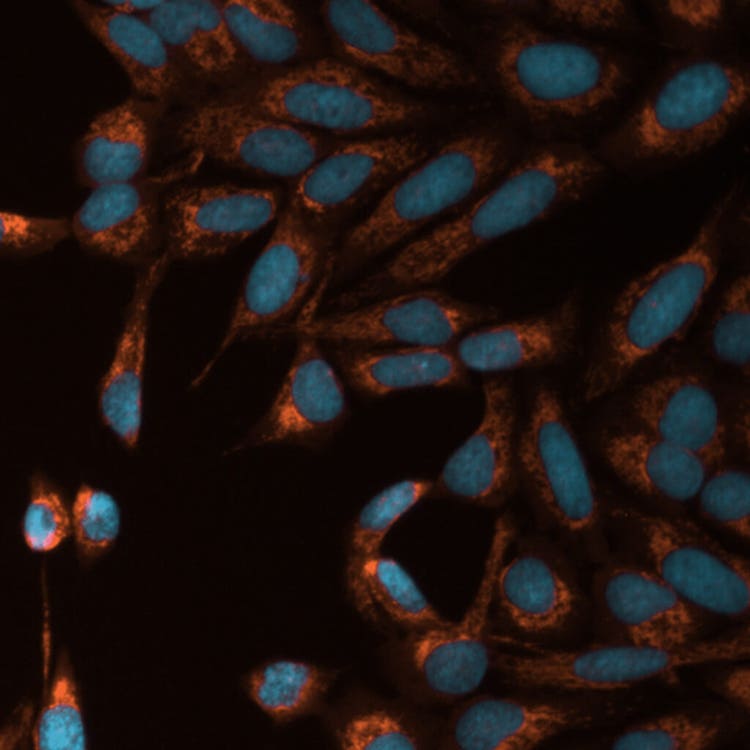
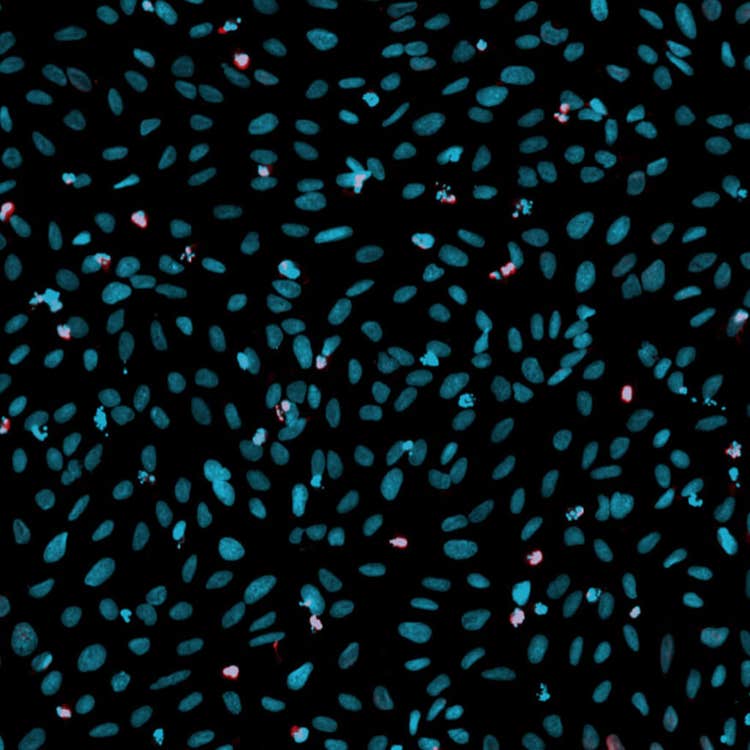
Screening: Compound or RNAi screening can be used to determine the mechanisms of action in the research or treatment of cancer, neurological disorders, viral infection, hemophilia, and premature aging. Many of these assays require the detection of one to four fluorescent markers along with the ability to resolve their colocalization. Multiple fluorophores can be imaged simultaneously or sequentially with the ImageXpress Ultra System and images overlaid for quantitating multiplexed cellular responses such as apoptosis, cell cycle, micronuclei, neurite outgrowth, angiogenesis, intracellular translocation, endocytosis, and cell signaling.
 |
 |
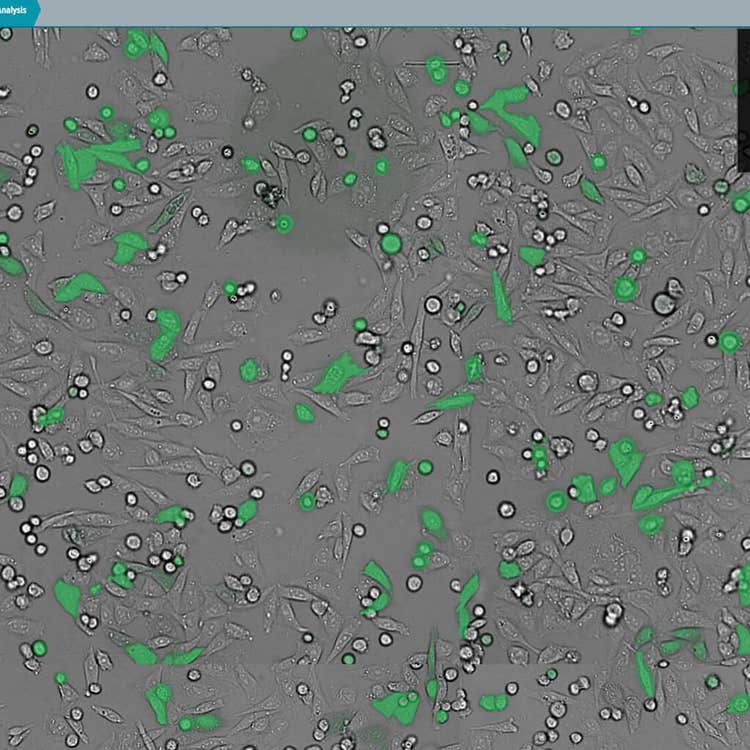
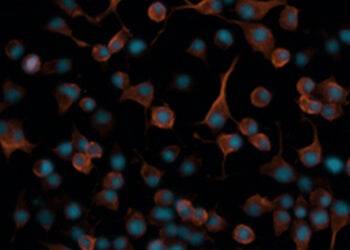
| Unstimulated Transfluor Expressing cells wtih cytosolic distribution of beta arrestin GFP. |
Stimulated Transfluor expressing cells with beta-arrestin GFP that has redistributed to vesicles. |
Click Here to learn more about analysis for Cell Health, Cell Cycle, Micronuclei, Neurite Outgrowth, Angiogenesis, Translocation, Multi-wavelength cell scoring and Granularity
Stem cells: Whether working with embryonic or induced pluripotent stem cells, the ImageXpress Ultra Confocal Imaging System provides insight into the complex molecular and genetic signaling events that underlie cell proliferation and differentiation. By combining our unique stitching algorithm with precise stage movements, accurate measurement of neuronal processes across multiple fields of view can be recorded. A stack of images can be captured in the Z-plane within each field of view. The Z series images can then be collapsed into a best-focus image or used to view the sample in 3 dimensions. Software modules will help you optimize your stem cell assays and characterize the resulting differentiated cells.
Click on these links to learn more about the following application modules: Neurite Outgrowth, Translocation, Cell scoring and Multi Wavelength Cell Scoring.
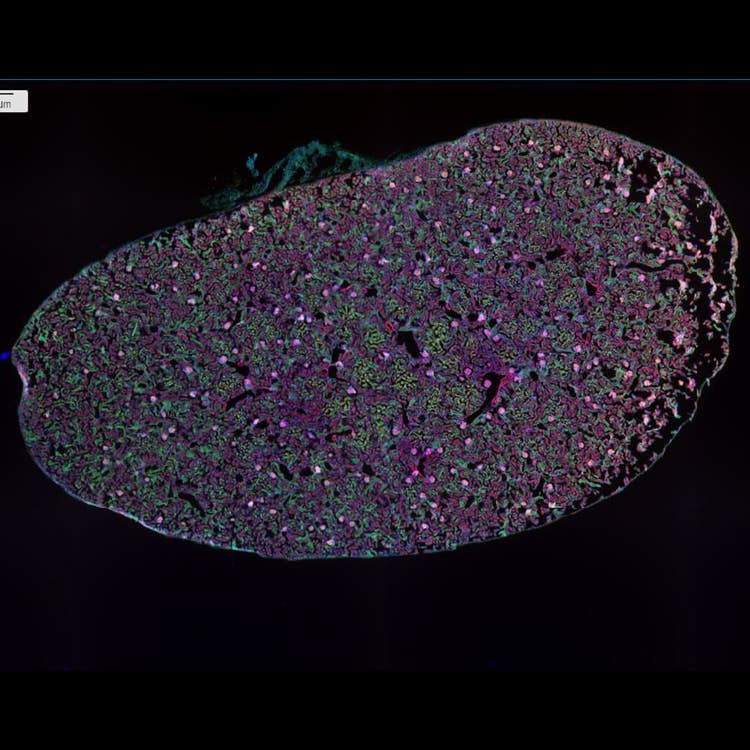
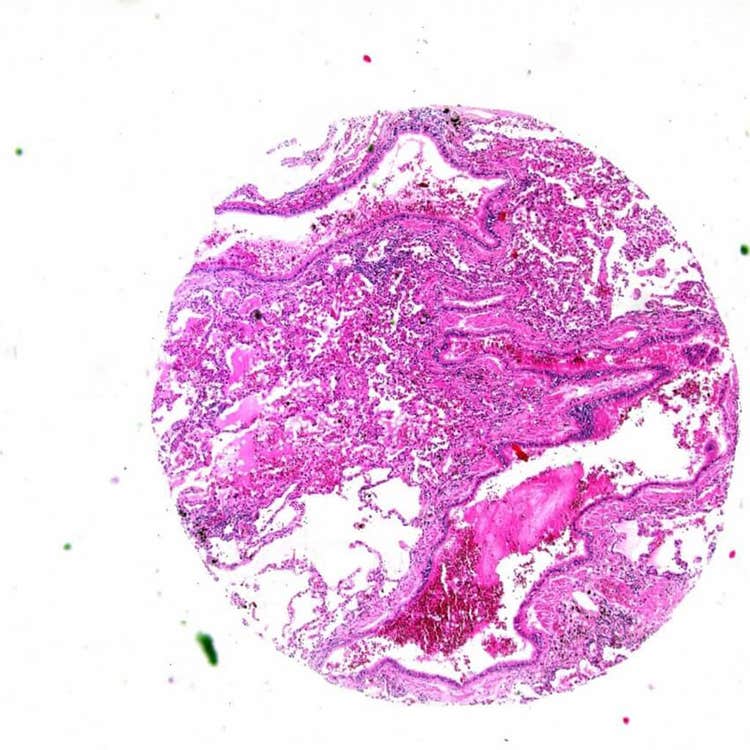
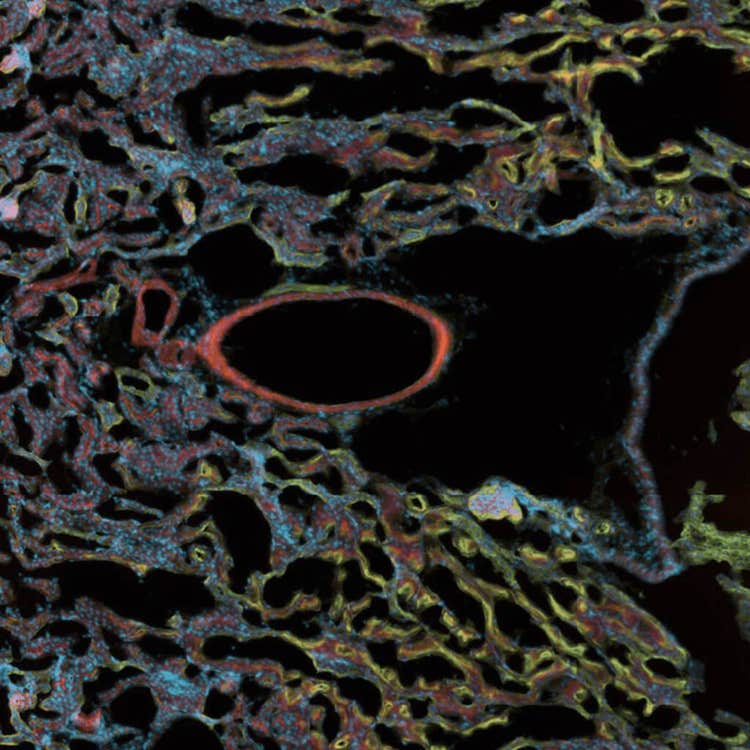
Thick samples: Some cells, particularly neurons or stem cells, must be grown on 3D matrices that can make focusing on the cells of interest a challenge. Additionally, tissue sections are typically at least 20 µm thick, and when stained, can be difficult to image due to high background fluorescence. The laser scanning confocal optics of the ImageXpress Ultra System make it ideal for viewing thick samples in microplates or on glass slides. A stack of crisp images can be captured in the Z-plane in as small as 100 nm increments. The Z series images can then be collapsed into a best-focus image or used to view the sample in 3 dimensions. Click on these links to learn more about the Neurite outgrowth and Angiogenesis application modules.
 |
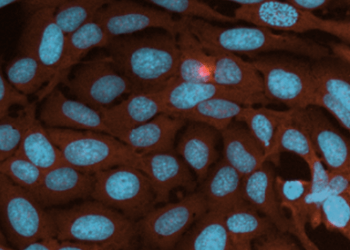
Mouse Kidney Section statined for nuclei (blue), actin filaments (green) and plasma membrane (red)
|
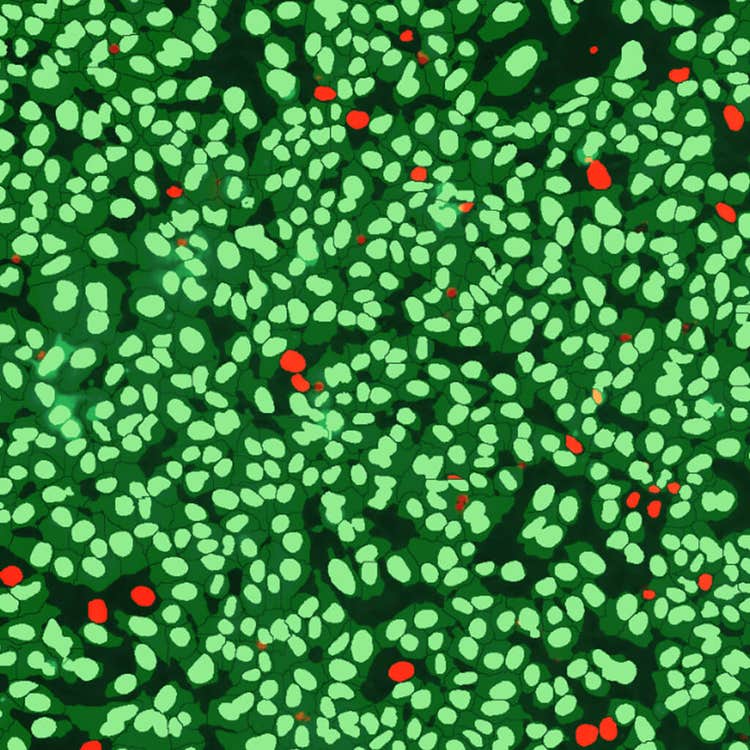
Additional applications: Images acquired with the top-of-the-line ImageXpress Ultra Confocal Imaging System can be analyzed using any of the numerous software modules that were developed in conjunction with researchers to address their specific applications needs. These modules are tailored to make it easy to perform both common (counting cells) and specialized analyses (counting micronuclei appearance due to addition of genotoxic compounds) required for HCS.
 |
 |
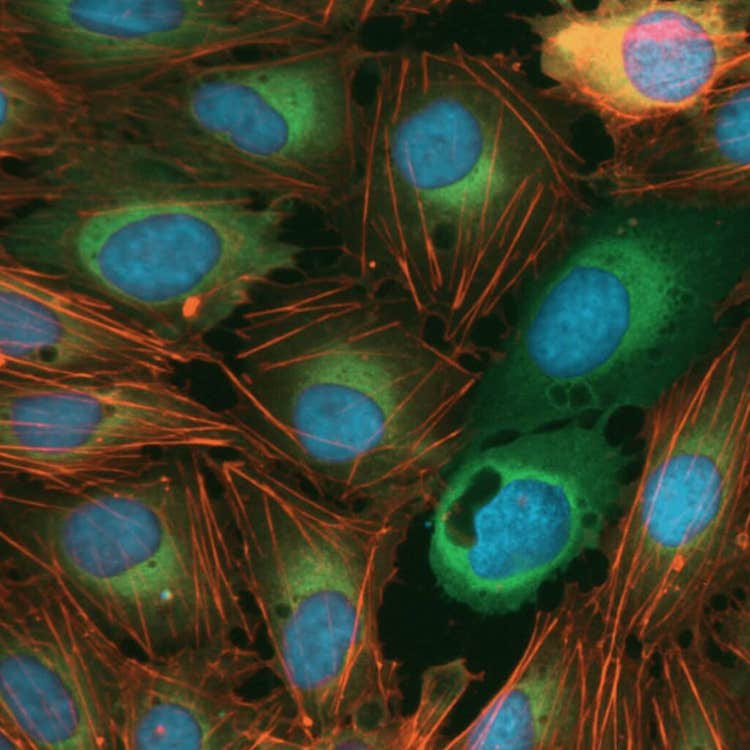
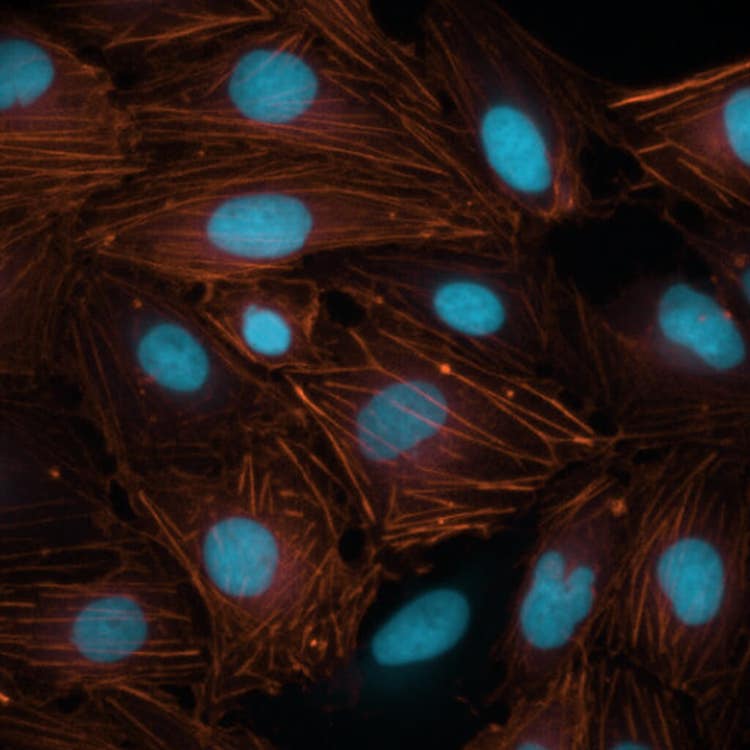
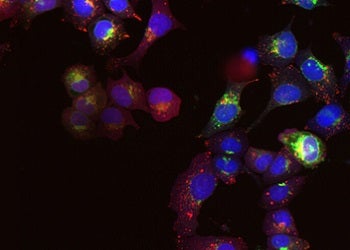
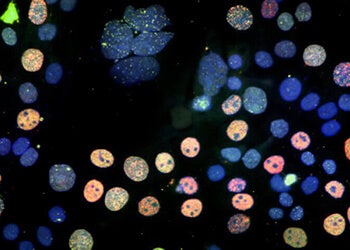
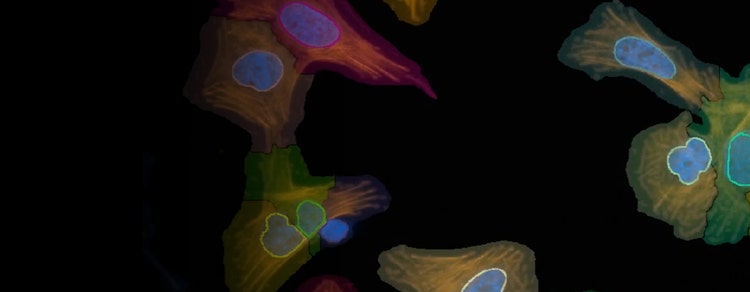
| Cells stained for Nuclei (Blue), actin filaments (green) and Mitochondria (Red) |
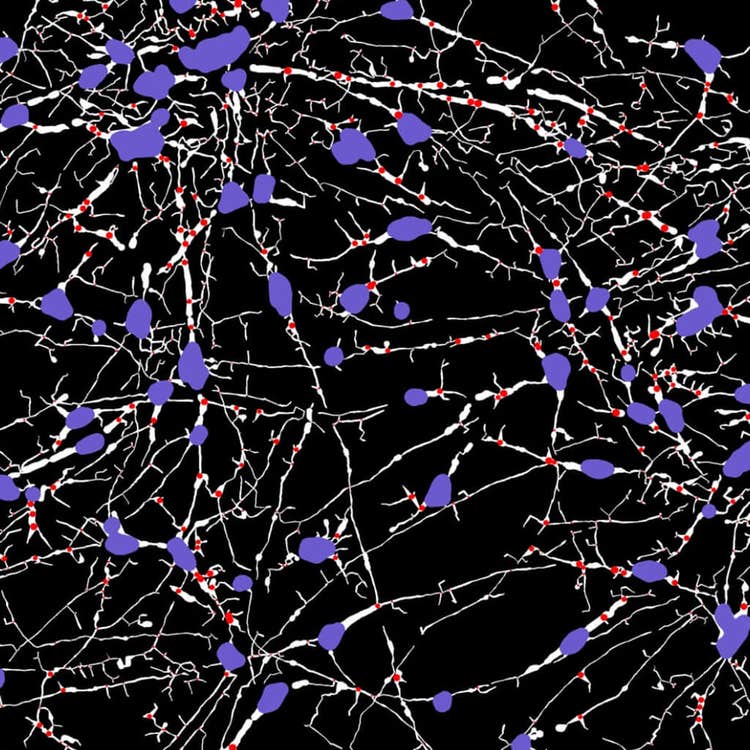
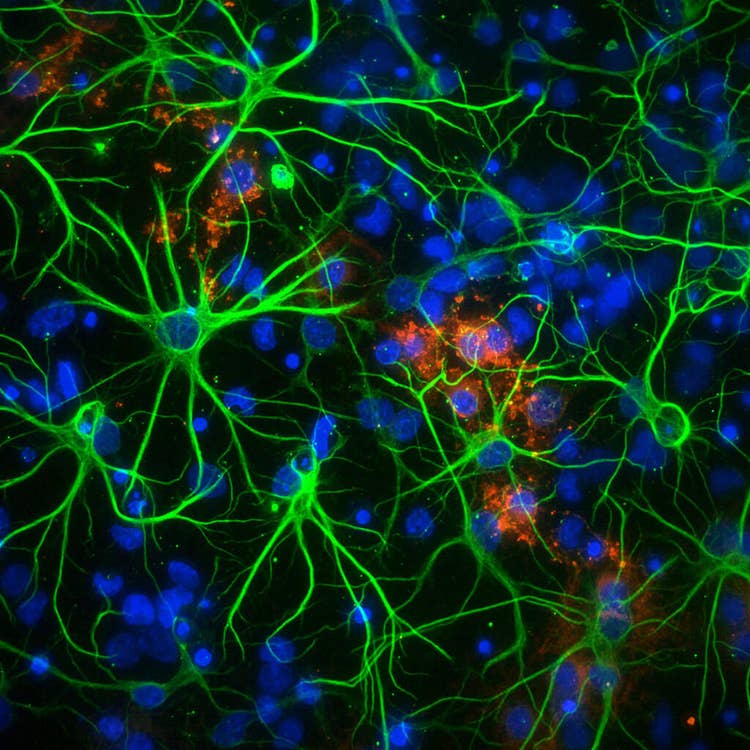
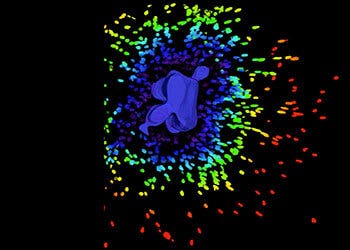
Neuronal processes can be measured and quantified with a Neurite Outgrowth Application Module in MetaXpress Software.
|
To learn more about MetaXpress Application Modules that enable some common HCS assays listed click here.
Specification Categories
- Linear encoded voice coil driven X,Y, and Z stages have < 100 nm resolution
Objectives
- Variety of Nikon 1x- 100x air and oil immersion lenses are supported. Click here for a full list of objective options.
Lasers
- The ImageXpress Ultra system is a Class I Laser Product.
- The system comes standard with 488 nm and 635 nm solid state lasers and a filter cube for GFP / DRAQ5 imaging.
- Up to 2 additional solid state lasers can be added
- Violet (405 nm)
- Green (532 or 561 nm)
- 690 nm wavelength laser for Autofocus
Return to top
Emission filter specifications vary by laser configuration
Standard Configuration
|
PMT
|
Excitation Laser (nm)
|
Fluor Label
|
Emission (nm)
|
LP Dichroic (nm)
|
|
1
|
|
|
|
|
|
2
|
488
|
GFP
|
538/84
|
650
|
|
3
|
|
|
|
|
|
4
|
635
|
DRAQ5
|
692/40
|
|
532 nm laser Filter Set Configuration
|
PMT
|
Excitation Laser (nm)
|
Fluor Label
|
Emission (nm)
|
LP Dichroic (nm)
|
|
1
|
405
|
DAPI
|
447/60
|
495
|
|
2
|
488
|
FITC
|
514/17
|
555
|
|
3
|
532
|
Cy3
|
585/40
|
650
|
|
4
|
635
|
Cy5
|
685/40
|
|
561 nm Laser Filter Set Configuration
|
PMT
|
Excitation Laser (nm)
|
Fluor Label
|
Emission (nm)
|
LP Dichroic (nm)
|
|
1
|
405
|
DAPI
|
447/60
|
495
|
|
2
|
488
|
FITC
|
525/50
|
555
|
|
3
|
561
|
Tex Red
|
593/40
|
650
|
|
4
|
635
|
Cy5
|
685/40
|
|
Return to top
Compatible Dyes
405 nm Laser Excitation
|
Fluors
|
Applications
|
Detection Theoretically Possible with Filters
|
|
DAPI
|
DNA (nuclear) staining
|
Yes (447/60)
|
|
Hoecht 33342
|
DNA (nuclear) staining
|
Yes (447/60)
|
|
Alexa 405
|
Secondary antibody or streptavidin staining
|
Yes (447/60)
|
|
Alexa 430
|
Secondary antibody or streptavidin staining
|
Yes (525/50, others possible)
|
|
Cyan fluorescent protein (CFP) (not optimal for 405 laser)
|
Live cell protein dynamics, FRET with YFP
|
Yes (525/50, others possible)
|
|
Blue fluorescent protein (BFP)
|
Live cell protein dynamics
|
Yes (447/60)
|
|
Pacific Blue
|
Secondary antibody or streptavidin staining
|
Yes (447/60)
|
|
Lucifer Yellow
|
Neuronal tracing
|
Yes (525/50, others possible)
|
|
CellTrace calcein violet 405
|
Live cell identification
|
Yes (447/60)
|
|
LIVE/DEAD Fixable Violet Dead Cell Stain
|
Dead cell identification
|
Yes (447/60)
|
|
LIVE/DEAD Fixable Aqua Dead Cell Stain
|
Dead cell identification
|
Yes (525/50 , others possible)
|
|
Photoactivatable GFP (PA-GFP)
|
Live cell protein dynamics
|
Not Applicable (405 laser used for activation only)
|
Return to top
488 nm Laser Excitation
|
Fluors
|
Applications
|
Detection Theoretically Possible with Filters
|
|
GFP
|
Live cell protein dynamics
|
Yes (514/17 or 525/50 or 538/84)
|
|
EGFP
|
Live cell protein dynamics
|
Yes (514/17 or 525/50 or 538/84)
|
|
FITC
|
Secondary antibody or streptavidrin staining
|
Yes (514/17 or 525/50 or 538/84)
|
|
Alexa 488
|
Secondary antibody or streptavidrin staining
|
Yes (514/17 or 525/50 or 538/84)
|
|
BODIPY FL
|
Coupled to various small compounds
|
Yes (514/17 or 525/50 or 538/84)
|
|
Calcein
|
Live cell identification
|
Yes (514/17 or 525/50 or 538/84)
|
|
Yellow fluorescent protein (YFP)
|
Live cell protein dynamics, FRET with CFP
|
Yes (525/50 or 538/84)
|
|
Oregon green
|
Fluorescein analog
|
Yes (514/17 or 525/50 or 538/84)
|
|
Rhodamine green
|
Secondary antibody or streptavidrin staining
|
Yes (514/17 or 525/50 or 538/84)
|
|
Acridine Orange
|
Dye (nuclear) staining
|
Yes (514/17 or 525/50 or 538/84)
|
|
7-AAD (7Aminoactinomycin D)
|
Dye (nuclear) staining
|
Yes (685/40)
|
|
Ethidium Bromide
|
Dye (nuclear) staining
|
Yes (585/40 or 593/40)
|
|
SYTOX Green
|
Dye (nuclear) staining
|
Yes (514/17 or 525/50 or 538/84)
|
|
BCECF
|
Intracellular pH measurements
|
Yes (514/17 or 525/50 or 538/84)
|
|
Calcium Green
|
Intracellular Ca2+ measurements
|
Yes (514/17 or 525/50 or 538/84)
|
|
Carboxy-SNARF (R)-1-AM pH 6
|
Intracellular pH measurements
|
Yes (585/40 or 593/40)
|
|
JC-1
|
Mitochrondrial membrane potential
|
Yes (585/40 or 593/40)
|
|
DiO
|
Membrane staining for cell tracking
|
Yes (514/17 or 525/50 or 538/84)
|
|
Fluo-3
|
Intracellular Ca2+ measurements
|
Yes (514/17 or 525/50 or 538/84)
|
|
NBD-C6
|
Golgi staining
|
Yes (514/17 or 525/50 or 538/84)
|
Return to top
532 nm Laser Exciation
|
Fluors
|
Applications
|
Detection Theoretically Possible with Filters
|
|
Alexa 555
|
Secondary antibody or streptavidin staining
|
Yes (585/40)
|
|
Alexa 610-RPE
|
Secondary antibody or streptavidin staining
|
Possibly (585/40)
|
|
R-phycoerythrin (R-PE)
|
Secondary antibody or streptavidin staining
|
Yes (585/40)
|
|
Calcium Orange
|
Intracellular Ca2+ measurements
|
Yes (585/40)
|
|
Dil
|
Membrane staining for cell tracking
|
Yes (585/40)
|
|
Propidium Iodide (PI)
|
DNA (nuclear) staining in dead cells
|
Yes (585/40)
|
|
POPO-3
|
DNA (nuclear) staining
|
Yes (585/40)
|
|
PO-PRO-3
|
DNA (nuclear) staining in dead cells
|
Yes (585/40)
|
|
TAMRA
|
Oligonucleotide labelling
|
Yes (585/40)
|
|
Ethidium homodimer (LIVE/DEAD)
|
DNA (nuclear) staining in dead cells
|
Yes (585/40)
|
Return to top
561 nm Laser Excitation
|
Fluors
|
Applications
|
Detection Theoretically Possible with Filters
|
|
TRITC
|
Secondary antibody or streptavidin staining
|
Yes (593/40)
|
|
Texas Red
|
Secondary antibody or streptavidin staining
|
Yes (593/40)
|
|
Mitotracker Red
|
Mitochondrial staining in live cells
|
Yes (593/40)
|
|
DsRed
|
Live cell protein dynamics
|
Yes (593/40)
|
|
Alexa 555
|
Secondary antibody or streptavidin staining
|
Yes (593/40)
|
|
Alexa 568
|
Secondary antibody or streptavidin staining
|
Yes (593/40)
|
|
Alexa 594
|
Secondary antibody or streptavidin staining
|
Yes (593/40)
|
|
R-phycoerythrin (R-PE)
|
Secondary antibody or streptavidin staining
|
Yes (593/40)
|
|
Dil
|
Membrane staining for cell tracking
|
Yes (593/40)
|
|
Calcium Crimson
|
Intracellular Ca2+ measurements
|
Yes (593/40)
|
|
LysoTracker Red
|
Lysosome staining in live cells
|
Yes (593/40)
|
|
Rhodamine Red
|
Secondary antibody or streptavidin staining
|
Yes (593/40)
|
|
Nile Blue (not optimal)
|
Lipid staining in fixed cells
|
No
|
|
Alexa 610 (not optimal)
|
Secondary antibody or streptavidin staining
|
No
|
|
Alexa 610-RPE
|
Secondary antibody or streptavidin staining
|
No
|
Return to top
635 nm Laser Excitation
|
Fluors
|
Applications
|
Detection Theoretically Possible with Filters
|
|
TO-PRO-3
|
DNA (nuclear) staining in dead cells
|
Yes (685/40)
|
|
Alexa 633
|
Secondary antibody or streptavidin staining
|
Yes (685/40)
|
|
Alexa 635
|
Secondary antibody or streptavidin staining
|
Yes (685/40)
|
|
Alexa 647
|
Secondary antibody or streptavidin staining
|
Yes (685/40)
|
|
Cy5.5
|
Secondary antibody or streptavidin staining
|
Yes (685/40)
|
|
BODIPY 630/650
|
Protein conjugation
|
No
|
|
DiD
|
Membrane staining for cell tracking
|
Yes (685/40)
|
|
CellMask Deep Red
|
Plasma membrane staining
|
Yes (685/40)
|
Space and Weight Specifications
|
W (in)
|
D (in)
|
H (in)
|
Weight (lbs)
|
W (cm)
|
D (cm)
|
H (cm)
|
Weight (Kg)
|
|
18.7
|
30.4
|
17.3
|
220
|
47.5
|
77.2
|
43.8
|
100
|
in = inches, lbs = pounds, cm = centimeters, Kg = Kilograms
Return to top
Molecular Devices brings the image acquisition and analysis for ImageXpress Systems under one common platform to streamline the HCS workflow, offering a truly end-to-end solution for high content screening.
MetaXpress® High Content Image Acquisition & Analysis Software
- MetaXpress Software Application Modules: turnkey solutions for your 100 most common analysis routines
- MetaXpress Software Custom Modules: flexible toolbox for advanced assays
- MetaXpress Software Journals: powerful macros to analyze unique applications
AcuityXpressTM High-Content Informatics Software further analyzes, visualizes, and mines data
MetaXpress® PowerCoreTM High Content Distributed Image Analysis Software dramatically accelerates analysis speed in a high-throughput environment
MDCStoreTM Data Management Solution provides users with a validated solution to securely access, manage, and depoly a high content analysis environment.
To learn more, visit our HCS Software section or download MetaXpress Software datasheet.
Contact Us
Product Collateral
Product FAQ